Sunday, April 02, 2006

The Bookery and the Book Fair

I have not forgotten my promise, dear Reader, to entertain you with my musings on the recent additions to my reading list. Those observations will be forthcoming this first week of April, 2006.

I do want to mention a successful two days of booking; Friday in Lexington, Kentucky, and Sunday in Lansing, Michigan.

In Lexington, I visited Glover’s Bookery and the Black Swan. On the edge of downtown, Glover’s, which I have visited many times, is the archetypal used bookstore . . . the two-story former house groans under the weight of the thousands of dusty tomes. Glover’s excels in Kentuckian, books on horses and horse racing, the Civil War and military history. It’s fiction selection is like someone's maiden aunt--old, lean and best neglected.

Here are the books I purchased at Glover’s:

  • Kansas, A History of the Jayhawk State by William Frank Zornow
  • Deadeye Dick by Kurt Vonnegut

Both books were first editions. At $10, I thought the copy of Deadeye Dick was a bargain.

The Black Swan, which is near the UK campus, is the polar opposite of Glover’s. It’s tidy where Glover’s is unkempt. It bright and well lit, while Glover’s is gloomy. The books are bright and clean. There is a nice selection of modern first editions. It was my first visit there.

Here are the first editions I purchased at the Black Swan:

  • Tales of Burning Love by Louise Erdrich
  • Wonder Boys by Michael Chabon

I like both book shops, which clearly appeal to a different clientele.

On Sunday, I flew to Lansing, Michigan. I flew here for work, but could not resist the attractions of the 43rd Michigan Antiquarian Book & Paper Show. The show boasted more than 90 dealers from the U.S. and Canada.

Here it was I purchased:

  • Jacklight by Louise Erdrich
  • Searching for Caleb by Anne Tyler
  • High Fidelity by Nick Hornby

A collection of poetry, Jacklight is Erdrich’s first book. It was paperbound . . . called “wraps” by those in the book trade. It was the one book I was searching for at the show. I am close now to assembling a run of Erdrich’s published works.

I am also close to a complete run of Anne Tyler. This has taken patience. Not because her books are rare, but because they are expensive. At least for me. Tyler has long been a favorite author of mine. I do sense that she has fallen out of favor with many collectors and, perhaps, if I continue to be patient I can snag her earliest books for a reasonable sum. Not that my wife will find any sum reasonable.

The copy of High Fidelity was a British first. It was surprisingly affordable. I now have British first editions of Hornby two earliest books, High Fidelity and Fever Pitch, his memoir of life as a football (soccer) fan. These books are coveted because they are the true first editions, preceding the American firsts. They are also coveted because Hornby is a Brit and collectors are always urged to “follow the flag,” which means to collect the earliest editions from an author’s home country.

Friday, March 31, 2006

Recent Reads . . . More to Follow

Time has been at a premium lately. But here's the most recent books I've read:

  • 27. The Rule of Four, Ian Caldwell and Dustin Thomason. Fiction, 3-20, p. 368
  • 28. What’s The Matter With Kansas?, Thomas Frank. Current Events, 3-24, p. 251
  • 29. A Sudden Country, Karen Fisher. Fiction, 3-27 p. 366
  • 30. The Professor, the Banker and the Suicide King, Michael Craig. Poker, 3-30, p.262

Thursday, March 23, 2006

Thoughts on Sources of Books to Read

I am always astounded at people who express a desire to read, but then indicate that they have trouble identifying what to read. There’s more than 50 books in my “to be read” pile and hundreds, if not thousands, of books I’d like to read.

So, this post is dedicated to our selection-challenged, wanna be readers.

The first, and I think most obvious, source of reading material is the literary (or Western) canon. A category that’s broad enough to include everyone from Shakespeare to Thorstein Veblen to Hemingway.

Wikipedia (http://en.wikipedia.org/wiki/Western_canon) provides a nice overview of the Western canon. The link to Great Books of the Western World will keep you occupied for a month or two.

I try (but don’t always succeed) to read something by Dickens, Shakespeare, Wharton and Cather every year. There’s great pleasure in reading classic works apart from the demands of a college class. Tapping canonical authors can also lead to a powerful process of rediscovery.

The shortlists of notable literary prizes provide endless possibilities. There’s the Booker, the National Book Award, the Pulitzer, the PEN/Faulkner and the National Book Critics Circle. The shortlists generally feature a nice combination of the established – Carey, McEwan, Doctorow – and the unfamiliar – Karen Fisher, Sebastian Barry, Rene Steinke.

The shortlists are issued annually, which means you aren’t going to run out of material any time soon. Plus, a visit to a website dedicated to any of these prizes will generate more possibilities from past selections.

My first introduction to many of the authors that I now routinely read came from the shortlists. I also find that if you like an author’s book it’s worth exploring the author’s earlier material.

Of course, friends shouldn’t be ignored as a source of recommendations. Some will insist on The Kite Runner or The Time Traveler’s Wife, but others may steer you to Frederick Busch, Anthony Bourdain or such extraordinary books as Aidan Hartley’s The Zanzibar Chest.

Anyone who is, or wants to be, a great reader must develop several friends whose judgment they value, someone whose recommendation is automatically accepted.

I scan book reviews daily, notably those published in the Washington Post, the New York Times and the Guardian. Reviews account for only a small percentage of the books that I choose to read, but sometimes serendipity intervenes. The Internet provides ready access to these resources.

One source that I eschew is the best-seller list. Most of the material here has no appeal to me. Nor have I ever been part of a book club, which could be a good starting point, but might become limiting after your critical selection skills are fully engaged.

Sunday, March 19, 2006

Wilentz Provides Balanced Portrait of Jackson

“Questions thus linger over Jackson’s contributions and leadership. What difference did he really make in the democratization of Americans’ political sensibilities and practices? Given the terrible conflicts that followed, does his presidency deserves admiration or condemnation? Was he truly a democratic man of the people or a vengeful backwoods autocrat?”

Princeton history professor Sean Wilentz asks these questions late in his biography of Andrew Jackson. He strives, ably, to answer them in a tidy 166 pages.

Andrew Jackson is part of The American Presidents Series from Times Books. I highly recommend the series. Generally less than 200 pages each, the books in the series provide a brief biography of each President and a skillful analysis of the successes and failures of each Administration.

Wilentz provides an exceptionally insightful and balanced portrait of Jackson, as in this passage: “More than any other American, Jackson oversaw the decline and fall of the elitist, gentry order established by the Framers, and its replacement with the ruder conventions and organization of democracy. More than any other president before him, he made the office of the presidency the center of action in national politics and government. Yet the incompleteness of Jackson’s democracy . . . contributed to the eventual disunion and terrible civil war he so deeply feared.”

Friday, March 17, 2006

Shuman's Debut Novel A Suspenseful Turn

25. 18 Seconds, George Shuman, 3-17, pp. 320

First novels are not supposed to be this good.

Despite the improbable conceit underlying this thriller, George Shuman’s 18 Seconds is a riveting read. Shuman, a former D.C. cop, delivers the requisite twists, thrills and creepiness in his suspenseful debut effort. I can’t wait until the movie.

The conceit is this: abandoned as a child, Sherry Moore is blind, not because of a physical condition, but from emotional trauma. Someone, as a result of that emotional short circuit, Sherry also has an unusual ability. By touching the hand of a dead person, Sherry can retrieve that person’s final 18 seconds of memory. Shuman trots out a computer analogy to explain Sherry’s “gift.” She is, in effect, a biological data retrieval system.

The “gift” won’t work on living people. We have some sort of biological firewall in place that keeps our thoughts and memories from trickling out at the merest touch. But with the dead, the security system goes down, allowing Sherry to tap into their memories.

It doesn’t always work. The longer someone’s been dead the less likely it is the data is intact. Plus, the memories aren’t sequential. They’re random. Someone’s thoughts might jump from the man in front of them with a gun to a childhood memory to their teen years. Sherry has to make sense of it all.

For the most part, she manages to do just that; which makes Sherry a valuable resource to the law enforcement personnel willing to work with a psychic. That's how the public understands Sherry's gifts, although the reader knows she's more Microsoft than medium.

Sherry’s also beautiful and without the customary mannerisms we associate with the blind. Recently Shuman said he didn’t have an actress in mind to play Sherry in the movie – and Hollywood should definitely option this book – but it’s a no-brainer. Ashley Judd is Sherry Moore.

Sherry’s special skill drives the book, but there’s far more too it than just a beautiful biological data retrieval system. The serial killer, Earl Sykes, is suitably creepy. Shuman’s added an especially nice touch with Earl. At the beginning of the novel, he’s in prison, not for the murders he’s committed, but for a tragic accident involving a school bus. When he’s eventually released from prison, the unpleasant Mr. Sykes isn’t on anyone’s radar.

Lt. Kelly Lynch-O'Shaughnessy, the small-town cop, is earnest, confused about the direction of her marriage and dogged in the investigation into the disappearances of several women from the beach town of Wildwood, N.J. But, predictably, she’s looking in the wrong direction. She’s also beset by wrong-headed parents, city administrators and a drunken lout of a cop.

It all works. Many of the elements of thrillers have become formulaic, but Shuman’s material rises above the banal. The pacing is brisk, the characters well drawn and the suspense, well, suspenseful. Also to his credit, Shuman pulls all the loose ends together for a satisfying conclusion. There are elements of improbability to 18 Seconds, but when it’s all said and done you won’t care. I didn’t.

Wednesday, March 15, 2006

The Last Kingdom a terrific diversion

24. The Last Kingdom, Bernard Cornwell, 3-12, pp. 329

Books engender a great many responses. Perhaps the greatest response any book can evoke from a reader is disappointment that it’s ended. And that’s exactly what I experienced after reaching page 329 in Bernard Cornwell’s The Last Kingdom.

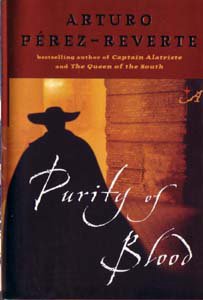
This is not a great book. It is not a piece of enduring literature. But, boy, is it fun. To the degree that it is a finely executed piece of historical fiction, The Last Kingdom recalls the Purity of Blood by Arturo Perez-Reverte, but only to a degree. There are differences. Some superficial – it’s longer. Some significant—Purity of Blood was set in Spain during the Inquisition, The Last Kingdom is set in ninth century Britain.

The biggest difference is this book is more fun. Purity of Blood is terrific, but Perez-Reverte’s Captain Alatriste is a gloomy fellow. The hero of The Last Kingdom is, well, Conan. OK, that’s not his name, it’s Uhtred, and it’s all sword, no sorcery, but Robert E. Howard would feel comfortable around these pages.

It’s better written than anything by Howard, well researched and purposeful. It’s also a rollicking saga that I didn’t want to end. The good news it didn’t—the sequel, The Pale Horseman, was released earlier this year. Cool.

*****

In a column in The Guardian, author Annie Proulx takes Oscar voters to task. Proulx is disappointed that Brokeback Mountain, the movie based on her terrific short story, didn’t win the Best Picture Award. Her disappointment is understandable. The tenor of her comments isn’t.

Proulx decries the "atmosphere of insufferable self-importance" at the Oscar ceremony. She writes that the event was "reminiscent of a small-town talent-show night." She also calls Best Picture winner Crash “Trash.”

Whoa! A little harsh Annie. I liked Crash. I didn’t think it was a perfect film and it probably wouldn’t be my choice as best picture, but it generated a great deal of conversation between my wife and I over the period of about a week, which compares favorably to most films which are forgotten by the time I've reached my car. Any film that can promote ideas, and generate conversation, has something going for it.

I haven’t seen Brokeback Mountain. I admire the short story and I do plan to see the movie. Still, I am disappointed in Proulx and her response. Anyone who has watched the Oscar ceremonies recognizes that the best pictures don’t always win the Oscar. It a political process and it’s a subjective process too. Book awards aren't much different.

Two thumbs down, Annie.

Sunday, March 12, 2006

Shooting Straight About New Journalism

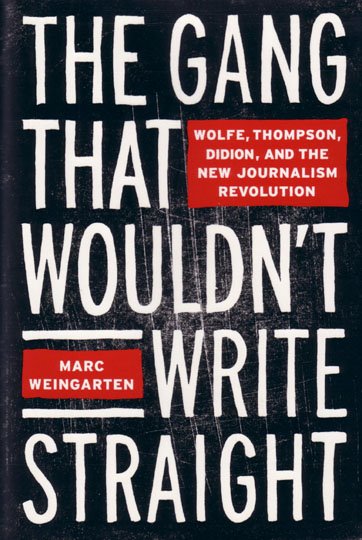
A caution: The average reader isn’t going to be as thrilled with this book as I am. I’m a little over the top on the subject matter—journalism. It’s an abiding passion. So please, run that through your critical filter before rushing out to buy Marc Weingarten’s The Gang That Wouldn’t Write Straight.

That said, I loved this book. Plowed through it like it was a work of fiction. Speaking of works of fiction, maybe this should be the test for prospective readers, if you don’t instantly know the title is a derivation of a Jimmy Breslin novel—The Gang That Couldn’t Shoot Straight—put the book down and back away.

Weingarten’s book is a brief, and by no means comprehensive history, of Breslin and other practitioners of the so-called “New Journalism.” Tom Wolfe. Hunter S. Thompson. Joan Didion. Michael Herr.

In the early 70s, as a journalism student, these writers were an inspiration to me. They were re-writing, literally, the norms of journalism even as they skewered societal norms and it seemed so right, so fun and so important.

I was too much the adherent of hard news to ever be a “new” journalist. My standards were shaped by juco instructor Bill Bidwell—a twitchy, chain-smoking ex-newspaperman. Bidwell taught to me get it right. Be objective. Never omit the attribution to a quote. Spell names correctly and always, always, always confirm a scoop with at least three sources.

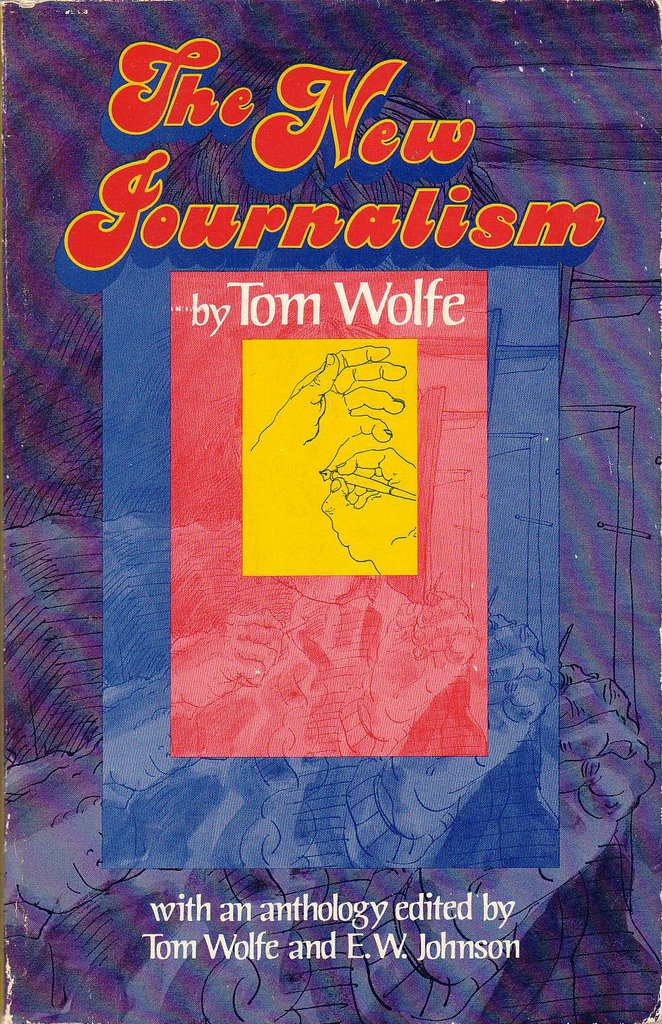
Bidwell’s training did not stop me from being influenced by Thompson and company. In 1973, Wolfe and E.W. Johnson issued an anthology/text book on the new journalism. It’s still on my shelves.

As Weingarten notes the New Journalism wasn’t exactly new. This kind of participatory journalism has been around a while. It’s just that this particular variant involved so many writers, appeared in so many high-profile publications and came along at a time of great social upheaval and change.

“New Journalism as Wolfe envisioned it—as the great literary movement of the postwar era—died a long time ago, but its influence is everywhere. Once a rear-guard rebellion, its tenets are so accepted now that they’ve become virtually invisible. The art of narrative storytelling is alive and well; it’s just more diffuse now, spread out across books, magazines, newspapers, and the Web,” writes Weingarten in the book’s epilogue.

The book is best early as we’re introduced to Wolfe, Didion, Herr and Thompson. It’s not perfect, there are a few curious omissions. In recounting how Rolling Stone (the magazine, not the band) dispatched Thompson and Timothy Crouse to cover the 1972 election, Weingarten neglects to mention Crouse’s superb book, The Boys on the Bus. Published in 1973, it was a scathing and brilliant insiders account of the media, who covered the ’72 Presidential race.

Weingarten’s final chapter on Rupert Murdoch’s seizure of New York magazine from Clay Felker is over long and doesn’t fit comfortably within the book’s overall theme. It does serve as an unfortunate introduction to the sad state of affairs that is magazine journalism today.

Still, it’s a good read and a good work. Personally, I can’t imagine anyone not finding this stuff riveting.

Everyone: “Hernia, hernia, hernia, hernia . . . “

Friday, March 10, 2006

Former D.C. Cop Makes Authorial Debut

18 Seconds is not George Shuman’s first book. It’s just his first to be published.

He’d written another book a few years ago. It attracted an agent’s interest, but found no takers when it was auctioned to the various New York publishing houses. Shuman put it away and kept writing.

He’s currently on tour to promote 18 Seconds. His publisher, Simon & Schuster, has teamed him with best-selling author Robert Crais, a clever marketing move to build early interest in Shuman’s debut novel. Shuman signed a contract with Simon & Schuster just this week for a sequel.

18 Seconds features Sherry Moore, a blind woman who has the unique ability to “see” a deceased person’s last 18 seconds by touching the corpse; a serial killer, who is serving prison time, not for the murders he’s committed, but a deadly traffic accident; and a New Jersey policewoman investigating a young woman’s disappearance that recalls similar unsolved cases from the seventies.

The mystery novel is set in Wildwood, New Jersey. “I start with location. Draw characters into and see where it goes.” Shuman choose Wildwood because he has pleasant memories of visiting there with his parents as a child.

Shuman is a 20-year veteran of the D.C. police force. He career includes serving as an undercover narcotics detective and as a sergeant in Internal Affairs.

During an appearance, with Crais, at a Smithsonian-sponsored program on crime novels, Shuman was asked if he had ever used a psychic, like Sherry Moore, during his career in law enforcement. “Never,” he said. Would he? “Never.”

Shuman researched both memory and mediums before setting down to write 18 Seconds.

A binge writer, Shuman might write for days without stopping, only to come to halt because he’s suddenly caught up in the research. When he starts to write, he has no outline or plan about where the book is heading. Instead, he lets his characters take him where they want to go.

Crime novels enjoy an enduring popularity, Shuman said, because “they are the place where heroes are born.”

Thursday, March 09, 2006

Down the Rabbit's Hole with Robert Crais

Robert Crais looks every inch the best-selling author. Lean, of medium height, he’s a darkly handsome man. Hair cropped short with a few days growth of beard on his chin. He’s dressed the part . . . jeans, soft-sided, soft-soled shoes, blue and black striped socks, a dressy black T beneath a wool sports coat.

He’s alternately funny and serious. A published author since 1987 and hugely successful since L.A. Requiem in 1999, he’s right at home at books events like this one March 8 at the Smithsonian in Washington, D.C.

A native of Baton Rouge, Crais comes from four generations of police, although he was never a cop himself. He saw the job from the family’s perspective. “I saw who cops are when they come home.” It’s that understanding he brings to his novels, which include the highly successful Elvis Cole series.

Crais’ new book, The Two Minute Rule, is a one-off, featuring an entirely new cast of characters. It began as an Elvis Cole novel, but en route a new character—Max Holman—began to assert himself. Holman is a former bank robber, just released from prison and trying to go straight. He’s an appealing character. So much so that Crais vows he will re-appear in future books, perhaps alongside Elvis.

The FBI’s Los Angeles bank squad aided Crais in his research for the new book. They also provided him with its title. Two minutes is all the time a bank robber has to get in and to get out if he’s to avoid capture.

Authenticity is important to Crais. “If it’s inaccurate I’ll get 862 emails.” Consequently, he also believes in research. “It leads me to ideas that are better than anything I could make up.”

Crais, who novels grow out of a character not plot, always researches a book before he writes it. Before writing, he also spends about a third of his time outlining the new book. “I develop an over-riding structure. I often have a clear idea of the ending before I start writing.”

He’s works closely with his editor during this preliminary phase. This practice eliminates pitfalls that might arise if the editor doesn’t see the book until it’s written.

Crais’ first exposure to the American detective novel came at age 15. He picked up a copy of Raymond Chandler’s The Little Sister, attracted by the “hot chick on the cover.” Reading Chandler, he said, “was like tumbling down the rabbit hole.”

Crais honed his writing skills as a screen writer in L.A. It was exciting, fun and an education, but not an experience he cares to repeat soon. Crais did write the original screenplay for his 2001 novel Hostage. By the time the movie, which starred Bruce Willis, was made the screenplay had gone through so many changes Crais didn’t receive a writing credit.

“The check cleared,” he said of the experience. “It taught me the lesson of non-involvement.”

Elvis Cole and sidekick, Joe Pike, won’t ever appear on film. “The Elvis Cole books are special to me. They’re my life work.” Plus, Crais views his readers as collaborators. Each reader has a different vision of Elvis Cole. “I don’t want that to be lost.”

Crais avoids trends in the mystery genre, perhaps because he had trouble selling his first book, The Monkey’s Raincoat. The market was flooded with detective novels in the late 1980s. Most publishing houses already had an author turning out P.I. novels and weren’t interest in someone new. Crais persisted, The Monkey’s Raincoat was published as a paperback original by Bantam and today he’s consistently on the best-seller list.

“I tell aspiring writers to ignore trends. Write what you love to read.”

Crais describes his approach to writing as “dogged.” He writes six to seven days a week for hours at a time. “I don’t believe in the muse. I don’t wait for inspiration. I don’t believe in writer’s block.”

Mysteries remain a popular and enduring genre, Crais believes, because they are entertaining and because of their “car-wreck quality.” Mysteries are also popular, he said, “because our own lives are so fraught with every day mysteries,” such as how to pay for a child’s braces or a college education.

People are attracted to mysteries because the protagonist “divines order from chaos, ferrets out the truth from lies.”

Robert Crais On Elvis Cole, Joe Pike and His Next Novel

Best-selling author Robert Crais and fledgling novelist George Shuman presented A Hard-Boiled Look at the Crime Novel Wednesday in Washington, D.C. as part of a Smithsonian Associates’ program.

Here are the highlights from Crais, creator of the Elvis Cole novels:

  • His first exposure to the American detective novel was at age 15. Attracted by the “hot chick on the cover,” he picked up a paperback copy of Raymond Chandler’s Little Sister. “It was like falling down the rabbit hole.”

  • Crais won’t allow his best-selling Elvis Cole series to be filmed by Hollywood. “The Elvis Cole books are special to me. They’re my life’s work.” Crais views his readers as collaborators, who have an image of Cole and sidekick Joe Pike in their mind. “I don’t want that to be lost.”

  • Joe Pike will be featured prominently in Crais’ next novel. In the original draft of Crais’ first book, The Monkey’s Raincoat, Pike was supposed to have died. “But I couldn’t do it.”

  • The Louisiana-born writer is okay with selling his one-offs to Hollywood. Asked about his experience as a screen writer on the movie version of Hostage, Crais said, “The check cleared.” Crais wrote the original screen play, but didn’t receive screen writing credit as the work was taken over by others. “It taught me the lesson of non-involvement.”

  • On writers who say their characters tell them the course of a story. “The day my characters start talking to me, I’ll go on medication.”

  • Elvis Cole’s sweetheart Lucy Chenier attracts a lot of hate mail.

  • Expect Max Holman, bank robber turned good guy in Crais' new novel The Two Minute Rule to appear in a future book, perhaps alongside Elvis Cole. "I will definitely write about Max Holman again."

  • Why no hyphen in The Two Minute Rule? "We tried it. I didn't like the hyphen."
More on Crais and Shuman to follow . . .

Gordon Parks: Creative Force, American Original

Parks' took this photograph of cleaning lady Ella Watson in 1942. while working for the Farm Security Administration. It launched his career.

Gordon Parks died Tuesday at the age of 93. A native Kansan, Parks was a major creative force – a photographer, writer and movie director. Here’s what two newspapers have to say about Parks extraordinary career:

An iconoclast, Mr. Parks fashioned a career that resisted categorization. No matter what medium he chose for his self-expression, he sought to challenge stereotypes while still communicating to a large audience. In finding early acclaim as a photographer despite a lack of professional training, he became convinced that he could accomplish whatever he set his mind to. To an astonishing extent, he proved himself right.

–Andy Grundberg, New York Times, 3/8/06

Parks, who died Tuesday at the age of 93 in New York, crisscrossed America and the world for decades. He was an artist, writer, movie director. He was a Life photographer when that gig gave you a powerful cachet. In America, he used his cameras like six-shooters, aiming right at the nation's broken souls, her sad-eyed children, her blacks, browns and whites, her shoeshine men and faceless women with both dishrag and dignity.

–Will Haygood, Washington Post, 3/9/06

Wednesday, March 08, 2006

Parker's California Girl Proves Biblio Baggins Wrong

22. California Girl, T. Jefferson Parker. Mystery, 2-7, pp. 370

I love being wrong about a book or an author. I really do. Wrong in that I’m certain that I won’t like the book, that I have a pretty good sense of what the author’s about. I know the type of writer he is and, “Thank you, no,” it’s not for me. And I am certain about all this without being, in any way, “informed” about either; I haven’t read the book or anything by the author.

That was my attitude about California Girl by T. Jefferson Parker. I’ve seen his books around, but never deigned to pick one up. I figure his books were – I don’t know – not my type. Not all that good, perhaps. I finally picked up a book by Parker for a buck at a book sale. It was a lousy sale and I really had to stretch to find three books. Parker’s book was clean and a first edition, so I thought, “What the hell. Can’t go too wrong for a buck.”

After completing California Girl yesterday, I would have paid more. Much more.

California Girl was a delight; a well-written, fast-paced read. Riveting. Remember, in the past I’ve said I enjoy books by John Lescroart. And I do. He’s good a writer with strong, memorable characters. But Lescroart’s plots leave something to be desired. They’re strained, a little too improbable, too convoluted. Parker’s plots aren’t like that. Here’s what Parker does – or better yet what he doesn’t do – there’s a murder and someone solves it. No complicated plot, but a simple, straight forward murder investigation.

Rather than the plot, Parker focuses on the people and their motives, their motivations. People, even good people, sometimes lie in the course of a murder investigation. Not because they committed the murder, but because they’ve got secrets. Secrets they don’t what others to know about. Sometimes people do things, extreme things, to keep those secrets from being exposed.

California Girl isn’t about the dead girl and it’s only peripherally about solving her murder. It's really about the three Becker brothers – a cop, a reporter and a pastor – whose lives are caught up with that of the dead girl. Parker's novel is about these three respond to the pressures imposed by the murder and that – far more than the crime itself or its solution – is what makes California Girl so good.

I will read other books by T. Jefferson Parker. Even if I have to pay more than a buck a book.

Saturday, March 04, 2006

Miscellaneous Book Thoughts

21. The Best British Mysteries 2005, ed. Maxim Jakubowski. Mysteries, 3-4, pp. 341

Best is an arguable description for this collection of short stories. Ian Rankin, Peter Robinson and a smattering of other authors are definitely worth perusing, but it's an uneven assortment at best.
---
Attended the annual Washington Antiquarian Book Fair yesterday. I'm not at all certain why I parted with $12 to do so. I bought two books, both from the same dealer. Generally, the books on offer are extremely over-priced. Book fairs do tend to attract dealers who are quite proud of their inventory. In fairness, book fairs are costly ventures for dealers--there's the cost of travel and subsistence as well as the registration fee. I do wonder if they serve much of a purpose. I enjoy looking (but not buying) all the rare and expensive books on offer. Such pleasure is increasingly offset by the $12 opening day fee and the difficulty of getting to the Washington Book Fair which is, strictly speaking, in Arlington, Virginia.
---
Borders annoys me. They persist in shelving Joan Didion's fine memoir, The Year of Magical Thinking, among the fiction. I have found other memoirs there, also. This is most annoying. Why don't the powers-that-be at Borders establish a section for biographies, autobiographies and memoirs? In this, they could learn from their counterparts at Barnes & Noble.

The March Wins Second Book Award

NEW YORK (AP) -- E.L. Doctorow's The March, his acclaimed story of Gen. William Tecumseh Sherman's ruthless Civil War campaign, received yet another literary honor Friday night, winning the National Book Critics Circle prize for fiction.

"I've wondered for many years if awards are good for literature," said Doctorow, who also won the critics' prize for his 1989 novel, Billy Bathgate. "But I find when I'm offered an award I tend to accept it."

Doctorow's novel, the rare work of American fiction last year to attract both strong sales and widespread praise, has already won the PEN/Faulkner prize and was a finalist for the National Book Award. It stands a strong chance of bringing the author his first Pulitzer Prize in a 45-year career that includes Ragtime, World's Fair and Loon Lake.

"The independent witness of book writers I think provides the deepest and profoundest ... form of communication in our society," said Doctorow, 75, who observed that books are written in silence and read in silence, a "soul to soul" bond unique in the modern world.

Also Friday, Svetlana Alexievich won the general nonfiction award for Voices from Chernobyl, an oral history of the 1986 nuclear disaster. Kai Bird's and Martin J. Sherwin's American Prometheus, a work on atomic pioneer J. Robert Oppenheimer that took so long to write the book's first two editors retired, was the biography winner. Francine du Plessix Gray's Them, a memoir about her glamorous, but troubled mother and stepfather, won for autobiography.

"There was so much good in them, along with the naughty and the slightly evil," Gray said Friday of her stepfather, Conde Nast editorial director Alexander Liberman, and mother, the Russian-born designer Tatiana Yakovleva du Plessix Liberman.

The poetry winner was Jack Gilbert's Refusing Heaven, and William Logan's The Undiscovered Country won for criticism. Logan, an NBCC criticism finalist in 1999, acknowledged Friday that his demanding assessments have caused hard feelings, saying that one poet threatened to run him over and another poet to threaten assault by hand.

He then joked that his wife, herself a poet, was relieved to be married to him because "I could not review her."

Among the runners-up Friday: Joan Didion's memoir, The Year of Magical Thinking; Doris Kearns Goodwin's biography of Abraham Lincoln, Team of Rivals; and a collection of art criticism by John Updike, Still Looking.

There are no cash prizes for the NBCC awards.

Two honorary awards were presented. Bill Henderson, an author, editor and founder of the Pushcart Press, received a lifetime achievement prize, and Wyatt Mason, a critic and translator whose essays have appeared in Harper's, The New Yorker and elsewhere, was cited for excellence in reviewing.

The National Book Critics Circle, founded in 1974, has about 500 members.

Friday, March 03, 2006

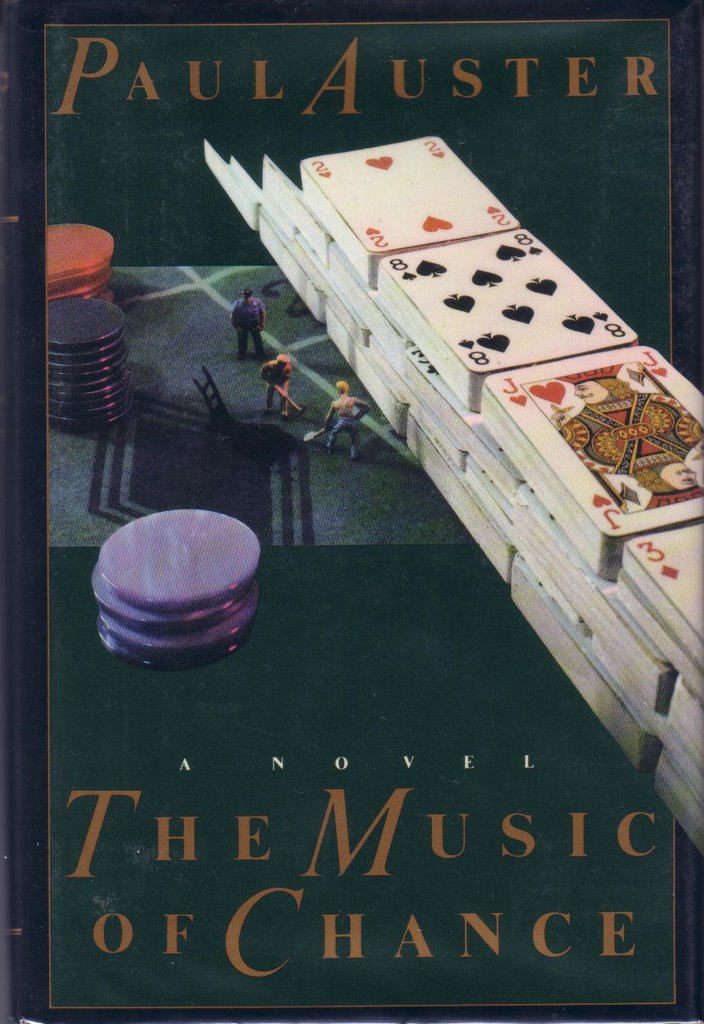
Auster's Music of Chance Unsatisfying

20. The Music of Chance, Paul Auster, Fiction, 2-2, pp. 217

An unexpected inheritance arrives too late to save Jim Nashe’s marriage. Consequently, he packs his young daughter off to his sister’s, quits his job and embarks on a purposeless cross country drive. So begins Paul Auster’s equally purposeless The Music of Chance.

Just as his funds begin to dwindle, Nashe picks up a young hitchhiker, who has clearly been beaten. The hitchhiker turns out to be a foul-mouthed wannabe gambler, robbed of his funds while en route to a high stakes game with two millionaires.

Nashe risks what’s left of his inheritance by staking the gambler in his can’t miss venture. Of course, can’t miss can and the gambler, Jack Pozzi, loses all Nashe’s money and his car. Destitute and oweing the two millionaires a substantial sum, Nashe and Pozzi are virtually enslaved as they agree to work off their debt.

The book is replete with homoerotic implications. There’s enough strangeness to fill a much larger book, including a weird model “City of the World” and a mysterious wall being erected in a meadow.

Auster fails to resolve several plot points—the millionaires virtually vanish from the pages of the novel, we never do learn Pozzi’s ultimate fate or truly understand what drives Nashe to his final, inexplicable act. The Music of Chance raises more questions than it answers. The lack of resolution is as unsatisfying as is the read.

Thursday, March 02, 2006

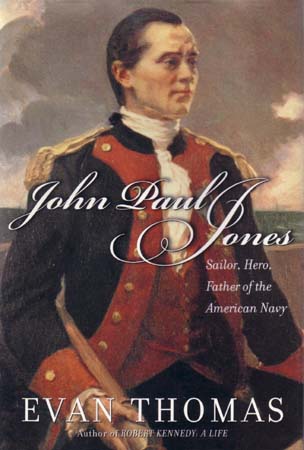
Book 19 An Even-Handed Biography of the Pirate John Paul

19. John Paul Jones, Evan Thomas, Biography. 3-2, pp. 311

A nicely rendered portrait of John Paul Jones, whose exploits on behalf of American independence are largely forgotten today. Thomas paints a balanced portrait of the corsair—Jones was thin-skinned, quick to take offense and inept at handling his subordinates. He was also a courageous man, driven by a steady determination to succeed and a visionary, who saw the need for a strong U.S. navy and who successfully terrorized the British during the American Revolution.

A few factoids about Jones that Thomas reveals:

  • He was a Scot, whose real name was John Paul.
  • While captain of a British merchant ship, Jones killed a sailor who was stirring up the crew. Jones called the incident “that great misfortune of my life.”
  • To avoid arrest by civil authorities in Tobago, where the crime took place, Jones fled to Fredericksburg, Virginia.
  • Jones served briefly and unhappily as an admiral in the Russian Navy during the reign of Catherine the Great.
  • Jones probably never said, “I have not yet begun to fight.” He may have said, “I may sink, but I’ll be damned if I strike” or something similar.
  • Jones died in France. His remains were brought to America by Theodore Roosevelt in 1906. He was laid to rest at the Naval Academy in Anapolis.

Smithsonian Features "Presidents All"

Four authors and four presidents were spotlighted Wednesday, March 1, in a Smithson Associate’s program in Washington, D.C. The program, Presidents All, featured the following presidents and their biographers:


  • Thomas Jefferson by Joyce Appleby, professor of history, UCLA
  • James Monroe by Gary Hart, former U.S. Senator from Colorado
  • Andrew Jackson by Sean Wilentz, professor of history, Princeton
  • Benjamin Harrison by Charles W. Calhoun, professor of history, East Carolina State
All four books are part of Times Books American Presidents Series. Times Books is a subsidiary of Henry Holt.

Thomas Jefferson
Jefferson’s reputation has gone up and down through the years, Appleby said. It’s currently at a low, just as it was prior to the Civil War and again late in the 19th Century. Jefferson’s reputation was at a high under FDR, she said, because Roosevelt and his advisors decided to make Jefferson the founder of the Democrat Party.

As the Civil Rights movement gathered strength, Jefferson’s reputation began to ebb. Appleby said inquiries into Jefferson as a slaveholder, as the father of a child by a slave and as a man who kept his progeny in slavery served to damage his reputation. Although other Founding Fathers also kept slaves, Jefferson’s reputation was especially damaged because he raised our expectations with his affirmation of human rights, Appleby said.

James Monroe
Monroe was first and foremost a solider, according to Hart. The former Senator said Monroe’s outlook on his role as a public servant was conditioned by his military service. Hart also said that Monroe had a preoccupation with what we today call national security. Monroe was aggressive in securing U.S. borders.

Hart also said Monroe had a lengthy career as a diplomat, but that it was largely unsuccessful.

Andrew Jackson
Wilentz noted that Arthur Schlesinger Jr., general editor of the series, is the author of the definitive biography on Jackson. He said that being asked to write about Jackson by Schlesinger was like being asked to write about baseball by Babe Ruth.

Jackson thought of himself as a Jeffersonian, Wilentz said, but Jefferson was horrified that a military man, like Jackson, had become president. Jackson’s reputation peaked in the 40s and has since declined largely because of his policies on the American Indian. “He became known for one thing and one thing only,” Wilentz said, “Killing lots of Indians. He is remembered for his greatest failure.”

Wilentz described Jackson as a “strange guy” and the first “perfect nobody” to become president. He said Jackson was truly a self-made man whose politics were simple: He hated the British and aristocracy and believed fervently in the U.S. Constitution.

Benjamin Harrison
Unlike Jefferson and Jackson, whose reputations have gone up and down, Harrison’s reputation has remained steady, said Calhoun. He has always been lightly regarded. “He is often regarded as a caretaker between Grover Cleveland’s two terms. The truth is more complex.”

Harrison, who came into office at a time that the presidency had been diminished because of the impeachment of Andrew Johnson, made significant contributions to the office. Calhoun said those contributions included his effectiveness as a communicator and as a “legislative president.” Unlike previous presidents, who took the separation of powers seriously, Harrison promoted issues, and legislation, that he thought was important, including Civil Rights legislation. Harrison was also active in foreign affairs because of the illness of his Secretary of State James G. Blaine.

McKinley is generally regarded as the first "modern" president. Calhoun suggested that designation truly belongs to Harrison. He said both McKinley and Cleveland, in his second term, learned from Harrison.

American Presidents series
The American Presidents series comes highly recommended. It takes the Penguin Lives approach to biography – bite-sized biographies, usually no more than 200 pages in length. The emphasis in each book is on the individual’s presidency. The series is well written and impeccably researched.

    Wednesday, March 01, 2006

    Chabon Delays Release of Newest Novel

    Michael Chabon recently announced the delay of his newest novel, The Yiddish Policemen's Union. Information below is taken from Chabon's website, http://www.michaelchabon.com/

    The Yiddish Policemen's Union

    As of December 10, 2005, 07:21 AM

    Alert readers of the Schedule page on this website may notice that a number of dates (twenty-six in all) have been deleted. These dates represented the putative book publicity tour for The Yiddish Policemen's Union.

    I have decided never to do another such tour, and from now on to refuse to be photographed or interviewed. With my family I am retreating to a fire-spotting tower on a mountain outside of Trinity, California. When I am required by some extraordinary circumstance to make a public appearance I will send a lookalike, wearing my trademark voluminous alpaca topcoat and a vintage-1984 Debra Winger model Rene of Paris wig.

    Actually, with my publisher's generous assent, I pulled the plug on April publication.

    HarperCollins had been sort of rushing the thing along, over a steady but polite murmur from the author that perhaps they were moving too quickly. The manuscript was complete. It was not impossible to make the April 11 pub date. But we didn't even have a finished jacket. Many people who were selling and marketing the book hadn't had the opportunity to read it. Everything just felt too rushed and when that sense of undue haste finally caught on at the publishing house, I was able to persuade them to see reason, and wait.

    Unfortunately, their Fall list is already set, which means that the book won't come out until Winter 2007. I had hoped never to repeat the seven-year gap between The Mysteries of Pittsburgh and Wonder Boys, but now--if you don't count Summerland (for younger readers) or The Final Solution (a novella)--I will have done it again. Oh, well.

    The good news, from my point of view, is that I will now be able to take the step that I had been obliged by the accelerated schedule to sacrifice: giving the book to some trusted readers, some of them with special knowledge of the subjects involved. Based on their responses, I will have a last precious opportunity to take one more run through the manuscript.

    Anyway, if you were hoping to get to read it anytime soon, or to come hear me read from it this April, I'm sorry. I promise it is going to be worth the wait.

    Tuesday, February 28, 2006

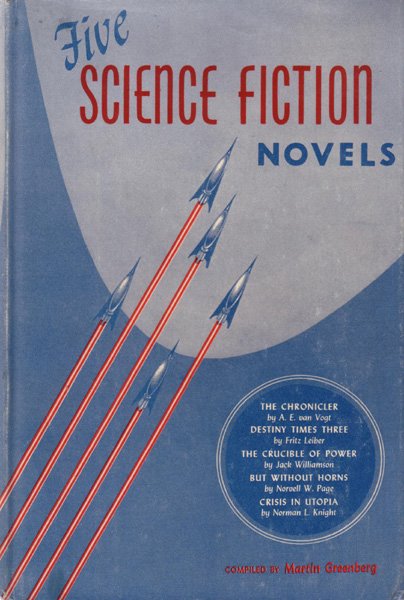
    A Recent Acquisition: Five Science Fiction Novels

    Here's a book I acquired over the weekend: Five Science Fiction Novels. Edited by Martin Greenberg, it was published by Gnome Press, New York, in 1952. It contains the following stories:

    • The Chronicler, A.E. van Vogt
    • Destiny Times Three, Fritz Leiber
    • The Crucible of Power, Jack Williamson
    • But Without Horns, Norvell W. Page
    • Crisis in Utopia, Norman L. Knight

    Book recommendation: The Two Minute Rule

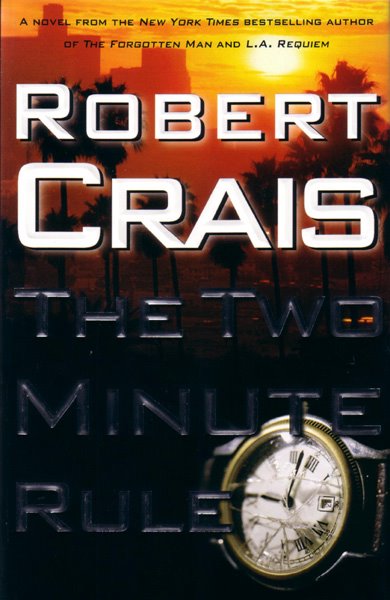
    18. The Two Minute Rule, Robert Crais, Thriller, 2-26

    Robert Crais fans may experience at twinge of disappointment upon first diving into his new book, The Two Minute Rule. Disappointment because Crais’ ace detective Elvis Cole is nowhere to be found. The Two Minute Rule is a one off, featuring a new cast of characters that include a reformed ex-con and a former FBI agent.

    The two-minute rule dictates that bank robbers must be in and out of a bank in two minutes or risk arrest. Or worse. In the book’s prologue, two violent amateurs, Marchenko and Parsons, violate the two-minute rule and, as a result, are killed by cops in a wild shoot-out as they leave the bank.

    Years before, Max Holman also violated the two-minute rule. Holman wasn’t an amateur like Marchenko and Parsons. Instead, he stays too long because in the course of the bank robbery an elderly man has a heart attack. Holman stops to administer CPR. Holman is sent to prison for 10 years, leaving behind a bitter young son.

    On the day that he is to be discharged from federal custody, Holman, is informed that his son, now a cop, has been brutally murdered. Holman is determined to learn who killed his son and three other cops. As his investigation proceeds, Holman learns that his son, and the other dead cops, may have been after $16 million in loot that Marchenko and Parsons had hidden before their death.

    Suddenly, finding his son’s killer is less important than answering a larger question: Was his son a dirty cop? Holman enlists the FBI agent who arrested him to find his son’s killer and the missing money. The agent, Katherine Pollard, has left the “FEEB” and is now a struggling single mom.

    The Two Minute Rule is vintage Crais. It’s a fast-paced ride with a satisfying twist to keep the reader guessing.

    Monday, February 27, 2006

    Death claims Busch, Butler

    Authors Frederick Busch and Octavia E. Butler died this past week.

    Butler, the first black woman to gain national prominence as a science fiction writer, died after falling and striking her head on the cobbled walkway outside her home in Seattle. She was 58.

    Butler was found outside her home in the north Seattle suburb of Lake Forest Park after the accident Friday, and died the same day. She had suffered from high blood pressure and heart trouble and could only take a few steps without stopping for breath.

    Butler’s first novel, Kindred, came out in 1979. It concerned a black woman who travels back in time to the South to save a white man. She went on to write about a dozen books, plus numerous essays and short stories. Her most recent work, Fledgling, a reinterpretation of the Dracula legend, was published last fall.

    She won numerous awards, and in 1995 became the first science fiction writer granted a "genius" award from the John D. and Catherine T. MacArthur Foundation, which paid $295,000 over five years. She served on the board of the Science Fiction Museum.

    Busch, died Thursday at Bellevue Hospital Center in Manhattan. He was 64. His son Benjamin said the cause was a heart attack he suffered in a hotel room where he and his wife, Judith, were staying during a visit to New York. Their home is in Sherburne, N.Y.

    Busch wrote 27 books, with another scheduled for publication this October. Among his many prizes were the American Academy of Arts and Letters Fiction Award in 1986, and the PEN/Malamud Award in 1991.

    His first novel, I Wanted a Year Without Fall, chronicled the misadventures of two young men fleeing troubled pasts. It was published it in 1971.

    Among is many books, three that the author particularly liked, according to his wife, were The Night Inspector, A Memory of War and Girls: A Novel.

    I especially recommend The Night Inspector, Girls and his final novel, North.

    Sunday, February 26, 2006

    Into the Reading Process: Book Piles

    The books I intend to read, or think I might read, are distributed into four piles.

    The first pile is small, it consists of the books I am currently reading. It is composed of two to three books. There is always a novel and a non-fiction work, which are occasionally supplemented with a collection of short stories. It may take a month to six weeks to finish the short stories because I only read them, a couple of stories at a time, between novels.

    The second pile—books to be read immediately—is made up of two stacks of about five books each. One stack is fiction. The other non-fiction. When all the fiction has been read I start a new stack. I do the same with non-fiction. These short stacks are made up of both current releases and older books. For example, the current stack of fiction was comprised of George Pelecanos’ The Big Blowdown, The Two Minute Rule by Robert Crais, The Last Kingdom by Bernard Cornwell, T. Jefferson Parker’s California Girl, The Rule of Four by Ian Caldwell and Dustin Thomason, Louise Erdrich’s Tracks and The Music of Chance written by Paul Auster in 1990.

    Actually, The Two Minute Rule was not part of the original stack, but when it arrived, late this week, it went to the top of the pile. That’s what I’m reading now. The Big Blowdown and Tracks were finished this past week.

    The third pile is books I’ve recently purchased. Most of these books will find their way into the second pile, those books I plan to read immediately. Some, through neglect or lack of interest, will slip into the fourth pile—books I plan to get around to reading some day.

    Books in this fourth pile can be promoted immediately into pile two. Some sit on the shelf for months. Three works by Patrick O’Brian are there. Two by Amy Tan. Gordon Parks is represented. Rick Bass. T.C. Boyle, John Lawton and Richard Ford.

    There’s rarely uncertainty about what I will read next. A current release will grab my attention. Certain authors always go directly to the short list—Michael Connelly, Richard Russo, Ian McEwan, Cormac McCarthy, Ian Rankin. Non-fiction is usually a current release like Doris Kearns Goodwin’s Team of Rivals or At Canaan’s Edge by Taylor Branch. Non-fiction selections tend to be histories or biographies with the occasional memoir tossed in.

    Friends will make suggestions. I almost always try to read a book if a friend asks. Such concessions always have mixed results, but for every The Time Traveler’s Wife, there is a The Zanzibar Chest.

    Saturday, February 25, 2006

    Erdrich's Tracks Powerful Poetry In A Novel

    17. Tracks, Louise Erdrich. Fiction, 2-22, pp. 226

    The voice of the American Indian, written with all the power and richness that poetry can convey, inhabits this book. Tracks is Louise Erdrich’s fourth book; of the books preceding it, two were novels, the first, Jacklight, was a collection of poetry. And it is as a poet that Erdrich establishes herself as a novelist.

    Both her previous novels, Love Medicine and The Beet Queen, hinted at Erdrich’s talent as a writer. In Tracks her talent—to breathe life into characters, to establish a sense of place and to create a narrative filled with subtlety and tension—emerges fully formed.

    By focusing on the lives of a handful of Chippewa’s early in the 20th Century, Erdrich deftly charts the slow, but certain erosion of Indian culture. The old beliefs cannot stand before the greed and the machinery, or even the good intentions, of the white man.

    Erdrich’s strength is the subtlety with which she traces the Chippewa’s loss of land, pride and sense of self. She does not preach or hector the reader. Instead, she traces the slowly disintegrating lives of people we have come to care about. Ultimately, sadly, the Chippewa betray one another, completing the work the white man started.

    Tracks is a lyrical book of great pain, sadness and regret. It is a novel written by a poet who understands the old ways of the Chippewa.

    Friday, February 24, 2006

    Thoughts From A Friend On His Current Reading

    You were quite right about Never Let Me Go -- a brilliant, haunting book, indeed. As you say, when K.I. is on, he's on.

    I do recommend The Sea -- Banville's a talented writer and the book is a quick read but weighty and moving nonetheless.

    I quite enjoyed A Slight Trick of The Mind despite Cullin's occasionally clunky dialogue, which perhaps owes something to the fact that he's American. Still, if you are a Sherlock Holmes fan, I recommend it.

    I also recently finished The Rings of Saturn by W.G. Sebald. I find Sebald's writing (in translation) to be beautiful and moving like nothing else I've read. But he is definitely an aquired taste, and I seem to recall that Austerlitz didn't do much for you, so you'll probably want to skip this one.

    Just started The Accidental, which I am enjoying very much.

    Tuesday, February 21, 2006

    Official PEN/Faulkner Press Release

    Washington, DC—E.L. Doctorow’s novel The March (Random House) has been selected as the winner of the 2006 PEN/Faulkner Award for Fiction. The announcement was made today by the directors of the PEN/Faulkner Foundation, Patricia Griffith and Robert Stone, Co-Chairmen.

    The judges—George Garrett, Ana Menéndez, and Melissa Pritchard—considered more than 359 novels and short story collections by an American author published in the U.S. during the 2005 calendar year from over 90 publishing houses, including small and academic presses. There is no fee for a publisher to submit a book.

    Founded in 1980, the PEN/Faulkner Award is the largest peer-juried prize for fiction in the United States. As winner, Doctorow receives $15,000. Each of the four finalists—Karen Fisher for A Sudden Country (Random House); William Henry Lewis for I Got Somebody in Staunton (Amistad/Harper Collins); James Salter for Last Night (Knopf); and Bruce Wagner for The Chrysanthemum Palace (Simon & Schuster) —receives $5,000.

    All five authors will be honored during the 26th annual PEN/Faulkner Award ceremony on Saturday, May 6, at 7 p.m.at the Folger Shakespeare Library, located at 201 East Capitol Street, S.E., Washington, DC. Tickets are $100, and include the award ceremony followed by dinner and dancing. They can be purchased by phoning the Folger Box Office at (202) 544-7077 or online at www.folger.edu.

    About the Winner

    Praised for its elegant prose, visionary historical sweep and remarkable characterization, the honored book, E.L. Doctorow’s The March, begins after the burning of Atlanta and recounts General William Tecumseh Sherman’s march of sixty thousand Union soldiers, in 1864-65, through Georgia and the Carolinas. Doctorow recounts devastations done to the Deep South—a 60-mile-wide trail of transformed lives, landscapes, and history—as the march drives forward, accumulating freed blacks and dislocated whites. Long admired for his masterfully drawn characters, Doctorow portrays General Sherman alongside a cast of dozens of memorable men and women, black and white, caught up in what The New Yorker called “a revolution in motion.”

    Winner of the 1990 PEN/Faulkner Award for Billy Bathgate, Edgar Laurence Doctorow was named after Edgar Allan Poe and credits his family’s love of music and literature to his own artistic beginnings. His other novels include City of God, Welcome to Hard Times, The Book of Daniel, Ragtime, Loon Lake, Lives of the Poets, World’s Fair, and The Waterworks. In addition to the PEN/Faulkner Award, Doctorow has also been honored with the National Book Award, two National Book Critics Circle Awards, the Edith Wharton Citation for Fiction, the William Dean Howells Medal of the American Academy of Arts and Letters, and the presidentially conferred National Humanities Medal. Doctorow lives in New York and teaches at New York University.

    About the Finalists

    Hailed as a “great novel of the American West” by Publishers Weekly, Karen Fisher’s debut novel, A Sudden Country, is based on a journal written by the author’s ancestor Emma Ruth Ross Slavin, who was 11 when her family joined the 1847 Oregon migration. Exploring the intersection of two characters—James MacLaren, who has lost his children to small pox and his Nez Perce wife to another man; and Lucy Mitchell, a remarried widow and mother—the novel follows their deeply affecting encounter, as MacLaren agrees to Guide the Mitchell family from the Iowa banks of the Missouri to the Columbia River in Oregon. Fisher lives with her husband and their three children on an island in the Puget Sound.

    I Got Somebody in Staunton is a collection of 10 dazzling stories set variously in Bedford-Stuyvesant; Denver; and Staunton, Virginia, all deeply concerned with the pride and pain of African-American heritage. In William Henry Lewis’s title story, a black college professor, haunted by his dying uncle Izell's memories of lynchings and the ways of the old South, flirts with danger by giving a ride to a flirtatious young white woman. A winner of The 2006 Black Caucus of the American Library Association (BCALA) Literary Awards for this collection, which was also named one of the “25 best books of 2005” by Kirkus Review, Lewis is also the author of In The Arms of Our Elders, an earlier collection.

    James Salter won The PEN/Faulkner Award in 1989 for his collection Dusk and Other Stories. Admired as one of the most compelling voices in contemporary fiction, Salter’s stunning Last Night is a collection of ten provocative stories that explore situations of love, disappointment, desire, and deception, rendered in luminous prose. Salter, who lives in Colorado and on Long Island, is also the author of the novels Solo Faces, Light Years, A Sport and a Pastime, The Arm of Flesh (revised as Cassada), and The Hunters; as well as the memoirs Gods of Tin and Burning the Days.

    The Chrysanthemum Palace, the newest biting satire by Los Angeles novelist Bruce Wagner, introduces three self-absorbed friends—all descendents of Hollywood stardom, Bertie Krohn, only child of Perry Krohn, creator of TV’s longest running space opera, recounts the last months in his relationship with Thad Michelet, a 50-something author, actor, and son of a revered author; and Clea Freemantle, daughter of a legendary movie star. Admired as “a millennial heir to Nathaniel West” by the New York Times, Wagner is also the author of Force Majeure; and the Cellular Trilogy: I’m Losing You; I’ll Let You Go, which was nominated for the PEN USA fiction award; and Still Holding.

    About all five of these remarkable books, judge Melissa Pritchard says, “Whether writing of the civil war, the American West, Hollywood, or the subtle, plaguing wounds of eros, ignorance, fear, and desire, each of this year’s authors gives us stories quintessentially American in their mythical scope and critical to our current need to stand on more compassionate ground.”

    About PEN/Faulkner

    The PEN/Faulkner Foundation is committed to building audiences for exceptional literature and bringing writers together with their readers. This mission is accomplished through readings at the Folger by distinguished writers who have won the respect of readers and writers alike; the PEN/Faulkner Award, the largest peer-juried award for fiction in the United States; the PEN/Malamud Award, honoring excellence in the short story; and the Writers in Schools program, which brings nationally and internationally-acclaimed authors to public high school classrooms in Washington, Atlanta, Chicago, Detroit, and Kansas City.

    ###

    Press release issued on February 21, 2006.

    Doctorow's The March wins Pen/Faulkner

    The Washington Post reports today that the PEN/Faulkner Foundation will announce later today that E.L. Doctorow has won its 2006 fiction award for his novel "The March." It is the second PEN/Faulkner award for Doctorow, who won in 1990 for "Billy Bathgate."

    The other finalists were:

    • William Henry Lewis for "I Got Somebody in Staunton," a story collection examining African American lives.
    • Karen Fisher for her first book, "A Sudden Country," a tale of America's 19th-century western migration.
    • Bruce Wagner for his novel "The Chrysanthemum Palace."
    • James Salter for his story collection "Last Night."

    Monday, February 20, 2006

    AP Story Features Lincoln Book Shop

    The life of Lincoln, by the books

    February 20, 2006 12:50 am

    By DON BABWIN
    ASSOCIATED PRESS WRITER

    CHICAGO--About a decade ago, as she was starting to research Abraham Lincoln, Pulitzer Prize-winning historian Doris Kearns Goodwin stepped into a small bookshop she'd heard about here devoted to the nation's 16th president.

    She expected a dusty little store, but what she found was practically a museum, filled with books, documents, photographs and other historical gems that for decades have been making collectors, history buffs and the nation's leading historians fans of the Abraham Lincoln Book Shop.

    Goodwin made several pilgrimages to the bookstore--during which she bought several dozen books that helped her write her best-selling "Team of Rivals: The Political Genius of Abraham Lincoln."

    "It really stands by itself," said Goodwin, who thanks the store's owner, Daniel Weinberg, in her book and returned there in November for a book signing. "I certainly don't know of any other like it."

    The store, founded in 1938, stands as a monument to a man who more than 140 years after his death continues to make headlines as scholars and others put forth theories about everything from his physical and mental health to his sexuality.

    Poet Carl Sandburg, whose six-volume book on Lincoln is considered by many one of the greatest biographies ever written, was a regular visitor and even designed the store's hat and umbrella logo. "The Civil War" filmmaker Ken Burns and U.S. Supreme Court Justice William O. Douglas visited. Historians Bruce Catton and Shelby Foote were customers, and their work is sprinkled around the store.

    "I've dropped a bundle there," said Frank Williams, sounding more like a gambler talking about a trip to Las Vegas than the chief justice of the Rhode Island Supreme Court. He has been a collector of what is called "Lincolniana" since he was 11.

    Along with 8,000 books (more are in storage) there are all sorts of framed documents and photographs and other memorabilia lining the walls and in display cases.

    "I try to make this a museum in a way," said Weinberg, who became the business partner of shop founder Ralph Newman in 1971 and has owned the store outright since 1984.

    Sharing space are the signatures of Lincoln and his assassin, John Wilkes Booth. There's Ulysses S. Grant and Robert E. Lee. There are signatures of presidents from George Washington to Gerald Ford. There are the John Hancocks of Mark Twain, Napoleon, Patrick Henry and, of course, John Hancock.

    There is what Weinberg said is the second-earliest photograph of Lincoln, taken in 1854 when he was 45 years old--a photograph that is interesting not just because it shows a clean-shaven Lincoln, but also because he is holding an anti-slavery newspaper.

    "If anyone would have noticed, that would have sunk him," said Weinberg, explaining that any connection with abolitionism would have been political suicide.

    The significance of some items is self-evident, like the $9,500 first edition of "Gone With The Wind," open to the page autographed by its author, Margaret Mitchell.

    But across the room, a military commission signed by Lincoln promoting a Union soldier named Francis Brownell requires a little explanation.

    "Lincoln signed 25,000 of these," Weinberg said, but Brownell was in the regiment of Elmer Ellsworth, whom Lincoln came to view almost as a son.

    In 1861, Ellsworth led the regiment to Alexandria, where he spotted a secessionist flag flying from an inn. After Ellsworth ordered the flag cut down, he was fatally shot by the innkeeper, thus becoming the first officer killed in the Civil War, Weinberg said. Brownell then shot and killed the innkeeper, earning the nickname "Ellsworth's Avenger."

    "Think of Lincoln's emotional state when he signed this," Weinberg said.

    Weinberg won't come closer than "hundreds of thousands of dollars" when asked the price of the most expensive items he's sold, like a desk in the room at Appomattox Court House when Lee surrendered to Grant at the end of the Civil War.

    Hanging in Weinberg's office is the one thing he said is not for sale: A letter dated Sept. 14, 1863, in which the author of the Gettysburg Address commits a memorable error.

    "There was not much going on that day [and] he signed it 'A. Linclon,'" said Weinberg, pointing to a signature that's been crossed out above one in which the name is spelled correctly. "His mind got lost."

    Abraham Lincoln Book Shop: alincolnbookshop.com

    Sunday, February 19, 2006

    Michael Connelly at 2006 National Book Festival

    On his website, Michael Connelly announces he will attend the National Book Festival on September 30, 2006, on the Mall in Washington, D.C. Connelly has attended the festival in the past.

    Pelecanos and The Big Blowdown

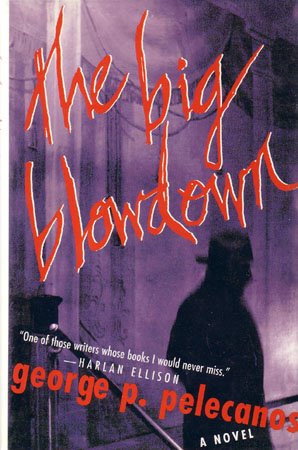
    16. The Big Blowdown, George Pelecanos. Thriller, 2-19, pp. 313

    April, 2003. That’s when I was introduced to the novels of D.C. writer George Pelecanos. The book, his sixth, was The Sweet Forever. I read one more Pelcanos book that year, three more the next. His work has been an enduring passion since.

    At the end of 2005, and into the first two months of this year, I set out to acquaint myself with Pelecanos’ early books. His first three books were entertaining, but imperfect. Many of the elements that would become his trademark were there, but those elements had not yet coalesced into a seamless whole.

    That happened in his fourth book, Down By The River Where The Dead Men Go. Before that book, “I was learning to be a writer,” Pelecanos told me at a recent book signing. In Down By The River everything falls into place. His dream of becoming a writer is realized.

    In his fifth book, The Big Blowdown, Pelecanos emerges as a master of his craft. The characters are vivid and fully realized, the pace is breathtaking and the atmosphere palpable—the pages reek of cigarettes, cheap booze, cheaper perfume and illicit sex. Automobiles, music and the City of Washington, D.C., always graphically drawn in Pelecanos’ writing, manifest themselves as elements vital to Pelecanos’ work.

    Pelecanos ranks with Michael Connelly, Ian Rankin and Robert Crais as one of the leading practitioners of the thriller today.

    Purity of Blood a wild, rollicking read

    13. The Body Artist, Don DeLillo. Fiction, 2-14, pp. 124

    14. Purity of Blood, Arturo Perez-Reverte. Fiction, 2-15, pp. 267

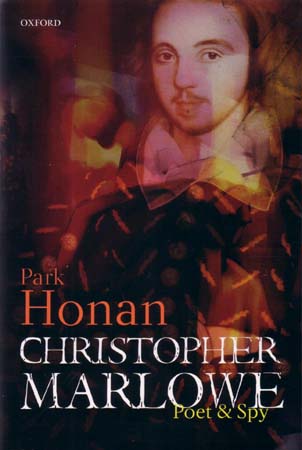
    15. Christopher Marlowe, Poet & Spy, Park Honan. Biography, 2-19, pp. 367

    I started Park Honan’s Christopher Marlowe Poet & Spy on January 29 and finished it February 19. That’s an average of 16 pages a day, which is about all I could read in a single sitting. Honan’s prose is serviceable, but dense. In fairness, this biography of the 16th Century poet and playwright isn’t mean for the general public. Like his earlier work, Shakespeare A Life, it’s an academic work with a healthy helping of literary analysis. Personally, I would have preferred a Penguin Lives treatment of Kit Marlowe – a concise 120 pages; he was born only to die a quick, brutal and mysterious death, leaving behind a few extraordinary works.

    Purity of Blood is the second in Perez-Reverte’s series set in Spain during the Inquisition's reign of terror and featuring Captain Alatriste, a gloomy, principled sword-for-hire. The series, which appeared in Spain years earlier, is just now appearing in America based on Perez-Reverte’s success with such books as The Club Dumas and Queen of the South. In the Alatriste series, Perez-Reverte emerges as a modern day Dumas. The books are a wild, rollicking ride. The series seems to have found an audience--the publisher, Putnam, is promising three additional books starring Alatriste in the next three years.

    Don DeLillo’s Underworld was a lyrical, sometimes difficult book. The Body Artist is simply difficult. DeLillo, like Ishiguro, is extremely talented, but wildly uneven.

    Saturday, February 18, 2006

    Tom Wolfe at the National Book Festival

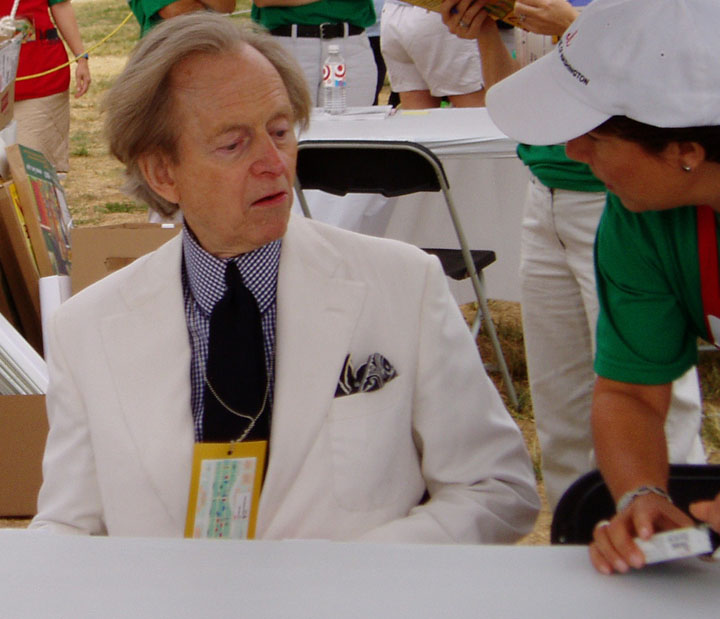
    Here's a photograph I took of Tom Wolfe at the National Book Festival in 2005. I was second in line to have books signed by Wolfe. Signed books by Wolfe in my collection now include a first edition of The Right Stuff and a textbook on The New Journalism (also a first). I got in line about 90 minutes early. It was a good thing. The line for Wolfe was long and before the signing ended the rules changed from "He'll sign everything." to "One book per person."

    Thursday, February 16, 2006

    Miscellaneous book thoughts

    • Peter Benchley died this week. He was 65. Why did I sell that first edition of Jaws? Who did I sell it to and for how much?

    • Remembering that first edition of Jaws starts me thinking about other books that have passed through my hands. Notably, a first edition of John Steinbeck’s first book, Cup of Gold. I passed it up during a silent auction. Everyone else did too. I don’t think any one realized it was a first. I went back the next day and bought it for $5. Sold it for much more, but would sure like it back.

    • I’m ready for a really good book sale. Recently went to a library book sale in Madison, Wisconsin, and it was horrible. I’m guessing 80 percent of the books were library cast-offs. I bought three books. It was all I could find and I was pushing to buy the three.

    • Can’t wait for Robert Crais’ new book, The Two-Minute Rule. It will move immediately to the top of my reading pile.

    • Hit a reading alpha state this week. Finished a book on Monday. Finished another on Tuesday and a third on Wednesday. All were fiction. Tuesday’s book was only about 120 pages. I read half the book on my commute to work; the other half on the return trip. Wednesday’s book was more than 250 pages, but I was traveling. Six hours on an airplane allowed me to read the book from start to finish (Purity of Blood by Perez-Reverte), knock off two short stories and several pages in a biography.

    Guardian announces Batman's return

    Holy comic book! Batman returns to wage war on al-Qaida

    Dan Glaister in Los Angeles
    Thursday February 16, 2006
    The Guardian

    Holy terror, Batman! Gotham's under attack, and the caped crusader is the only one who can kick al-Qaida's butt.

    That, in essence, is the plot of the latest Batman comic book by leading graphic novelist Frank Miller.

    Speaking at a comic book convention in San Francisco at the weekend, Miller, the author of The Dark Knight Returns and the Sin City series, said Batman could ill afford to chase fantasy villains when the real thing was on his doorstep.

    "Not to put too fine a point on it, it's a piece of propaganda," he said.

    "Superman punched out Hitler. So did Captain America. That's one of the things they're there for.

    "These are our folk heroes. I just think it's silly to have Batman out chasing the Riddler when you've got al-Qaida out there."

    Comparing Batman to Clint Eastwood's Dirty Harry character - a lone urban hero fighting a crime wave - Miller said: "Batman kicks al-Qaida's ass ... I wish the entertainers of our time had the spine and the focus of the ones who faced down Hitler."

    In the book, Holy Terror, Batman is "a reminder to people who seem to have forgotten who we're up against", the author said.

    Miller, 49, is credited with rejuvenating the Batman series when he returned the character to his dark roots in the Dark Knight Returns in the 1980s. He is one of the most successful graphic novelists, and last year turned to film, co-directing the adaptation of his graphic novel series Sin City.

    Miller has drawn 120 pages of the 200-page graphic novel. There is no completion date.

    Monday, February 13, 2006

    The Widow of the South a powerful, evocative read

    12. The Widow of the South, Robert Hicks. Fiction, 2-13, pp. 404

    Sometimes a book catches you completely off guard. Not merely the quality of its writing, although that is part of it, but the emotions that it touches; touches more deeply, more genuinely, more ineffably than hundreds of other books.

    My youngest son asked me recently why I read. This is the answer. I read in the hope of just such a book. A book that illuminates the human spirit, that instructs and edifies, and that connects me to my fellow man – in mind and body and spirit – in ways we seldom experience in our daily lives.

    Cold Mountain was such a book. As was Atonement and Gilead. The Widow of the South by Robert Hicks now joins that select list. In this, his first book, Hicks weaves a tender, at times horrific, story of one of the final battles of the Civil War and how that battle changed the life of one woman forever. In telling the story of Carrie McGavock, Hicks lays bares the horror of war, evokes the powerful hold life has on each of us and reminds us, once again, how one persons’ sacrifice can touch the lives of thousands.

    The Widow of the South is a powerful, evocative story and a superior read.

    "I had resolved to be the designated mourner, to be the woman who would remember so others could forget. In the forgetting, I prayed, would be some relief, some respite from the violence and bitterness and vengeance. Did I have hope? It did not really matter, but I had little. Still, there are things we are called to do that we cannot refuse, as futile as they seem, because to refuse them would mean to lose faith. Not just faith in God so much as faith in man, which I supposed amounted to the same thing."

    --from The Widow of the South

    Sunday, February 12, 2006

    Pete Dexter's God's Pocket

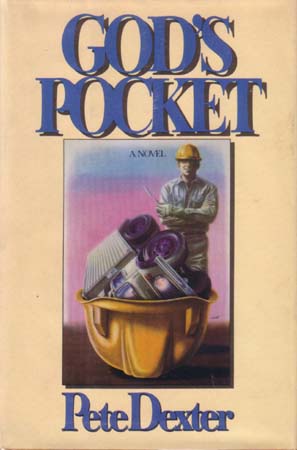
    11. God’s Pocket, Pete Dexter. Fiction, 2-8, p. 274

    My 11th book of 2006 was Pete Dexter’s first, God’s Pocket. Dexter is a terrific writer; one of my favorites. Think Elmore Leonard with an edge.

    God’s Pocket was better than I had anticipated. It is one of those books that doesn’t go where you think it will. The narrative begins focused on a couple of characters and only later do you realize they’ve dropped from the story, only to re-appear near the conclusion.

    Humor is an unexpected bonus in God’s Pocket. In that sense this novel reminds me of something by Carl Hiaasen.

    Dexter has written six novels. I especially recommend God’s Pocket, Deadwood, Paris Trout and Train, his most recent effort.

    Saturday, February 11, 2006

    Avol's shines in Madison, Wisconsin

    Madison, Wisconsin, boasts a variety of new and antiquarian bookstores, which also have the advantage of being located close to one another.

    Avol’s Bookstores draws my top recommendation. I’ve been to Avol’s twice and twice come away with some very nice books. Avol’s is actually a combination of two stores; the first featuring more recent books, the second a small but nice selection of antiquarian books. Notable among the antiquarian books is the selection of science fiction offerings and the works of August Derleth, a local boy made good. The books in Avol’s are notable for their condition. I especially like bookstores that offer a broad selection of used books that are bright and clean.

    That’s not a claim that can be made by Shakespeare’s books, just a few yards from the State Capitol. I thinks there are books to be found here, but there’s a lot of shabby later printings too. This is the sort of store that awards a patient shopper. It’s notable for its non-fiction selection. I thought its fiction offerings were poor. The books in all the glass cases are probably worth some attention, but I didn’t have the time. I understand dealers need to protect their books from shoplifters, but it is off-putting to have to disturb the lone sleepy clerk to open every case. I feel as if I should buy something after I’ve disturbed the clerk. In this instance, feelings did not translate into action.

    Both shops are located just off State Street, which runs from the Capitol to the University of Wisconsin. It's a pleasant street for a stroll, even in February, with lots of restaurants and non-book shops to compete for your attention.

    There are more shops in Madison beyond the two I've mentioned. These are the only shops I’ve visited, but I expect to return to Madison later this year. I plan to stop (and buy) in Avol’s again. And I hope to visit a few new (as in I haven’t been there before) stores as well.

    Saturday, February 04, 2006

    Book signings

    2006 has been a great year for book signings. Earlier in this blog I mentioned that I had the opportunity to hear Taylor Branch and that he signed all three books in his history of the Civil Rights Movement during the King years.

    Since then I have heard Nicholas Basbanes and George Pelecanos. I missed most of Basbanes talk at the Library of Congress, but was fortunate enough to be first in line for the signing. He signed all four of his past books as well as his new book, Every Book Its Reader. Basbanes was very attentive and took a lot of time personalizing the inscription on his new book.

    Pelecanos was at Politics & Prose -- the best independent bookstore in the country -- promoting D.C. Noir, a noir anthology that he edited for Akashic Books. Pelecanos, who also has a short story in the anthology, was joined by 10 of the authors whose works appear in D.C. Noir, including Laura Lippman. In addition to having my copy signed by the 11 authors, it was also signed by cover photographer Jim Saah and Akashic publisher Johnny Temple.

    Kudos to Temple for his fine Noir series (it includes Dublin Noir, Chicago Noir and Lone Star Noir). In addition to featuring established writers, like Pelecanos, Lippman and Jim Fusili, the series has attracted many authors who are being published for the first time.

    Reading Update

    Here's the most recent books that I have read:

    9. Down by the River Where the Dead Men Go, George Pelecanos. Thriller, 1-29, pp. 234

    10. The Crazed, Ha Jin. Fiction, 2-3, pp. 323

    Down by the River Where the Dead Men Go is Pelecanos' fourth book. It's the book where everything falls into place for Pelecanos as a writer. Everything that I enjoy about his current works--the atmosphere, the masterful pacing and the vivid characters--can be found in Down by the River.

    The Crazed is interesting, but only mildly so. It is not as skillfully rendered as The Bridegroom or War Trash.