

Sunday, February 19, 2006
Michael Connelly at 2006 National Book Festival


Pelecanos and The Big Blowdown
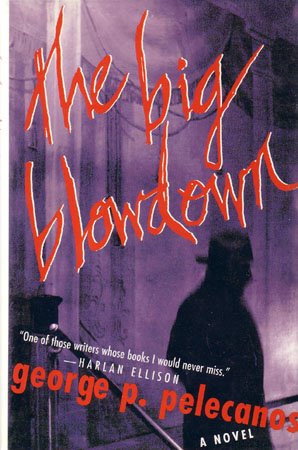 16. The Big Blowdown, George Pelecanos. Thriller, 2-19, pp. 313
 April, 2003. That’s when I was introduced to the novels of D.C. writer George Pelecanos. The book, his sixth, was The Sweet Forever. I read one more Pelcanos book that year, three more the next. His work has been an enduring passion since.
At the end of 2005, and into the first two months of this year, I set out to acquaint myself with Pelecanos’ early books. His first three books were entertaining, but imperfect. Many of the elements that would become his trademark were there, but those elements had not yet coalesced into a seamless whole.
That happened in his fourth book, Down By The River Where The Dead Men Go. Before that book, “I was learning to be a writer,” Pelecanos told me at a recent book signing. In Down By The River everything falls into place. His dream of becoming a writer is realized.
In his fifth book, The Big Blowdown, Pelecanos emerges as a master of his craft. The characters are vivid and fully realized, the pace is breathtaking and the atmosphere palpable—the pages reek of cigarettes, cheap booze, cheaper perfume and illicit sex. Automobiles, music and the City of Washington, D.C., always graphically drawn in Pelecanos’ writing, manifest themselves as elements vital to Pelecanos’ work.
Pelecanos ranks with Michael Connelly, Ian Rankin and Robert Crais as one of the leading practitioners of the thriller today.
Purity of Blood a wild, rollicking read
 13. The Body Artist, Don DeLillo. Fiction, 2-14, pp. 124
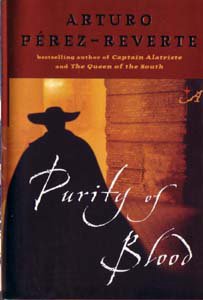
14. Purity of Blood, Arturo Perez-Reverte. Fiction, 2-15, pp. 267
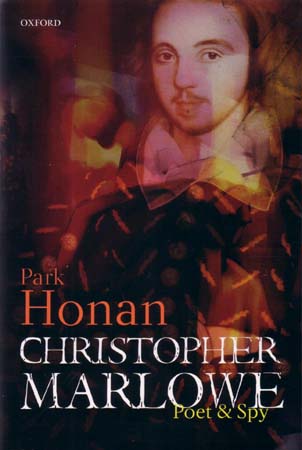
15. Christopher Marlowe, Poet & Spy, Park
I started Park Honan’s Christopher Marlowe Poet & Spy on January 29 and finished it February 19. That’s an average of 16 pages a day, which is about all I could read in a single sitting.
Purity of Blood is the second in Perez-Reverte’s series set in Spain during the Inquisition's reign of terror
Don DeLillo’s Underworld was a lyrical, sometimes difficult book. The Body Artist is simply difficult. DeLillo, like Ishiguro, is extremely talented, but wildly uneven.
Saturday, February 18, 2006
Tom Wolfe at the National Book Festival
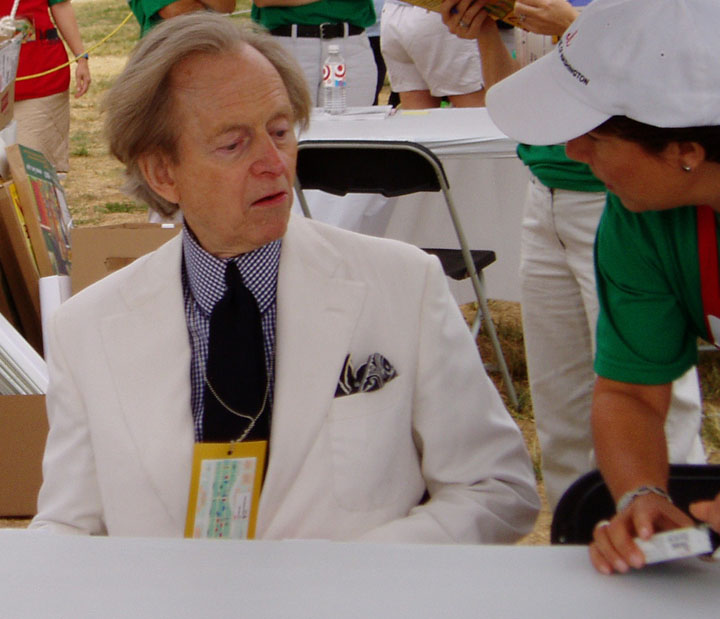 Here's a photograph I took of Tom Wolfe at the National Book Festival in 2005. I was second in line to have books signed by Wolfe. Signed books by Wolfe in my collection now include a first edition of The Right Stuff and a textbook on The New Journalism (also a first). I got in line about 90 minutes early. It was a good thing. The line for Wolfe was long and before the signing ended the rules changed from "He'll sign everything." to "One book per person."
Thursday, February 16, 2006
Miscellaneous book thoughts
- Peter Benchley died this week. He was 65. Why did I sell that first edition of Jaws? Who did I sell it to and for how much?
- Remembering that first edition of Jaws starts me thinking about other books that have passed through my hands. Notably, a first edition of John Steinbeck’s first book, Cup of Gold. I passed it up during a silent auction. Everyone else did too. I don’t think any one realized it was a first. I went back the next day and bought it for $5. Sold it for much more, but would sure like it back.
- I’m ready for a really good book sale. Recently went to a library book sale in Madison, Wisconsin, and it was horrible. I’m guessing 80 percent of the books were library cast-offs. I bought three books. It was all I could find and I was pushing to buy the three.
- Can’t wait for Robert Crais’ new book, The Two-Minute Rule. It will move immediately to the top of my reading pile.
- Hit a reading alpha state this week. Finished a book on Monday. Finished another on Tuesday and a third on Wednesday. All were fiction. Tuesday’s book was only about 120 pages. I read half the book on my commute to work; the other half on the return trip. Wednesday’s book was more than 250 pages, but I was traveling. Six hours on an airplane allowed me to read the book from start to finish (Purity of Blood by Perez-Reverte), knock off two short stories and several pages in a biography.
Guardian announces Batman's return
Dan Glaister in Los Angeles
Thursday February 16, 2006
The Guardian
Holy terror, Batman! Gotham's under attack, and the caped crusader is the only one who can kick al-Qaida's butt.
That, in essence, is the plot of the latest Batman comic book by leading graphic novelist Frank Miller.
Speaking at a comic book convention in San Francisco at the weekend, Miller, the author of The Dark Knight Returns and the Sin City series, said Batman could ill afford to chase fantasy villains when the real thing was on his doorstep.
"Not to put too fine a point on it, it's a piece of propaganda," he said.
"Superman punched out Hitler. So did Captain America. That's one of the things they're there for.
"These are our folk heroes. I just think it's silly to have Batman out chasing the Riddler when you've got al-Qaida out there."
Comparing Batman to Clint Eastwood's Dirty Harry character - a lone urban hero fighting a crime wave - Miller said: "Batman kicks al-Qaida's ass ... I wish the entertainers of our time had the spine and the focus of the ones who faced down Hitler."
In the book, Holy Terror, Batman is "a reminder to people who seem to have forgotten who we're up against", the author said.
Miller, 49, is credited with rejuvenating the Batman series when he returned the character to his dark roots in the Dark Knight Returns in the 1980s. He is one of the most successful graphic novelists, and last year turned to film, co-directing the adaptation of his graphic novel series Sin City.
Miller has drawn 120 pages of the 200-page graphic novel. There is no completion date.
Monday, February 13, 2006
The Widow of the South a powerful, evocative read
 12. The Widow of the South, Robert Hicks. Fiction, 2-13, pp. 404
Sometimes a book catches you completely off guard. Not merely the quality of its writing, although that is part of it, but the emotions that it touches; touches more deeply, more genuinely, more ineffably than hundreds of other books.
My youngest son asked me recently why I read. This is the answer. I read in the hope of just such a book. A book that illuminates the human spirit, that instructs and edifies, and that connects me to my fellow man – in mind and body and spirit – in ways we seldom experience in our daily lives.
Cold Mountain was such a book. As was Atonement and Gilead. The Widow of the South by Robert Hicks now joins that select list. In this, his first book, Hicks weaves a tender, at times horrific, story of one of the final battles of the Civil War and how that battle changed the life of one woman forever. In telling the story of Carrie McGavock, Hicks lays bares the horror of war, evokes the powerful hold life has on each of us and reminds us, once again, how one persons’ sacrifice can touch the lives of thousands.
The Widow of the South is a powerful, evocative story and a superior read.
"I had resolved to be the designated mourner, to be the woman who would remember so others could forget. In the forgetting, I prayed, would be some relief, some respite from the violence and bitterness and vengeance. Did I have hope? It did not really matter, but I had little. Still, there are things we are called to do that we cannot refuse, as futile as they seem, because to refuse them would mean to lose faith. Not just faith in God so much as faith in man, which I supposed amounted to the same thing."
Sunday, February 12, 2006
Pete Dexter's God's Pocket
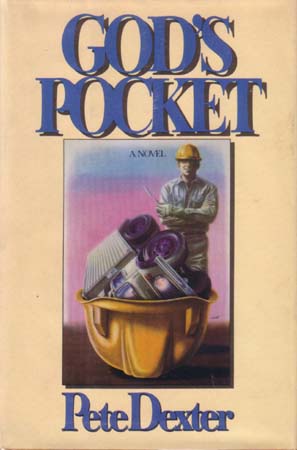 11. God’s Pocket, Pete Dexter. Fiction, 2-8, p. 274
 My 11th book of 2006 was Pete Dexter’s first, God’s Pocket. Dexter is a terrific writer; one of my favorites. Think Elmore Leonard with an edge.
God’s Pocket was better than I had anticipated. It is one of those books that doesn’t go where you think it will. The narrative begins focused on a couple of characters and only later do you realize they’ve dropped from the story, only to re-appear near the conclusion.
Humor is an unexpected bonus in God’s Pocket. In that sense this novel reminds me of something by Carl Hiaasen.
Dexter has written six novels. I especially recommend God’s Pocket, Deadwood,
Saturday, February 11, 2006
Avol's shines in Madison, Wisconsin
Avol’s Bookstores draws my top recommendation. I’ve been to Avol’s twice and twice come away with some very nice books. Avol’s is actually a combination of two stores; the first featuring more recent books, the second a small but nice selection of antiquarian books. Notable among the antiquarian books is the selection of science fiction offerings and the works of August Derleth, a local boy made good. The books in Avol’s are notable for their condition. I especially like bookstores that offer a broad selection of used books that are bright and clean.
That’s not a claim that can be made by Shakespeare’s books, just a few yards from the State Capitol. I thinks there are books to be found here, but there’s a lot of shabby later printings too. This is the sort of store that awards a patient shopper. It’s notable for its non-fiction selection. I thought its fiction offerings were poor. The books in all the glass cases are probably worth some attention, but I didn’t have the time. I understand dealers need to protect their books from shoplifters, but it is off-putting to have to disturb the lone sleepy clerk to open every case. I feel as if I should buy something after I’ve disturbed the clerk. In this instance, feelings did not translate into action.
Both shops are located just off State Street, which runs from the Capitol to the University of Wisconsin. It's a pleasant street for a stroll, even in February, with lots of restaurants and non-book shops to compete for your attention.
Saturday, February 04, 2006
Book signings
 2006 has been a great year for book signings. Earlier in this blog I mentioned that I had the opportunity to hear Taylor Branch and that he signed all three books in his history of the Civil Rights Movement during the King years.
Since then I have heard Nicholas Basbanes and George Pelecanos. I missed most of Basbanes talk at the Library of Congress, but was fortunate enough to be first in line for the signing. He signed all four of his past books as well as his new book, Every Book Its Reader. Basbanes was very attentive and took a lot of time personalizing the inscription on his new book.
Pelecanos was at Politics & Prose -- the best independent bookstore in the country -- promoting D.C. Noir, a noir anthology that he edited for Akashic Books. Pelecanos, who also has a short story in the anthology, was joined by 10 of the authors whose works appear in D.C. Noir, including Laura Lippman. In addition to having my copy signed by the 11 authors, it was also signed by cover photographer Jim Saah and Akashic publisher Johnny Temple.
Kudos to Temple for his fine Noir series (it includes Dublin Noir, Chicago Noir and Lone Star Noir). In addition to featuring established writers, like Pelecanos, Lippman and Jim Fusili, the series has attracted many authors who are being published for the first time.
Reading Update
9. Down by the River Where the Dead Men Go, George Pelecanos. Thriller, 1-29, pp. 234
10. The Crazed, Ha Jin. Fiction, 2-3, pp. 323
Down by the River Where the Dead Men Go is Pelecanos' fourth book. It's the book where everything falls into place for Pelecanos as a writer. Everything that I enjoy about his current works--the atmosphere, the masterful pacing and the vivid characters--can be found in Down by the River.
The Crazed is interesting, but only mildly so. It is not as skillfully rendered as The Bridegroom or War Trash.
Saturday, January 28, 2006
Teacher Man by Frank McCourft
 Book 8 of 2006: Teacher Man, Frank McCourt. Memoir, 1-28, pp. 258.
OK, it's not Angela's Ashes and how many books, even one by the same author, can be? But Teacher Man grows on you. It starts slow, like McCourt's career as a teacher in New York, but ends strong. Part III, his account of his years teaching creative writing at Stuyvesant High School is especially engaging. McCourt was a creative, caring, committed teacher. He's a pretty darned good writer, too.
Thursday, January 26, 2006
Taylor Branch speaks on Civil Rights movement
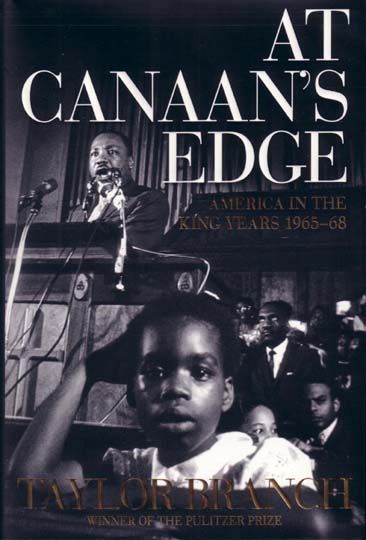 I heard Taylor Branch speak today at noon at the Woman’s National Democratic Club in Washington, D.C. Branch, of course, is the author of a three-volume history of the Civil Rights movement in America. He won a Pulitzer Prize for the first book in the series, Parting the Waters, America in the King Years 1954-63. The second book was Pillar of Fire, America in the King Years 1963-65. He concludes the trilogy with At Canaan’s Edge, America in the King Years 1965-68, released this month.
“All of us stand on the shoulders of the Civil Rights movement,” Branch said. Considering his venue, Branch focused his remarks on the debt that the movement for woman’s rights owes to the Civil Rights movement.
Branch spent 24 years on his sweeping chronicle of the King years. He told me that he does not yet know what his next project will be. Branch is a gracious man (a native of the South), who obligingly signed my books during a reception prior to his talk.
Paul Auster's Brooklyn Follies an engaging read
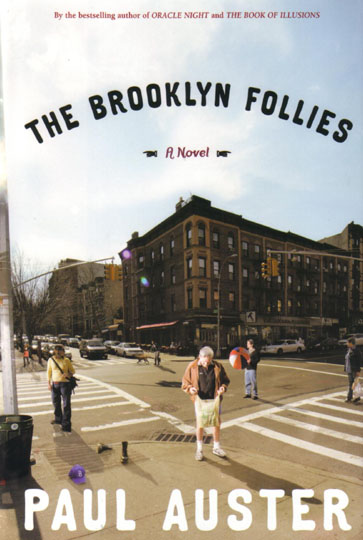 Book 7: Brooklyn Follies, Paul Auster. Completed: 1-26. 306 Pages.
Auster is an acquired taste. There’s a disturbing element to his writing. The man is hard on his characters. But there is also a strong element of hope. Auster seems to say that no matter what befalls us life is good.
I am most attracted to his voice. Auster writes like I think I might. There isn’t any exposition in the conventional sense. Auster’s narrator tells us about the events that unfold in his life and in the lives of the other characters. And, while the narrator isn’t or can’t always be present in those events, he’s a wise, affable sort who earns the confidence of the other characters. They share their stories with him and he shares them with us. It’s a relaxed form of novel writing, as if we were listening to an old friend tell stories over coffee.
This is not a powerful or especially illuminating novel, but it is an engaging read.
Wednesday, January 25, 2006
First book recommendation of 2006: Team of Rivals
 Book recommendation:
My first book recommendation of 2006: Team of Rivals by Doris Kearns Goodwin. It’s also the sixth book I have read so far this year (completed January 25, 754 pages).
The story of Abraham Lincoln, particular the years of his presidency during the horrors of the Civil War, never cease to entertain, inform and enlighten. This is especially true with Goodwin’s Team of Rivals. The book focuses on Lincoln’s efforts to secure the Presidency, his decision to place his rivals to the Republication Presidential nomination in his cabinet and his relationship with those men. Salmon Chase never ceased to believe he should be President and pursued the office while serving as Secretary of the Treasury. Lincoln tolerated Chase’s ambition because he was an able administrator. Edward Bates and William Seward served ably as well as loyally. Seward, who had the greatest claim to the Presidency, became Lincoln’s confidant and friend.
The book emphasizes the greatness and rarity of Lincoln’s moral character. It was exactly this quality that has set him aside -- then and now -- from generations of politicians and guaranteed his immortality. Goodwin illustrates Lincoln’s political genius – he deftly managed his nomination as Republican candidate for the presidency and balanced the composition of his cabinet throughout his Administration so as to blunt the worst of the political opposition. And while we do not think of Lincoln as a people person, Goodwin shows he was exactly that. Lincoln built lasting relationships, gained the admiration of most of his Cabinet (Chase excepted) and, from the time he was a child, delighted in entertaining any gathering in which he found himself with well-crafted, humorous yarns. She dispels the image of Lincoln as a gloomy man, given to a continual state of depression. Lincoln felt the magnitude of the war’s horror, but also envisioned “the new nation conceived in liberty” that would arise from the end of slavery.
Well written, impeccably researched, Team of Rivals belongs on every reading short list.
Sunday, January 22, 2006
The Beet Queen by Louise Erdrich
 The fifth book of 2006 is The Beet Queen by Louise Erdrich. 338 pages. Completed January 22.
This is Erdrich's second book. Her strength, as a writer, is in capturing the hopes and desires of small-town people. The book has just the slightest hint of magical realism.
Saturday, January 21, 2006
Reading so far in 2006
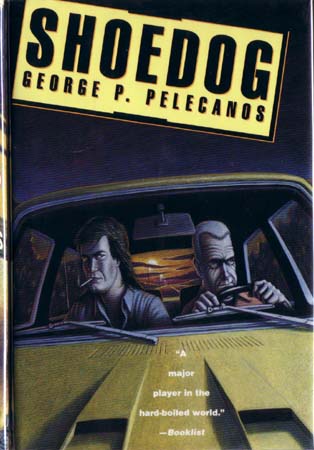 I've had a slow start in 2006. Here's the book read to date:
- A Gesture Life, Chang-rae Lee. Fiction, 1-4, 356
- Shoedog, George Pelecanos. Thriller, 1-7, 200
- The Hearing, John Lescroart. Legal Thriller, 1-11, 451
- The Second Chair, John Lescroart. Legal Thriller, 1-14, 387
I like Lee. I didn't think this book was quite as good as Aloft, but it's far, far better than most fiction being written today. Shoedog is an early Pelecanos; his third book. Clearly evident in this thriller are Pelecanos' economical style and rapid pacing, which he masters by his sixth book, King Suckerman.
Lescroart is something of a guilty pleasure. Lescroart's skill in developing characters more than makes up for the somewhat improbable plots.
Sunday, January 08, 2006
Final thoughts on 2005

 A few thoughts on the New York Times, the National Book Awards and the Booker Prize:
 The Times, whose Books page I visit daily on the web, listed four books that I read this year among its 10 best book of 2005: Ian McEwan’s Saturday, Veronica by Mary Gaitskill, Zadie Smith’s On Beauty and The Year of Magical Thinking by Joan Didion. McEwan and Didion belong there. Although I did not list either book among my very best reads of the year, they were certainly in the running. But I didn’t care for Zadie Smith’s On Beauty. In particular, I did not find her characters believable. I have just about concluded I am not a Z. Smith fan. As for Gaitskill’s Veronica, I thoroughly disliked this book, a fictional account of a whiny former model. I didn’t find it the least compelling. I did find it tiresome.
Veronica also made the shortlist for the National Book Awards’ best fiction of 2005. That was a sorry lot. I wouldn’t recommend any of the five. If forced to choose, I preferred The Trance, a fictional account of the Patty Hearst kidnapping. I was disappointed in E.L. Doctorow’s The March. And I absolutely hated 2005 award winner Europe Central. I came close to putting it down a dozen times. Reading it to completion felt like a life sentence. It was one of those intentionally difficult books that I thoroughly dislike. Don’t bother. I was indifferent to Holy Skirts by Rene Steinke. Four of the five nominees were historical fiction i.e. fictional accounts with historic events as the backdrop, such as
If you must read historical fiction, pick up Julian Barnes’ Arthur & George, about Sherlock Holmes’ creator Sir Arthur Conan Doyle. Barnes gets it right. This is a terrific book that should have won the Booker Prize. My second choice would have been McEwan’s Saturday, which wasn’t on the shortlist, or Ali Smith’s The Accidental. I did not like Smith’s Hotel World, but this was a cool, creepy book. Another second choice (yes, I know that makes three second choices) would be Kauzo Ishiguro’s Never Let Me Go. OK, it was cool and creepy, too. Masterfully told. I find Ishiguro problematic as an author. I never did understand his Unconsoled, but when he nails it, as he did with Never Let Me Go, he nails it. I didn’t read the other two books on the Booker shortlist, including Banville’s winning submission. Based on a few dozen reviews of Banville’s book, I don’t plan to pick it up.
And final thoughts on 2005 . . .
And, if you were wondering, 126 books in 2005 compares with 123 in 2002 and 124 in 2003. The 142 books read in 2004 is a four-year high.
Saturday, January 07, 2006
Best Reads of 2005


- The Painted Drum
- The
- The Making of an Ink-Stained Wretch
- The
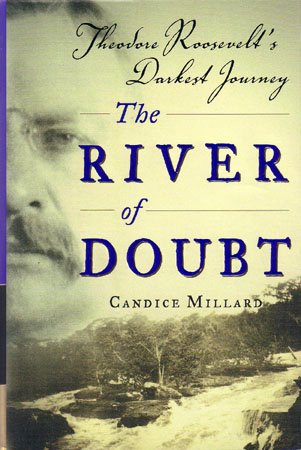
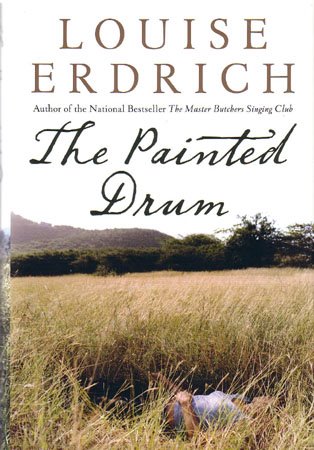
I approach every book with the same simple request: Tell me a story. I want engaging characters, a compelling plot (or compelling characters and an engaging plot, either way) and narrative purity. I don’t like artifice or obscurity or experimentation for the sake of experimentation*. Ultimately, I always ask, “Was it a good read?” A number of books that I read in 2005 met that standard; four were exceptional. The four, my Best Reads of 2005, are: Louise Erdrich’s The Painted Drum, Michael Connelly’s The Lincoln Lawyer; The Making of an Ink-Stained Wretch by Jules Witcover and The River of Doubt by Candice Millard.
These four books cover a range of authorial styles and genres. There are two widely different novels, a biography and an adventure tale-cum-biography. Erdrich’s novel aspires to literary excellence. The Lincoln Lawyer is a courtroom thriller. Witcover’s biography delves into politics and journalism—a delightful double-double. And The River of Doubt is a true adventure tale featuring, as a definite bonus, one of my favorite past presidents.
At first, I was uncertain about The Painted Drum. Erdrich seemed to have abandoned her traditional, fertile field of native American life. It was only a feint; the main character, a painted drum, was waiting just off stage. When the drum makes it appearance, 40 pages into the book, we are off on an enchanting, evocative tale. A powerful narrative arc, vivid characters (customary with Erdrich) and a compelling insight into native American life (also customary) are the rich rewards awaiting the reader. I don’t place this book on the same level as
Connelly had two books appear in 2005: The Closers and The Lincoln Lawyer. The Washington Post selected The Closers as one of its best books of the year, so why did I give the nod to The Lincoln Lawyer? Because it was the most recent book by Connelly I’ve read and, with Connelly, his best book is the last one you read. In the past 10 years Connelly has emerged as the leading practitioner of the police procedural. Much of his success is because (forgive me, Michael) he transcends the genre. Book after book, Connelly gives us riveting plots, memorable characters and a dash of social commentary. If you are unfamiliar with Connelly, grab his first book, The Black Echo, and work your way through his oeuvre.
Witcover won me over when I met him at the National Press Club’s annual book fair. I asked him to sign a copy of his recently released biography. “Were you an ink-stained wretch?” he asked. What followed was a brief synopsis of my journalistic career. Witcover listened intently, disregarding the norm that insists any discussion at a book signing is about the author not the reader. But it is exactly that inquisitive nature, which Witcover revealed this past November, that made him one of our preeminent political journalists for a generation. Witcover’s career roughly coincides with my awareness of and interest in presidential politics and this book is strongest in dwelling on those campaigns in the 70s that are of the greatest emotional and intellectual resonance with me. Equally as interesting as his re-telling of 50 years of political coverage is when he pulls back the curtain to talk about life as a newspaper reporter long before the advent of Fox News, cells phones and blogs.
I love true adventure tales, what Maureen Corrigan dubs the “male extreme-adventure tale”—he-man exploits of extreme derring-do and occasional foolishness. The genre is typified by such superb books as Jon Krakauer’s Into Thin Air. The River of Doubt is just such a “male extreme-adventure tale”, but with an added bonus. It’s also the account of Teddy Roosevelt’s journey down an uncharted river in
Here’s a few other books I read in ‘05 that are well worth your attentio
| Fiction
| Non-Fiction
And a few disappointments:
|
The first two months of 2005 were devoted to re-reading works of favorite fiction . . . Slaughterhouse Five, My Antonia, Morgan’s Passing and others. It was a rewarding two months.
*Michael Cunningham’s Specimen Days is an excellent example of experimentation for the sake of experimentation. He’s a superb wordsmith. There are brilliant phrases, beautiful passages, in this novel, but to no good end. It is a hopeless jumble of a novel. Bad is another description that comes to mind. On the flip side, Never Let Me Go by Kazuo Ishiguro is a perfect example of a writer in tune with the reader. He never leaves us guessing, but never tips his hand too soon. Just as we began to understand what’s happenings he confirms our realization. Ishiguro deftly handles the narrative.
Friday, January 06, 2006
2005 Reading List
1. Don Quixote, Cervantes (trans. Edith Grossman). Fiction 1-9 940.
2. The Book of the Dun Cow, Walter Wangerin, Jr. Fiction 1-12 241.
3. Slaughterhouse Five, Kurt Vonnegut Jr. Fiction 1-15 205.
4. Nixon, The Education of a Politician 1913-1962, Stephen Ambrose. Biography 1-18 674.
5. My Ántonia, Willa Cather. Fiction 1-20 419.
6. The Wind in the Willows, Kenneth Grahame. Fiction 1-22 241.
7. Morgan’s Passing, Anne Tyler. Fiction 1-24 311.
8. Collapse, Jared Diamond. Social history 1-26 525.
9. The Age of Innocence, Edith Wharton. Fiction 1-30 287.
10. Shelf Life, Suzanne Strempek Shea. Books on Books 1-31 221.
11. Get Shorty, Elmore Leonard. Thriller 2-1 292
12. The Spy Who Came In From The Cold, John le Carre. Espionage 2-4 256
13. Moanin’ at Midnight, The Life and Times of Howlin’ Wolf,
James Segrest and Mark Hoffman. Biography 2-8 325
14. Martin Van Buren, Ted Widmer. Biography 2-13 171
15. Sophie’s Choice, William Styron. Fiction 2-15 515
16. Outwitting History, Aaron Lansky. Books on books 2-18 312
17. Cannery Row, John Steinbeck. Fiction 2-19 208
18. Caribou Rising, Rick Bass. Nature 2-21 154
19. The Pickwick Papers, Charles Dickens. Fiction 2-28 801
20. Bloodlines, Jan Burke. Mystery 3-4 465
21. Skeleton Man, Tony Hillerman. Mystery 3-7 241
22. Lincoln and Whitman, Daniel Mark Epstein. History 3-8 339
23. Fleshmarket Alley, Ian Rankin. Mystery 3-10 420
24. Saturday, Ian McEwan. Fiction 3-13 279
25. Snow, Orhan Pamuk. Fiction 3-19 426
26. The Forgotten Man, Robert Crais. Mystery 3-24 342
27. Men and Cartoons, Jonathan Lethem. Fiction 3-25 160
28. The Oregon Trail, David Dary. History 3-28 332
29. War Trash, Ha Jin. Fiction 3-29 350
30. Playing With Fire, Peter Robinson. Mystery 4-2 354
31. Strange Affair, Peter Robinson. Mystery 4-5 368
32. The Time Traveler’s Wife, Audrey Niffenegger. Fiction 4-10 536
33. Drama City, George Pelecanos. Fiction 4-12 291
34. Extremely Loud & Incredibly Close, Jonathan Safran Foer. Fiction 4-15 326
35. Mindscan, Robert Sawyer. Speculative Fiction 4-18 295
36. The Position, Meg Wolitzer. Fiction 4-21 307
37. The Sign of the Book, John Dunning. Mystery 4-24 353
38. Aloft, Chang-rae Lee. Fiction 4-27 343
39. Negro League Baseball, Neil Lanctot. Baseball 4-28 379
40. Ultramarathon Man, Dean Karnazes. Running 4-30 277
41. Singularity Sky, Charles Stross. Speculative Fiction 5-2 313
42. Garlic and Sapphires, Ruth Reichl. Auto-biography 5-4 328
43. Rules for Old Men Waiting, Peter Pouncey. Fiction 5-6 208
44. The Old Ball Game, Frank Deford. Baseball 5-9 224
45. The Seville Communion, Arturo Perez-Reverte. Mystery 5-11 375
46. The Geographer’s Library, Jon Fasman. Mystery 5-16 372
47. The Closers, Michael Connelly. Mystery 5-19 403
48. Bangkok Tattoo, John Burdett. Mystery 5-22 302
49. How To Be Alone, Jonathan Franzen. Essays 5-23 278
50. The Complete Western Stories of Elmore Leonard. Short Stories 5-23 528
51. Captain Alatriste, Arturo Perez-Reverte. Adventure 5-24 253
52. The Hot Kid, Elmore Leonard. Thriller 5-29 312
53. Wilt, 1962, Gary M. Pomerantz. Basketball 5-30 223
54. The History of Love, Nicole Krauss. Fiction 6-4 255
55. A Long Way Down, Nick Hornby. Fiction 6-7 256
56. North, Frederick Busch. Fiction. 6-10 302
57. Thomas Jefferson, Christopher Hitchens. Biography. 6-11 188
58. George Washington, Paul Johnson. Biography. 6-16 123
59. The Mysterious Flame of Queen Loana, Umberto Eco. Fiction 6-16 449
60. The Plot Against America, Philip Roth. Fiction 6-21 391
61. Specimen Days, Michael Cunningham. Fiction 6-23 305
62. The Diezmo, Rick Bass. Fiction 6-25 208
63. One Shot, Lee Child. Thriller 6-27 276
64. The Jane Austen Book Club, Karen Joy Fowler. Fiction 7-2 250
65. Native Tongue, Carl Hiaasen. Fiction 7-6 481
66. What We Talk About When We Talk About Love, Raymond Carver. Fiction 7-11 159
67. The Dante Club, Matthew Pearl. Fiction 7-15 367
68. A Good Scent From A Strange Mountain, Robert Olen Butler.
Fiction 7-17 249
69. The Colonel and Little Missie, Larry McMurtry. Fiction 7-19 229
70. The Polysyllabic Spree, Nick Hornby. Books on Books 7-22 140
71. The Accidental, Ali Smith. Fiction 7-25 306
72. No Country For Old Men, Cormac McCarthy. Fiction 7-27 306
73. The Big Over Easy, Jasper Fforde. Fiction 7-30 398
74. In Evil Hour, Garbriel Garcia Marquez. Fiction 8-1 183
75. The Dew Breaker, Edwidge Danticat. Fiction 8-3 242
76. Sunlight at Midnight, St. Petersburg and the Rise of Modern
Russia, W. Bruce Lincoln. History. 8-9 365
77. Absent Friends, S.J. Rozan. Mystery 8-10 367
78. Crusader’s Cross, James Lee Burke. Mystery 8-14 325
79. Benjamin Harrison, Charles W. Calhoun. Biography 8-14 166
80. Accelerando, Charles Stross. Speculative Fiction 8-21 390
81. The Summer He Didn’t Die, Jim Harrison. Fiction 8-24 277
82. Kremlin Rising, Vladimir Putin’s Russia and the End of Revolution, Peter Baker and Susan Glasser. Current Events 8-25 382
83. Soul Circus, George Pelecanos. Thriller 8-28 341
84. Crossworld, Marc Romano. Non-Fiction 8-30 225
85. In A Dry Season, Peter Robinson. Mystery 8-31 420
86. Finding Moon, Tony Hillerman. Fiction 9-3 319
87. The Wailing Wind, Tony Hillerman. Mystery 9-5 232
88. Tell No One, Harlan Coben. Mystery 9-7 339
89. 1776, David McCullough. History 9-10 294
90. A Memory of War, Frederick Busch. Fiction 9-16 352
91. American Scoundrel, The Life of the Notorious Civil War General Dan Sickles, Thomas Keneally. Biography 9-20 356
92. Gifts, Ursula K. LeGuin. Fiction 9-20 274
93. Brotherly Love, Pete Dexter. Fiction 9-23 274
94. A Dangerous Friend, Ward Just. Fiction 9-27 256
95. James Monroe, Gary Hart. Biography 10-2 150
96. On Beauty, Zadie Smith. Fiction 10-3 443
97. The March, E.L. Doctorow. Fiction 10-7 363
98. Arthur & George, Julian Barnes. Fiction 10-11 360
99. Dr. Seuss & Mr. Geisel, Judith and Neil Morgan. Biography 10-17 293
100. The Lincoln Lawyer, Michael Connelly. Thriller 10-17 404
101. The Year of Magical Thinking, Joan Didion. Memoir 10-19 227
102. Veronica, Mary Gaitskill. Fiction 10-21 227
103. Tribeca Blues, Jim Fusilli. Mystery 10-22 273
104. Trance, Christopher Sorrentino. Fiction 10-28 513
105. Flush, Carl Hiaasen. Fiction 10-29 263
106. Beethoven, Edmund Morris. Biography 11-2 229
107. Holy Skirts, Rene Steinke. Fiction 11-4 358
108. Cinnamon Kiss, Walter Mosley. Fiction 11-5 312
109. Caravaggio, Francine Prose. Biography 11-6 146
110. Europe Central, William T. Vollmann. Fiction 11-16 752
111. The Sinister Pig, Tony Hillerman. Fiction 11-18 228
112. Anansi Boys, Neil Gaiman. Speculative Fiction 11-22 334
113. The River of Doubt, Candice Millard. Biography 11-26 353
114. Leave Me Alone, I’m Reading, Maureen Corrigan. Books on Books 11-30 184
115. The Painted Drum, Louise Erdrich. Fiction 12-2 276
116. Memories of My Melancholy Whores, Gabriel Garcia Marquez. Fiction 12-4 115
117. The Education of a Coach, David Halberstam. Sports/ Biography 12-5 272
118. The Lighthouse, P.D. James. Mystery 12-9 323
119. Never Let Me Go, Kazuo Ishiguro. Fiction 12-13 288
120. Andrew Jackson, H.W. Brands. Biography 12-18 560
121. Garnethill, Denise Mina. Mystery 12-18 349
122. Tooth and Claw, T.C. Boyle. Short Stories 12-20 284
123. Love Medicine, Louise Erdrich. Fiction 12-26 272
124. The Making of an Ink-Stained Wretch, Jules Witcover. Biography. 12-28 332
125. A Firing Offense, George Pelecanos. Mystery 12-29 216
126. Nick’s Trip, George Pelecanos. Mystery 12-31 276
127. Given, Wendell Berry. Poetry 12-31 147