Friday, February 18, 2011

Early reader


Photos often need little explanation. This suffices here: my granddaughter reading.

Thursday, February 17, 2011

Snared by The Darkness That Comes Before; a reading challenge update

Book 20: The Darkness That Comes Before by R. Scott Bakker

As a rule I avoid the fantasy series by such prolific authors as Robert Jordan and George R. R. Martin. I am put off by the impossible to pronounce names of characters as well as the length of the individual books that stretch into yet another book and yet another.

So how did I find myself in my current situation? I just finished reading The Darkness That Comes Before by R. Scott Bakker. I find myself 577 pages into his The Prince of Nothing series and I still have two books to read.

How did I wind up in this situation? My oldest son sent me the series as a Christmas present. My youngest is thrilled, waxing enthusiastically about the characters in this fantasy trilogy that he claims is his “favorite.”

The call of blood must be answered.

Yet, I admit to some reluctance even after I started reading. The convention for a fantasy series of this nature demands that the significance of the book’s opening be murky. Who is this man? His mission? Who are these people? What is this world? How the fuck do you pronounce this name?

Yet within 100 pages, perhaps fewer, I found myself totally absorbed by this story of a great Holy War, of magicians and mighty barbarian warriors. Bakker’s feat in fashioning this world and this cast of characters is impressive. The book is totally absorbing and, despite its vast size, a quick read because of the author’s skill in pacing and in storytelling.

So much so that I within minutes of taking down book one I have taken up book two.

And as with me, so with you, there is more to come, my friends, Much more. In the fullness of time.

+ + +

The completion of The Darkness That Comes Before advances me in two reading challenges that I have taken up in 2011.

The first challenge was issued by The Roof Beam Reader. The 2011 TBR (To Be Read) Pile Challenge is to read 12 books from your to-be-read pile in 12 months. I have read two of my 12 since undertaking the challenge. This is where I stand:

1. Lonesome Dove by Larry McMurtry
2. Gone With the Wind by Margaret Mitchell
3. War and Peace by Mr. Tolstoy
4. Harry Potter and the Sorcerer's Stone by J.K. Rowling
5. The Darkness That Comes Before by R. Scott Bakker
6. Under the Dome by Stephen King
7. White Noise by Don Delillo
8. Yogi Berra Eternal Yankee by Allen Barra
9. The Welsh Girl by Peter Ho Davies
10. Winter in the Blood by James Welch
11. Human Croquet by Kate Atkinson
12. Emotionally Weird by Kate Atkinson

Alternates:
Reservation Road by John Burnham Schwartz
Tales of Burning Love by Louise Erdrich

Further progress in this challenge awaits the completion of Bakker’s Prince of Nothing series.

The second challenge is the Chunkster Challenge, specifically the “Mor-book-ly Obese Challenge. I am attempting to reading eight books all with a minimum page count of 450 pages and three of those eight must be at least 750 pages.

Larry McMurtry’s Lonesome Dove weighed in at more than 900 pages. Bakker’s The Darkness That Comes Before (paperbound) was 577 pages (not counting appendices).

Six books remaining in this challenge, two of more than 750 pages.

Tuesday, February 15, 2011

National Book Festival to be Two-Day Event, Sept. 24-25

February 7, 2011

The 11th annual National Book Festival, organized and sponsored by the Library of Congress, will become a two-day event this year. The festival will be held on the National Mall between 9th and 14th Streets on Saturday, Sept. 24, 2011, from 10 a.m. to 5:30 p.m. and on Sunday, Sept. 25 from 1 p.m. to 5:30 p.m., rain or shine. The event is free and open to the public.

Several festival-related events will take place in the weeks preceding the beloved yearly festival, which celebrates the joys of books and reading. More information will be posted as planning for the festival continues at the festival’s website, www.loc.gov/bookfest.

"Fans of the National Book Festival have urged us to make it a weekend-long event for many years," said Librarian of Congress James H. Billington.

"Last September, during our wonderful 10th-anniversary celebration, we crossed the threshold of a million festival-goers over the life of the festival – and we look forward to welcoming millions more festival-goers of all ages for many years to come," Billington said. Some 150,000 book fans attended the festival of 2010.
The 2011 National Book Festival will feature award-winning authors, poets and illustrators in several pavilions dedicated to categories of literature. Festival-goers can meet and hear firsthand from their favorite authors, get books signed, have photos taken with mascots and storybook characters and participate in a variety of learning activities.

The Pavilion of the States will represent reading- and library-promotion programs and literary events in all 50 states, the District of Columbia and the U.S. trusts and territories.

The popular Let’s Read America Pavilion will offer reading activities that are fun for the whole family. The Library of Congress Pavilion will showcase the cultural treasures to be found in the Library’s vast online collections and offer information about popular Library programs.

The 2011 National Book Festival will be made possible through the support of David Rubenstein, co-chairman of the National Book Festival Board and many other generous supporters.

The Library of Congress, the nation’s oldest federal cultural institution, is the world’s preeminent reservoir of knowledge, providing unparalleled collections and integrated resources to Congress and the American people. Many of the Library’s rich resources and treasures may be accessed through the Library’s website, www.loc.gov, and via interactive exhibitions on myLOC.gov.

Sunday, February 13, 2011

Swamplandia!, Running the Books and Known to Evil


Book 17: Swamplandia! by Karen Russell

I confess, I don't get it.  Swamplandia! by Karen Russell that is.

Oh, I understand the pre-publication hype that accompanied this novel. Russell is one of those "20 Under 40" writers chosen by The New Yorker as the new literary vanguard. 

Yet, for me, the reality of the novel doesn't meet its expectations.

Swamplandia! is the story of the Bigtree family. There's mom and dad, Hilola and Chief, and their three children, Kiwi, Osceola and Ava.  The family, who live on an island, run a little tourist attraction. Hilola wrestles gators and dives into a pit full of the creatures.  Chief is the master of ceremonies, while the children perform various functions from selling popcorn to helping with the lights.

The enterprise falls on hard times when Hilola dies of cancer. Kiwi and Chief head to the mainland. Both seeking work to help offset the family's mountain of debt. Chief finds employment in a nearby casino, while Kiwi goes to work for the World of Darkness, a newly opened amusement park that's pulled all the tourist away from the gators.

Ava and Ossie are left to sort for themselves on the island.  Ossie falls in love with a ghost and later elopes with her immaterial lover. Ava, accompanied by a weird island Bird Man, sets off to rescue Ossie from the depths of the underworld. She learns, of course, to no one's surprise that there is no ghost or no underworld, but that hell is here on earth.

Russell's snarky take on the tourists who visit Swamplandia! and the World of Darkness reveal the influence of Jonathan Franzen.  I also thought of John Irving while reading this novel.  Remember Irving's ongoing fascination with bears and wrestlers? Here's its gators and ghosts.

It's difficult to understand exactly what Swamplandia! is meant to add up to.  A longish story on Louis Thanksgiving, the dead Dredgeman that Ossie's fallen in love with, takes up a chunk of the novel.  Otherwise, it's Ava in pursuit of the missing Ossie, cameos by the Chief and Kiwi learning to swap insults with the best of them while adjusting to life on the mainland.

I didn't much like Swamplandia! or its gator or ghosts.

 Book 18: Running the Books by Avi Steinberg

Based on its subtitle, "The Adventures of an Accidental Prison Librarian," I expected more about books in Running the Books. Books play a role, but a minor one.

Running the Books is really a memoir of a Harvard-educated Jewish nerd's experience working in a Boston prison library for two years. 

So much of the book seems predictable: conflicts with the guards, developing inappropriately close relationships with a few of the prisoners and prisoners who make lavish plans for their future only to be gunned down on the outside or fall victim to the drugs that landed them in prison in the beginning.

Running the Books falls short of being a compelling work. The best that can be said is that it's mildly interesting.

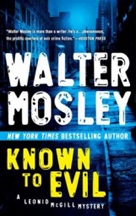
Book 19: Known to Evil by Walter Mosley

Leonid McGill, the reluctant hero of Walter Mosley's Known to Evil, is one of Mosley's best characters in many years.

Once a "fixer" for the New York underworld, McGill is attempting to go straight, launching a new career as a P.I.   But McGill's past, and the people that populated it, have a way of holding on.  They're either asking favors of McGill or he's having to turn to them for favors as he unravels the current mystery or protects his family from their own misdeeds.

The mystery at the heart of Known to Evil,  why someone is trying to kill a New York college girl, is merely a framework for these shady figures from McGill's past to re-enter his life.  All of which provides a satisfying friction as McGill is forced to make choices he thought he'd put behind him.

When Mosley truly devotes himself fully to the thriller, he's as good as any genre writer today. Known to Evil displays Mosley's talent at its fullest and finest.

Monday, February 07, 2011

Lonesome Dove by Larry McMurtry an American epic

On the way to San Antonio they passed two settlements -- nothing more than a church house and a few little stores, but settlements anyway, and not ten miles apart.

"Now look at that," Augustus said. "The dern people are making towns everywhere. It's our fault, you know."

"It ain't our fault and it ain't our business, either," Call said. "People can do what they want."

"Why, naturally, since we chased out the Indians and hung all the good bandits," Augustus said. "Does it ever occur to you that everything we done was probably a mistake? Just look at it from a nature standpoint. If you've got enough snakes around the place you won't be overrun with rats or varmints. The way I see it, the Indians and the bandits have the same job to do. Leave'em be and you won't constantly be having to ride around these dern settlements."

"You don't have to ride around them," Call said. "What harm do they do?"

"If I'd have wanted civilization I'd have stayed in Tennessee and wrote poetry for a  living," Augustus said. "Me and you done our work too well. We killed off most of the people that made this country interesting to begin with."

Book 16: Lonesome Dove by Larry McMurtry

There is a Dickensian quality to Larry McMurtry's elegiac epic of the dying Western frontier.

Dickensian in the vivid minor characters that inhabit this Pulitzer Prize-winning novel. From Blue Duck, a bloodthirsty Indian who leaves a trail of death in his path, to Lippy, the piano player in the whorehouse with the leaky stomach; from Po Campo, the trail drive cook who refuses to ride an animal, to all the cowboys and Indians and sporting women, who make this novel such a vivid and interesting stew.

Dickensian, too, in its scope. Lonesome Dove is principally the story of Augustus McCrae and Woodrow Call, two former captains in the Texas Rangers, who are now leading a cattle drive from Texas to Montana. But it is also the story of Jake Spoon, who once rode with McCrae and Call, and has now fallen into bad ways. Lorena Wood, a sporting woman who dreams of San Francisco. July Johnson who rides out of Arkansas in search of justice and a runaway wife. 

Lonesome Dove is nearly a thousand pages in length, yet McMurtry might have written a thousand pages more and still had stories to tell. The stories that McMurtry does consign to these pages are captivating; at once romantic and brutally candid. Death rides the trail with the Hat Creek cowboys as does a taste for sweet-young whores and bad whiskey.

The cowboys battle heat and cold, thirst, grasshoppers, snakes and river crossings, while living in fear of Indians who are rarely seen, but whose promise is always lurking beyond the next hill. The cowboys are a naive and sentimental bunch, given to hard work and long silences.

McCrae and Call are like two halves of one man. McCrae is a garrulous old philosopher and it is impossible to read this novel without conjuring an image of Robert Duvall as McCrae in the TV mini-series. Call is as reticent as McCrae is talkative. He's a brooding man, who wanders away from the campfire each night because of his preference for solitude. 

Lonesome Dove is a novel that will long endure. It is a true American epic, defining the West and its passing, celebrating (and sentimentalizing) the men and women who claimed a hard country during a brief interlude as wildness gave way to civilization.


+ + + + +

Lonesome Dove is the first book I've completed that meets the criteria for two challenges issued by other bloggers. The Chunkster Reading Challenge's Mor-book-ly Obese challenge calls for reading eight chunksters, including three books of 750+ pages. At 945 pages (paperback edition), Lonesome Dove easily meets that requirement.

The second challenge, from Roof Beam Reader, is called the 2011 To Be Read Pile Challenge. The idea is to take 12 books that have been on your bookshelf or "to be read" list for more than a year and actually read those books in 2011. One down, 11 books to go.


1. Lonesome Dove by Larry McMurtry
2. Gone With the Wind by Margaret Mitchell
3. War and Peace by Mr. Tolstoy
4. Harry Potter and the Sorcerer's Stone by J.K. Rowling
5. The Darkness That Comes Before by R. Scott Bakker
6. Under the Dome by Stephen King
7. White Noise by Don Delillo
8. Yogi Berra Eternal Yankee by Allen Barra
9. The Welsh Girl by Peter Ho Davies
10. Winter in the Blood by James Welch
11. Human Croquet by Kate Atkinson
12. Emotionally Weird by Kate Atkinson

Alternates:
Reservation Road by John Burnham Schwartz
Tales of Burning Love by Louise Erdrich

Thursday, February 03, 2011

Mockingbird a powerful and affecting story of persistence and loss

Book 15: Mockingbird by Kathryn Erskine

 Winner of the 2010 National Book Award for Young People's Literature, Mockingbird by Kathryn Erskine takes place in a small Virginia community in the weeks following a shooting at the local middle school.

Two students and a teacher were killed in the shooting. The story is told through the eyes of a 10-year-old girl, Caitlin whose brother was among those slain. Caitlin has Asperger's syndrome.

The choice of Caitlin as the narrator is at once a risky, yet inspired decision on Erskine's part.  Risky because of the inherent difficulty in portraying Caitlin in a realistic manner. Erskine must convince the reader that the character on these pages represents an authentic inner portrayal of an autistic child. That she does exactly this says much about her talent as a writer and her keen observational skills.

Inspired because Caitlin interprets the world quite literally. Told to experience the world as if she was wearing someone else's shoes, she wonders how they would ever fit. She sees the world in black and white. Too, Caitlin is plain spoken. She says what she thinks. Although she intends no harm, some find Caitlin's candor rude.

Because a child's understanding is limited, because a child is inclined to remark on the obvious, a child narrator allow an author to furnish the reader the story in small pieces, allowing tension to build and understanding to emerge page by page rather than in a rush. Like a chess grandmaster, Erskine is able to use Caitlin in such a satisfying fashion.

Caitlin's brother, Devon, helped her cope with the world. Now that he is dead, she must find her on way. We follow her as she seeks to make friends and to find closure, both for herself and her father, who is virtually paralyzed with anger and grief at the cruel and unexpected death of his son.

Caitlin befriends a young boy. We later learn that his mother was the teacher who died in the shooting. She also crosses the path of another boy, a classmate, whose cousin was one of the shooters. Perceived as evil, although he had no hand in the shooting, the boy is shunned by other children.

Alongside Caitlin, we learn a little something about finesse in human relationships and in the importance of persistence -- an attribute that Caitlin is really good at.

"You have to Work At It . . . ," Caitlin tells her father. "You have to try even if it's hard and you think you can never do it and you just want to scream and hide and shake your hands over and over and over."

A Virginia resident, Erskine developed the idea for Mockingbird following the shootings of 33 people at Virginia Tech University at Blacksburg in April, 2007. She has fashioned a powerful and affecting story, filled with humor and pathos.  It is a book not just for any age, but for the ages.

                                                                                  - - -

Erskine is among the participants at the Virginia Festival of the Book in Charlottesville. She will appear Thursday, March 17, at Buford Middle School.

Tuesday, February 01, 2011

Al Jaffee's Mad Life; Lippman's I'd Know You Anywhere

Book Thirteen: Al Jaffee's Mad Life by Mary-Lou Weisman

In the prologue of her biography of Mad Magazine cartoonist Al Jaffee, Mary-Lou Weisman introduces the concept of the "plausible impossible." It's the concept that allows Bugs Bunny to run off a cliff, across a yawning chasm and onto the other side.

"It is the guiding comic principle -- at once thrilling and ridiculous -- that lies at the heart of cartooning," Weisman writes. "This willing suspension of disbelief has a logic all its own. What keeps Bugs aloft, what makes the impossible plausible, is not looking down.

"It is a talent that eighty-nine-year-old Al Jaffee has displayed in his life as well as his art."

Indeed. Born in Savannah, Georgia, Jaffee was reared for almost six years in a Lithuanian shetl. He lived -- vermin-infest and always hungry -- among extreme poverty and extreme neglect on the part of his mother. Before his 12th birthday and the outbreak of war, Jaffee returned to America, where he was reunited with his father.

But the reunion was brief.  His father, once a successful businessman, had fallen on hard times and Jaffee and his two brothers (a fourth returned to America months later) were shuttled between family members, where they were sometimes welcome, sometimes not.

Jaffee also had trouble adjusting to his American classmates as well as to the culture of his homeland that now felt like a foreign country.  He never truly felt at home and always feared that he would once again be uprooted.

Art emerged, both in Lithuanian and later in America, as a way for Jaffee to find acceptance. His talent also led to his admission to a special New York high school. There he met Will Elder and Harvey Kurtzman, who became his colleagues on the Mad staff.

Before joining Mad, Jaffee worked at Timely Comics for Stan Lee where he wrote and drew Patsy Walker
 
Jaffee established his reputation as a great American cartoonist in the pages of Mad, principally as the creator of the Mad fold-in and the feature Snappy Answers to Stupid Questions.

Weismnan's biography is an engrossing and loving tribute to a talented cartoonist and absolute proof that the plausible impossible is possible as long as you don't look down.

Book Fourteen: I'd Know You Anywhere by Laura Lippman

I'd Know You Anywhere ranks as Laura Lippman's finest work. 

This tension-filled and disturbing novel, is the story of Eliza Benedict, the only survivor among a series of young girls kidnapped, raped and murdered by a West Virginia youth.

Since that event, years before, Eliza has managed to get on her life back on track. She is happily married, living with her husband and two children in Bethesda, Maryland. But there is a shadow looming.

Walter, who kidnapped and raped Eliza, and now grown old in prison, is scheduled to be executed soon. He reaches out to Eliza. It's clear he wants something, but what is not immediately apparent. Yet Eliza wants something too -- answers. She wants to know why the other girls were murdered and she was not. The question haunts her.

Lippman is skillful at ratcheting up the tension through the various assaults on Eliza's happy and orderly life. There is not only Walter's unwelcome intrusion into her life, but that of a woman who has taken up Walter's cause and is campaigning against the death penalty; an unprincipled journalist/blogger; and the mother of one of the victims, angry because Eliza might have saved her daughter, but did not.

I'd Know You Anywhere is a superb and riveting thriller.

Wednesday, January 26, 2011

Accepting the Chunkster Challenge

Early this month I wrote about my discovery of bloggers issuing reading challenges to other bloggers and readers.
I accepted a challenge offered by the Roof Beam Reader, the 2011 to be Read Pile Challenge.

Now, I'm accepting another -- the Chunkster Reading Challenge.

This challenge is about reading big books. A "chunkster" is defined as a book, fiction or non-fiction, that's 450 pages long or longer.

The challenge has different levels: the Chubby Chunkster is to read four books 450+ pages; the Plump Primer is to read six; the Do These Books Make My Butt Look Big? challenge is to read six books, two between 450-550 pages, two between 551-750 pages and two books of more than 750+ pages; and the Mor-book-ly Obese challenge calls for reading eight chunksters, three of 750+ pages.

I may be crazy, but I'm going to strive to meet the Mor-book-ly Obese challenge. In part, because the Chunkster Challenge and the Roof Beam Challenge overlap. In part, because, well, I like the challenge.

War and Peace and Lonesome Dove will make up two of those eight chunksters. I have others in mind and will furnish updates when I get started with the challenge in February.

I should also mention the Foodie's Reading Challenge. I've already contributed one book, Four Fish, to this site and hope to add more as 2011 unfolds.

Tuesday, January 25, 2011

Pike shines in starring role in The Sentry


Book Twelve: The Sentry by Robert Crais

Joe Pike began his literary life as a sidekick. He was Robin to Elvis Cole's Batman. Suddenly, in the span of three books all that's changed.

Pike is now a leading man. And his star power has never been more in evidence than in The Sentry, the newest thriller from author Robert Crais.

As the novel opens, Pike saves a restaurant owner from a severe beating by two gang members.  As a result of his timely intervention, Pike meets the restaurant owner's niece.  They share a quiet moment, she confides in him -- sharing a picture of her daughter -- and Pike asks if he can see her again. She says yes, but that meeting doesn't happen again until very late in the novel.

The young woman and her uncle vanish. Pike believes they've been kidnapped by gang members seeking retribution. But, as with any good thriller, things aren't what they seem. Pike and Cole soon discover that the couple aren't fleeing an L.A. gang, but a psychopathic killer who is working for a Bolivian drug cartel.

There are many twists and turns en route to the finale, delivered with typical brio by Crais. 

Fans of Elvis Cole, and there are many, will be pleased to know that he's very much a part of The Sentry. He's clearly not the star of the show, but his appearance is far more than a cameo.

Cole plays a key role late in the novel as deadly events unfold. And, with his wise cracks and steady patter, Cole is the perfect contrast to the silent, lethal Joe Pike.

The Sentry is another stellar effort from Robert Crais.

Sunday, January 23, 2011

Gordon-Reed on Andrew Johnson; Carl Hiassen on the cult of celebrity

Book Ten: Andrew Johnson by Annette Gordon-Reed

Randy Newman's album, Good Old Boys, is the perfect antidote to Annette Gordon-Reed's biography of Andrew Johnson.

An antidote isn't necessary due to anything Gordon-Reed has done, but rather it is needed due to the pernicious racism of the 17th President of the United States.

Newman explodes the notion of racism in his music. Johnson dashed the dreams of thousands of Freedmen in the heady days following the end of the American Civil War and set back their cause for nearly a century.

"Johnson's attitude toward blacks, or 'niggers' as he termed them in private conversation, was resolutely negative," writes Gordon-Reed. "It would be impossible to exaggerate how devastating it was to have a man who affirmatively hated black people in charge of the program that was designed to settle the terms of their existence in post-Civil War America."

Despite the task of writing a biogrpahy about such an unappetizing American politician as Johnson, Gordon-Reed provides a balanced portrait of the man who succeeded Abraham Lincoln as president. Her work fits admirably alongside the other uniformly superb biographies that make up Times Books' American Presidents Series. These are small books -- normally under 200 pages -- that focus on the individual's tenure as president.

Gordon-Reed notes, for example, that Johnson was a self-made man. He was born amid extreme poverty and later apprenticed to a tailor. In time, he fled the tailor and his hometown, ultimately migrating to Tennessee where opened his own tailor shop, married and found his way into elective politics.

Johnson was unusual in that when the Civil War broke out, and Tennessee left the Union, he remained loyal, continuing to serve in the U.S. Senate. He was selected Lincoln's running mate for his second term and became president when Lincoln was assassinated. He served only the one term, during which he was impeached and came within a single vote of being unceremoniously removed from office.

Gordon-Reed notes that Johnson believed that the South "never really left the Union because secession was a legal impossibility." Whatever his curious political beliefs, it is true that Johnson betrayed the thousands of African-Americans bound in slavery in the South, and millions of their descendants, by his resolute belief in white supremacy and in his desire to quickly restore the status quo following the war.

It is a sad chapter in American history. One that took generations to set right, if such a wrong can truly ever be set right.

Book Eleven: Star Island by Carl Hiaasen

I can think of few authors who so successfully explode pretension and greed as Carl Hiaasen. And, one should add, explode these fine attributes in such a damnably funny way.

Hiaasen's target in Star Island is the cult of celebrity that enthralls so many Americans today. He takes on narcisstic, talentless pop singers (think Jessica Simpson), whose true talent is their ability to ingest vast quantities of alcohol and drugs and engage in promiscious sex; their entourage from enabling parents to agents to PR flaks; and, finally, the paparazzi who prey on the famous and near-famous because of our endless appetite for scandal, sex, drugs and rock and roll.

The story isn't really important here. A few familiar faces do stroll across these pages, including Skink, the former, Florida governor who has abandoned the State Capitol for the Everglades, and Chemo, the pock-faced murderer with a weed whacker for an arm.

Star Island is funny, very funny. And, as with all Hiaasen's work, the bad guys get their comeuppance and good things happen to good people.

Saturday, January 22, 2011

On Zero History and The Sherlockian

Book Eight: Zero History by William Gibson

Damned if I know what William Gibson is up to in Zero History

It's his third novel to feature Hubertus Bigend, a Belgian who runs the viral marketing and cool-hunting agency, Blue Ant. Bigend made his first appearance in Pattern Recognition in 2003, his second in Spook Country in 2007.


Spook Country also introduced us to Hollis Henry, former lead singer of the fictional '90s band the Curfew. Hollis returns in Zero History, relcutantly back in the employee of Bigend. After the economy crashed Hollis's vow never to work for Bigend again must give way to the prospect of a lucrative payday.

Hollis was exploring "locative art" for Bigend in Spook Country. Now, she's trying to identify the creator of a mystertious "secret brand" of clothing called Gabriel Hounds. 

Also returning from Spook Country is Milgrim. Then a high-end junkie, now in recovery, Milgrim is off on a mission for Bigend that involves military uniforms. It seems there are lots of young men who don't want to be in the military, but who want people to think they are -- and Bigend senses an opportunity to control an important market.

Unfortunately, Miligrim has unintentionally drawn the interest and anger of a former special ops officer who is attempting to corner the market on combat wear as a way of concealing his illicit arms deals.

All this brings a sprawling cast of characters together in a climatic ambush that's over almost before it begins.

In the course of Zero History there's a nifty little surprise associated with Gabriel Hounds and a character from Pattern Recognition. The other delight of Zero History, which has been true of Gibson's work from the beginning, are all his shady, shadowy minor characters, which introduce a decidely Dickensian spirit to his writing.

Gibson once wrote about a not-too-distant future, now he's writing about a present that seems to exist in a parallel universe only a step or two removed from our own. It's all fun and cool, even if I don't understand what it's all about.

Book Nine: The Sherlockian by Graham Moore

I should like The Sherlockian more than I did. It's based on real-life events. A diary and papers belonging to Holmes' creator Arthur Conan Doyle did go missing after Doyle's death. And a foremost Holmes scholar did turn up dead, under mysterious circumstances, after announcing he had recovered Doyle's lost papers.

Author Graham Moore takes us down parallel, but related paths to explain what might have happened to the missing papers and the dead scholar. 

One path involves Harold White, a newly minted member of The Baker Street Irregulars, the world's premiere Holmes society, who is off to investigate the scholar's murder and re-locate the missing diary. The second path involves Doyle and Dracula author Bram Stoker, friends in real life, and recounts what the diary contains (all fictional, of course) and how it came to be missing.

The novel doesn't quite deliver. The tale of Doyle and Stoker is more intriguing than the implausible adventures of Mr. White, who never emerges fully formed as a character. 

Ultimately, White and another character do something that simply does not feel right. It's not merely unlikely, it's improbable. Moore presents it as a satisfying and appropriate conclusion to the novel, but for this reader it was quite the opposite. 

The best thing that can be said about The Sherlockian is that the cover design for its dust jacket is stunning.

Friday, January 21, 2011

Four Fish a chronicle of the poisoning and plundering of the seas


Book Seven: Four Fish by Paul Greenberg

Despite its Seussian title, there is nothing whimsical about Paul Greenberg's 2010 book. Four Fish is a grim reckoning of the world's dwindling fish population.

Four fish that commonly find their way to our dinner table and that have been especially mis-managed -- salmon, tuna, bass and cod -- provide the framework for Greenberg's chronicle of the poisoning and plunder of the seas. It's all here: the destruction of native habitat, the overfishing, the decimation of forage fish at the bottom of the food chain, the self-interest and greed.

Not that Four Fish is a screed.  A passionate fisherman, Greenberg provides a balanced account, relating valiant efforts to pull us back from the brink.  Most of those efforts entail some sort of fish farming. Sadly, even here, Greenberg believes we've gotten it wrong; attempting to farm salmon or sea bass, for example, while more suitable and sustainable fish such as barramundi or tilapia have been largely ignored.

Yet the most sobering observation Greenberg makes is how little impact the informed and conscientious consumer may have: "Choosing a fish that is well managed or grown on a farm that uses sound husbandry practices is most definitely personally satisfying. One feels 'good' when one eats 'well' . . . But the public's choosing of 'good' fish in the marketplace has little effect on the actual management of wild fish or the practices of growing farmed ones."

Greenberg writes that consumer awareness campaigns that lead us to leave certain fish off the menu have not significiantly reduced fishing pressure on those species.

But there are steps we can take. In his thoughtful conclusion, Greenberg offers a set of priorities to protect the world's remaining wild fish. Those priorities include "a profound reduction" in worldwide fishing. According to Greenberg, the United Nation estimates the world fishing fleet is twice as large as the oceans can support. He advocates that we move from heavily extractive fishing vessels to an artisanal sector of "respectful fishermen-herders that will steward the species, as well as catch them."

Other suggestions include establishing significiant no-catch areas, global protection of unmanageable species and protection of the bottom of the food chain. He also offers thoughtful principles to guide us as we continue to domesticate fish for human consumption.

Anyone who cares about the food they eat or the state of the world's wild animals will find Four Fish a thoughtful and important book. The challenge is to put the books into the hands of politicians and industry leaders throughout the world who can effect the changes enumerated here and pull us back from the brink of destruction.

Wednesday, January 19, 2011

The Anniversary Man a rewarding thriller

Book 6: The Anniversary Man by R.J. Ellory

As a rule, I don’t like novels about serial killers. And I didn’t much care for R.J.Ellory’s first book, A Quiet Belief in Angels, which – that’s right – was about a serial killer.

Which makes me wonder why I ever read Ellory’s second book, The Anniversary Man, which is also about – altogether now – a serial killer. But I did read it, and although Ellory stepped to the plate with two strikes against him, he wound up delivering, if not a walk-off home run, certainly a nice stand-up double.

 Let’s dispense with the baseball metaphor and just say The Anniversary Man was a solid hit.

Conceit and characters make this book entertaining.  The conceit: someone’s killing people, on the anniversary of past serial killings and in a manner frighteningly similar to those past murders. 

The characters are a lonely cop, Ray Irving, and John Costello, a researcher for a New York newspaper  who survived an attack by the so-called Hammer of God killer when he was 15. His girlfriend was not so fortunate.

The attack left its mark on Costello physically and emotionally. He has a deep-rooted obsession with serial killers and is the first to notice that there’s a pattern to the seemingly random murders.

Costello and Irving form a shaky alliance to catch the killer. Naturally, as the death toll mounts, Costello is Irving’s main suspect.

Ellory manages to deliver a thrilling climax that is altogether fitting without being obvious.

I’ve got a friend urging me to read Ellory’s third novel. Looks like that’s going to happen.

Thursday, January 13, 2011

The Spot and Guitar An American Life

Book Four: The Spot by David Means

Quirky seems too bright a word to describe the short stories of David Means. Offbeat? Unconventional? Bizarre?

All of that. The subject matter isn't the sort of fare dished up by Alice Munro or William Trevor.  Instead, we enter worlds few of us would enter voluntarily. A world of bank robbers and bums, failed actors, pimps and a couple caught in an affair that is going nowhere.

It isn't just the subject matter that's unconventional, but the voices that emerge from each of these stories. In Means' hands, the voices of these people from the fringe of society feels so authentic that the reader experiences a voyeuristic thrill that is deliciously creepy.

Book Five: Guitar An American Life by Tim Brookes

There are two stories in Guitar An American Life.  The first is a biography of the guitar, especially how it attained its place in American music.

Lots of performers you know -- Mother Maybelle, Chet Atkins, Django Reinhardt -- and many more you may not populate these pages.  Brookes tells us how various forms of music -- from wave after wave of Hawaiian performers that inundated the Mainland to rock and roll -- shaped our acceptance and understanding of this instrument that was once seen as a tool of the devil.

The second story is about the efforts of guitar maker from the Green Mountains of Vermont to build a new guitar for Brookes.  It's a surprisingly intimate account and a fascinating look at a creative process that strikes a balance between functionality and art.

Guitar An American Life came to me as a Christmas gift from my oldest son.  It was a title well chosen.

Biblioz.com, Birthday Best Sellers

This is an intriguing website. Type in your birthday and see the New York Times bestsellers that week. Desiree by Annemarie Selinko was the topselling book the week I was born. Followed by A.J. Cronin's Beyond This Place, Too Late the Phalarope by Alan Paton and Time and Time Again by James Hilton.

The Power of Positive Thinking by Norman Vincent Peale was the top-selling work of non-fiction.

D.C. is America's most literate city.

Since moving to Washington, D.C. in 2002, I've often thought it was the best book city in the country. Better than New York. Better than Seattle or Minneapolis. We can boast the most outstanding independent bookstore in the nation, Politics & Prose. What's more, the Smithsonian, Library of Congress and Folger offer an outstanding array of programs. Each fall, there's the National Book Festival on the Mall.

And, what makes it all especially nice from a residents' point of view, is that D.C. is so compact, and the Metro so convenient, that all of the events offered up annually are easy to get to.

Now, in a story this morning, USA Today reports that an annual study finds Washington is America's most literate city.

Wednesday, January 12, 2011

The Long Ships: "It's really good." Really.

Book Three: The Long Ships by Frans G. Bengtsson, translation by Michael Meyer

In his introduction to Fran G. Bengtsson's The Long Ships, author Michael Chabon assures us "it's really good."

Chabon is spot on. It is good. Damn good.

Books like The Long Ships are the reason I read.

Bengtsson was born and raised in the southern Swedish province of Skåne. He published Red Orm on the Western Way in 1941. Red Orm at Home and on the Eastern Way followed in 1945.  The two books first appeared in America and England in 1955 in a single volume titled The Long Ships.

The Long Ships is the story of Red Orm. While still a youth, Orm, a Dane, attempts to prevent Viking raiders from absconding with the family livestock, only to find himself a captive aboard the radiers' ship. It isn't long before the youth convinces the raiders to return his sword and make him a part of their party.

And that quickly we're off on a propulsive series of adventures: Orm becomes a prisoner of the Moors in Spain, he later journeys to Iceland, finds himself at the Scandinavian court of King Harald and ransacks England only to meet King Ethelred and convert to Christianity.

What begins as a series of high adventures in the first books, develops, in the second half, into a satisfying story of Orm's life from his hasty marriage and baptism to the settled life that follows. Those seeking the thrills of the first part of the books need not fear, The Long Ships concludes with not one but two final adventures: the first to recover hidden gold and the second to reclaim his daughter from a rogue priest who now leads an outlaw band.

Bengtsson is a master of pace. Whether its swords and sea and high adventures or sewing crops, rearing children and raising churches, there is a gentle but insistence pace to the narrative that propels the reader from page to page.

The sly and subtle humor is The Long Ships most unexpected feature, and one of its best. Consider this excerpt:

The twelve Virds sat in the center of the half-circle, and their chieftain rose first. His name was Ugge the Inarticulate, son of Oar; he was an old man, and had the reputation of being the wisest person in the whole of Värend. It had always been the case with him that he was never able to speak except with great difficulty, but everyone agreed that this was a sign of the profundity of his thinking . . . 

Fans of everything from sword and sorcery to historical fiction -- from Robert E. Howard's Conan to Bernard Cornwell's Saxon Series -- will embrace this brilliant and buoyant novel. It's the slap of an ocean wave against a dragon-prowed ship, the clash of tempered steel, a quaff of cold ale.

Yes, it's really good.

Tuesday, January 11, 2011

A reading challenge for 2011

Hmmm. Apparently there are contests or challenges on the Internet devoted to reading.  Some are created by bloggers issuing throwdowns to other bloggers and readers. 

For example, a site called Roof Beam Reader has a contest called the 2011 To Be Read Pile Challenge. The idea is to take 12 books that have been on your bookshelf or "to be read" list for more than a year and actually read those books in 2011.

Curious, I'm always noodling with such a list. Might as well take up the challenge. The extra motivation is welcome.

Here's my list of 12 with two alternates:

1. Lonesome Dove by Larry McMurtry
2. Gone With the Wind by Margaret Mitchell
3. War and Peace by Mr. Tolstoy
4. Harry Potter and the Sorcerer's Stone by J.K. Rowling
5. The Darkness That Comes Before by R. Scott Bakker
6. Under the Dome by Stephen King
7. White Noise by Don Delillo
8. Yogi Berra Eternal Yankee by Allen Barra
9. The Welsh Girl by Peter Ho Davies
10. Winter in the Blood by James Welch
11. Human Croquet by Kate Atkinson
12. Emotionally Weird by Kate Atkinson

Alternates:
Reservation Road by John Burnham Schwartz
Tales of Burning Love by Louise Erdrich

You can read all the rules at the Roof Beam Reader website, but the list must be comprised of books you have not read.  It's an especially great challenge for me because I always try to read books that have been lingering on the list (entirely mental) or in the actual pile for years.

Should be fun. I'll keep you posted.

2011 reading begins with two mysteries by Louise Penny

Book One: A Rule Against Murder by Louise Penny

Book Two: The Brutal Telling by Louise Penny


The first two books of 2011 were mysteries by Louise Penny.

Increasingly, I've come to appreciate Penny's work in recasting the cozy mystery for a modern audience.

Largely set in the tiny Canadian village of Three Pines, Penny provides a fascinating cast of characters -- Chief Inspector Gamache, in particular, can hold his own with Banks or Rebus -- and through their lives she skillfully explores human nature, especially its dark side.

That's the value of such a large cast of charactes in a mystery series. Penny, who provides the reader with three sets of distinct characters, has the luxury of time and space to explore the twists and turns of human nature and to develop backstories for the most enduring of her characters.

The three sets of characters are Gamache and his investigative team, the villagers of Three Pines (both of these groupings re-appear from novel to novel) and finally those characters who are one-offs, appearing for the sake of the narrative in a single novel, but destined not to re-appear in future books.

In A Rule Against Murder, the village of Three Pines makes only a cameo appearance. Bulk of the novel is set in an isolated auberge where Gamache and his wife, Reine Marie, are vacationing. Also at the auberge, for an annual gathering, is a quarrelsome family that includes two of the Three Pines villagers that we've come to known.

Naturally, a member of the family is murdered, by a most ingenious method, which takes Gamache and the reader some time to unravel. It's not Penny's best book in the series, but it is especially good because of what we learn about Gamache's past and the insight into one of the two Three Pines familiars.

The Brutal Telling may be Penny's finest mystery to date. It involves the death of a hermit, whose existence in a cabin a short distance from Three Pines, is unknown to all of the villagers save one, until the hermit's untimely demise.

The mystery surrounding the hermit's identity and the treasure that fills his modest cabin is engaging, but what elevates the book is Penny's courage in tying the murder to one of the Three Pines denizens we've come to know since the series debuted.

Sunday, January 09, 2011

Erdrich on writing for children

Louise Erdrich on the difference between writing novels for adults and novels for children:

Writing for children now, I pare back description, stick to action, humor, trouble, triumph. Of course there also has to be death, but not too much. I have to watch that. I can't become Cormac McCarthy for the middle reader.

From an interview in the Paris Review (issue 195, Winter 2010).

Monday, January 03, 2011

More thoughts on Conroy's My Reading Life

In My Reading Life, Pat Conroy writes that he tries to read a minimum of 200 pages a day. That's an extraordinary undertaking. I attempt to read no fewer than 100 pages each day. If Conroy succeeds in his mission, I believe that he truly has accomplished his desire to "out read a generation."

Conroy's book inspired me to compile a list of book I want to read. Some were directly the result of Conroy's suggestion -- Gone With The Wind, War and Peace, Deliverance and the poetry of James Dickey, and the Lord of the Rings Trilogy, which I've read many times before, but not in some years.

I've also added Larry McMurtry's Lonesome Dove, Conroy's own The Great Santini and Willa Cather's Death Comes For the Archbishop, a book I have not read in many years.