Book 93: Harry Potter and the Sorcerer’s Stone by J.K. Rowling
Book 95: Harry Potter and the Chamber of Secrets by J.K. Rowling
I've done it. I've read them. Two books about that famous Potter boy. The one with the scar like a lightning bolt on his forehead. The one who had all those muzzy adolescents standing in line at midnight waiting for his next book to be issued. The one who starred in those movies.
O.K. Exactly what was all the excitement about?
Typical isn't it? Late to the party and now chippy about it. Would I have been so snarky if I'd stumbled on Harry Potter and the Sorcerer's Stone when it first appeared on the shelves of the local bookstores. Admittedly, I have the benefit of hindsight, but the books aren't all that well written (there is hope that the writing improves with each successive book) and they aren't terribly original.
That lack of originality is part of the appeal. Rowling's genius is not in unveiling something entirely new, but in repackaging something old. Just as Harry stumbled on the Chamber of Secrets, she's stumbled on an ancient formula that compels 12-year-olds to read voraciously.
In these two books, and I assume throughout the series, Rowling appeals to the fantasy life of the typical adolescent. A fantasy life that has nothing to be with magic or basilisks, flying cars or Sorting Hats, but everything to do with the perception that NO ONE UNDERSTANDS ME, NO ONE APPRECIATES ME, and NO ONE KNOWS HOW REALLY, REALLY SPECIAL I AM.
Here's two things I think Rowling got spot on:
1. Potter's an orphan. Brilliant. He lives with a family of Muggles -- the sobriquet for us non-magical sort -- who don't like him, who don't recognize there's anything special about him and who won't let him exercise his special gifts i.e. talking to snakes and other magical stuff.
Harry finds a new family, and friends, once's he packed off to Hogwarts. I cast Hagrid as the mother and Dumbledore as the father.
Think about it. What's the first thing Hagrid does after meeting Harry? He takes him shopping for school supplies. Bet, you did that with your mum. He's always quick to offer a refreshing cup of tea and bit of advice. Dumbledore is the stern, but supportive father. He know it's best if Harry learns for himself, but he's there in the background, with a vanishing cloak or a phoenix to hand, should Harry need help extricating himself from a spot of bother.
2. Anyone can develop magical powers. There are entire families with magical ability, true, but Harry's mother's parents were Muggles. The same is true for that Hermione Granger. My God! Her parents are dentists. You can't get LESS magical than that, yet she's the star pupil of Hogwarts. (I won't add a third point and get into all that suppressed sexuality that the films tap into in such marvelous fashion.)
But if anyone can develop magical powers, if a genetic line of succession isn't necessary, why I could become a powerful sorcerer. You could as well. It's all there, bubbling below the surface, especially for our typical 12-year-old who doesn't understand those strange feelings he/she is experiencing is called puberty and is not one damn bit magical.
I understand that down the line the books in the Potter series grow fatter and darker. I suppose I'll read them, but I don't feel any rush (that might require a tidy little compulsion spell, I suppose) now that I've satisifed my curiousity.
One aisde: The Guardian (a Brit newspaper) recently conducted a poll to see who was the favorite Harry Potter character. The winner was Severus Snape. Hermione was second and Harry was fourth -- a distant fourth.
Two thoughts on the poll: Harry is a rather innocuous character, which I think is by design. The less well drawn he is, the easier it is for our 12-year-old audience to identify with him. He's an everyman. We can all wear Harry's cloak.
The second thought is that the vote was driven more by the movies than the book. In the movies, with his sneer and upturned brow, Alan Rickman is superb as Snape. He makes the character come alive. Snape's rather one dimensional in the books (at least these first two). He doesn't like Harry and he's the source of suspicious when anything nasty happens. Convenient that.
Friday, September 02, 2011
Wednesday, August 31, 2011
Chernow's Washington a fat, but fine biography
Book 92: Washington by Ron Chernow
The writing is serviceable, the research impeccable and the portrayal of the man, who even in his lifetime was proclaimed "The Father of His Country," is balanced.
And its title is the smallest thing about Washington, Ron Chernow's biography of George Washington. This book is fat.
As these things go, it's not morbidly obese. There's 817 pages of text. With notes, bibliography, index and other addendum the entire book stretches to 904 pages. And it's a single volume, not three.
Still, it felt as if it took as long just to read Chernow's lengthy section on Washington leadership during the Revolutionary War as it did for that first wrangle with the British to play out. (Nine years if you've forgotten your high school civics.)
In a brisk 294 pages, David McCullough gives us a lively -- and sufficient -- account of one critical year in the war in his 2005 history 1776. James MacGregor Burns and Susan Dunn neatly summarize Washington's entire presidency in fewer than 160 pages in George Washington -- their entry in the uniformly stellar American Presidents Series by Times Books.
Such comparisons are not entirely fair, or apt. Chernow is furnishing us with an updated biography of the entire life of Gen. George, while McCullough, Burns and Dunn are providing us with snapshots. Yet the problems inherent in such a lengthy work remain, and that is the author's tendency to include material that is extraneous and to be repetitive.
Do we really need to know in whose home George stayed during a certain winter of the war? Let me answer that -- it's on a need to know basis and no one needs to know.
Chernow tends to repeat certain points that he wants to make. He's like the proverbial Chicago voter who goes to the polls early and often. Themes that are repeated include Washington's bad teeth, his icy reserve that hides a violent temper and a sentimental streak, his flirtations that came up to the line but never crossed it (as far as we know, let it be understood: George liked the ladies) and George's profligate spending. (He also liked nice stuff.)
On a positive note, Chernow, who also wrote a fine and fat biography of Alexander Hamilton in 2004, knows this cast of characters especially well. He is adept at helping us understand the tempestuous relationships between George, Hamilton, John Adams, Jefferson and Madison.
He makes the political struggle between the Federalists and Republicans vivid and current, and neatly explains many of the heated issues of the day from Citizen Genet to Shay's Rebellion to Washington's distrust of political parties.
Chernow's Washington is a solid biography and a worthy read. It all comes down to a reader's willingness to devote a considerable chunk of time to one book.
The writing is serviceable, the research impeccable and the portrayal of the man, who even in his lifetime was proclaimed "The Father of His Country," is balanced.
And its title is the smallest thing about Washington, Ron Chernow's biography of George Washington. This book is fat.
As these things go, it's not morbidly obese. There's 817 pages of text. With notes, bibliography, index and other addendum the entire book stretches to 904 pages. And it's a single volume, not three.
Still, it felt as if it took as long just to read Chernow's lengthy section on Washington leadership during the Revolutionary War as it did for that first wrangle with the British to play out. (Nine years if you've forgotten your high school civics.)
In a brisk 294 pages, David McCullough gives us a lively -- and sufficient -- account of one critical year in the war in his 2005 history 1776. James MacGregor Burns and Susan Dunn neatly summarize Washington's entire presidency in fewer than 160 pages in George Washington -- their entry in the uniformly stellar American Presidents Series by Times Books.
Such comparisons are not entirely fair, or apt. Chernow is furnishing us with an updated biography of the entire life of Gen. George, while McCullough, Burns and Dunn are providing us with snapshots. Yet the problems inherent in such a lengthy work remain, and that is the author's tendency to include material that is extraneous and to be repetitive.
Do we really need to know in whose home George stayed during a certain winter of the war? Let me answer that -- it's on a need to know basis and no one needs to know.
Chernow tends to repeat certain points that he wants to make. He's like the proverbial Chicago voter who goes to the polls early and often. Themes that are repeated include Washington's bad teeth, his icy reserve that hides a violent temper and a sentimental streak, his flirtations that came up to the line but never crossed it (as far as we know, let it be understood: George liked the ladies) and George's profligate spending. (He also liked nice stuff.)
On a positive note, Chernow, who also wrote a fine and fat biography of Alexander Hamilton in 2004, knows this cast of characters especially well. He is adept at helping us understand the tempestuous relationships between George, Hamilton, John Adams, Jefferson and Madison.
He makes the political struggle between the Federalists and Republicans vivid and current, and neatly explains many of the heated issues of the day from Citizen Genet to Shay's Rebellion to Washington's distrust of political parties.
Chernow's Washington is a solid biography and a worthy read. It all comes down to a reader's willingness to devote a considerable chunk of time to one book.
Sunday, August 28, 2011
Cornwell stumbles with The Fort
Book 91: The Fort by Bernard Cornwell
I thoroughly enjoy Cornwell's Saxon Series and Agincourt was a treat, but The Fort fails to rise to the standards of those books.
Perhaps it the particular slice of Revolutionary War history that Cornwell chooses to recount -- a rather dreary standoff between British troops and Massachusetts militia.
Known as the Penobscot Expedition, the militia, accompanied by an impressive fleet of ships from the Continental Navy, attempt to seize Fort George from the British. The doughty Brits are out-numbered and initially the fort is virtually indefensible, which would seem to promise a quick American victory.
Victory is in the offing when the Americans quickly gain control of the high ground and are poised to charge the fort. But the American leader of the campaign falters and the quick victory promptly turns into an extended stalemate.
The Americans are riven by dissension and poor leadership. They never do seize the fort. Instead, additional British ships arrive and the Penobscot Expedition becomes the worst naval disaster in U.S. history until Pearl Harbor.
The most interesting aspect of The Fort is Cornwell's portrayal of Paul Revere. We know of Revere as a brave patriot largely, Cornwell points out in the book's historical notes, due to Longfellow's inaccurate poem. Cornwell depicts Revere as a difficult man, who blithely ignored orders from his superiors, and who may have been both a thief and a coward.
It may be that Cornwell's more at home with swords and long bows than muskets, but The Fort is a disappointing effort from this master of historical fiction.
I thoroughly enjoy Cornwell's Saxon Series and Agincourt was a treat, but The Fort fails to rise to the standards of those books.
Perhaps it the particular slice of Revolutionary War history that Cornwell chooses to recount -- a rather dreary standoff between British troops and Massachusetts militia.
Known as the Penobscot Expedition, the militia, accompanied by an impressive fleet of ships from the Continental Navy, attempt to seize Fort George from the British. The doughty Brits are out-numbered and initially the fort is virtually indefensible, which would seem to promise a quick American victory.
Victory is in the offing when the Americans quickly gain control of the high ground and are poised to charge the fort. But the American leader of the campaign falters and the quick victory promptly turns into an extended stalemate.
The Americans are riven by dissension and poor leadership. They never do seize the fort. Instead, additional British ships arrive and the Penobscot Expedition becomes the worst naval disaster in U.S. history until Pearl Harbor.
The most interesting aspect of The Fort is Cornwell's portrayal of Paul Revere. We know of Revere as a brave patriot largely, Cornwell points out in the book's historical notes, due to Longfellow's inaccurate poem. Cornwell depicts Revere as a difficult man, who blithely ignored orders from his superiors, and who may have been both a thief and a coward.
It may be that Cornwell's more at home with swords and long bows than muskets, but The Fort is a disappointing effort from this master of historical fiction.
Wednesday, August 24, 2011
Hamilton's Winter of the Wolf Moon a rewarding thriller
Book 89: Winter of the Wolf Moon by Steve Hamilton
I've now read three books by Steve Hamilton -- the first two entries in his Alex McKnight series and his one-off, The Lock Artist -- and I will admit that I am an unabashed fan.
The setting, the characters, the plots and his fast-moving narratives make Hamilton's thrillers a pleasure to read. But, perhaps, the best element of the McKnight series -- set in Michigan's Upper Peninsula -- is the humor.
Hamilton's use of humor reminds me of Robert Crais. Humor is largely absent from many thrillers. You won't find it in the writing of Michael Connelly or Ian Rankin. Not to knock them, I thoroughly enjoy their work.
But Hamilton, like Crais, brings a certain attitude to his novels that seems to say "this isn't rocket science or literary fiction, let's have some fun." Hamilton's world view is a bubble off center. He's enjoying himself and wants the reader to do so too.
I've also been a fan of Jan Burke's Irene Kelly series. As a former newspaper reporter and editor, I've enjoyed Kelly's newsroom antics at the Las Piernas News Express. But with Disturbance I'm beginning to have my doubts about the continuing viability of the series.
This is Burke's first Irene Kelly novel in five years. In between was the awful, The Messenger, which appears to have been Burke's effort to tap into the hunger for supernatural thrillers among a sizable population of readers.
The Messenger didn't work and I can only hope that Burke doesn't venture into that territory again.
Yet Burke's commitment to the Irene Kelly series seems lacking. Disturbance, a sequel to Bones, just doesn't have the same oomph of her past novels. In the opening of Disturbance the serial killer, who almost dispatched Irene in Bones, is paralyzed and in prison. It isn't long before his paralysis has been miraculously cured and he escapes from prison.
But wait . . . as they say on all those late-night commercials . . . there's more. Aiding his escape and inevitable bid to kidnap Irene is a trio of admirers, who, as it happens, are the serial killer's sons. Burke observes that the killer is known for planning well in advance, but this is taking planning to the extreme.
Irene is kidnapped. It doesn't feel like a spoiler to disclose that plot point. You knew it was coming. After her kidnapping, events do unfold in a surprising, yet not particularly satisfactory, manner. Sad to say, it feels as if Burke mailed this one in.
Tuesday, August 23, 2011
Hadley takes the reader on a rewarding trip on The London Train
Book 87: The London Train by Tessa Hadley
Two people meet on a train to London. Improbably, their chance meeting leads to a love affair. It is intense, but brief. Both are married; the man has children and makes clear that they are what's important to him.
Tessa Hadley charts the course of this affair and its effects upon the man and woman in the beautifully told, closely observed The London Train. The novel is really two novellas, one belonging to the man and one to the woman.
The woman is only mentioned in passing in the first novella, The London Train. Paul, her erstwhile lover, is reeling. His mother has just died and now he learns that his oldest daughter, from his first marriage, is missing. He later finds her living with a Polish man, safe, but pregnant.
Paul flees his rural home, leaving his current wife and two young daughters. He lives for a spell with his daughter and her lover, entertaining thoughts of an affair with a woman his daughter's age.
In the second novella, Only Children, Cora has fled London and her husband for the consolation of her childhood home. It soon becomes clear that the affair has had a more lasting, unsettling effect upon Cora than Paul.
The affair fulfilled the needs of both Paul and Cora. Paul is a sexual predator, blithely unconcerned with the impact of his cheating on his wife or Cora. Cora is unaware of her needs until Paul stirs something deep within her. Now -- hurt, confused, angry -- she withdraws from life.
Hadley has given the reader a subtle, powerful study of how one event effects two people so differently. It is honest and true and disquieting. The London Train is a challenging journey with a rewarding destination.
Readers of The New Yorker will recognize many of the stories in this collection by celebrated novelist E.L. Doctorow. Seven of the 12 stories were originally published in that magazine.
It is an uneven collection. Some of the stories are superb, yet others fail to meet a reader's expectation. Liner Notes: The Songs of Billy Bathgate feels incomplete. It is as if Doctorow couldn't fit these pieces into a novel, hated to see them go unused and so here they appear.
The solution is to skip this book -- there are far better story collections on the bookstore shelves just now -- and subscribe to The New Yorker.
Sunday, August 21, 2011
Stross rules, Robopocalypse falters
Rule 34: Generally accepted internet rule that states that pornography or sexually related material exists for any conceivable subject. (Urban Dictionary)
Singularity: Technological singularity refers to the hypothetical future emergence of greater-than human intelligence through technological means. (Wikipedia)
Book 86: Robopocalypse by Daniel H. Wilson
There's a commonality between these two novels that I'll let the reader self-identify.
Rule 34 is written by Charles Stross, a veteran science fiction writer, and Robopocalypse is by Daniel H. Wilson, who has written a handful of books, including How to Build a Robot Army and How to Survive a Robot Uprising. (Whether those previous titles are fiction or non-fiction, I don't know.)
The title, Rule 34, is a bit of misdirection from Charlie. His protagonist, Edinburgh Detective Inspector Liz Kavanaugh, heads a crime unit known as the Rule 34 Squad. But, despite the title and Liz's nominal police responsibilities, this isn't about Internet porn.
Instead, Liz is caught up in a murder investigation. Actually, she's caught up investigating multiple homicides. Several of the Edinburgh underworld are dying in bizarre fashion -- killed by seemingly harmless household appliances.
Later, Liz and her colleagues learn that the murders aren't confined to Edinburgh. Someone is killing off a passel of bad guys in innovative ways.
I could sum up Rule 34 as standard Stross fare, but if you haven't read him you wouldn't know that means an edgy, inventive thriller with a jaundiced views of how the future looks from here. It's probable enough to be disturbing, improbable enough to be deliciously disturbing.
There have been some new entries recently -- notably authors Mieville and Bacigalupi -- but Stross is still the reigning king of cool among today's crop of science fiction writers.
Straining the bounds of probability is Wilson's Robopocalypse. The comparisons to Michael Crichton on the inside flap of the dust jacket are an indication of what the reader can expect. No, in this case, Wilson's book doesn't read like a chubby movie script, but it is a breezy little read that wants so badly to be a bestseller.
A full-fledged A.I. (artificial intelligence) is loose in the world and it's pissed. It's been "killed" something like 14 times before and determined that that won't happen again. It turns its fury on humanity. Humanity wins. That's not a spoiler. Wilson furnishes the outcome in the novel's first sentence.
That does let some of the suspension out of Robopocalypse. What Wilson does, in lieu of suspense, is give us some nasty "isolated incidents" followed up zero hour, when the machines turn against mankind, followed by man's steps to survive in various locations from a major city to an Indian reservation in Oklahoma. And, finally, all out war.
We win -- the dinosaurs are herded back in their cage. Well, maybe we win. There's just a suggestion the A.I. may have survived. (Hell, it's more of an outright promise that a sequel is coming. The truth is the villain dies in these books about as often as one of Marvel's costumed heroes.)
After finishing Robopocalypse, my first thought was: "Well, it wasn't as bad as I expected." It's a quick little read. Nicely paced. But I would have liked one idea. Just one. My thoughts then went to Robert Sawyer's provocative WWW trilogy (Wake, Watch and Wonder), which dares to contemplate a benign singularity.
Conclusion: Read Rule 34. Stross is good. Very good. And if you still have an urge to read about A.I.s, turn to Robert Sawyer's fine trilogy. Now that's an idea.
Friday, August 19, 2011
Gone With The Wind an American classic
Book 81: Gone With the Wind by Margaret Mitchell
I only read six books the entire month of July. The reason is that Gone With The Wind consumed half the month. This is one big ass book. My paperback copy runs to 1,448 pages.
It's not difficult to read. Mitchell has a comfortable style that invites the reader in, but there's just so much ground to cover. The novel ranges from the halcyon days prior to the war, to the war (still known in these parts as the War of Northern Aggression) and finally to the post-war Reconstruction.
It is not THE great American novel, but it is a great American novel that warrants a place alongside such classics as Huckleberry Finn and The Great Gatsby. Interesting, isn't it, how many of the books we view as American classics are about race and class.
Gone With The Wind is a flawed book. (I'm not certain there are any books I'd consider flawless.) I'll tackle Mitchell's missteps first.
The book is wildly overwritten. Mitchell would have benefited from an editor who would have trimmed this book by several hundred pages. Another alternative would have been to split it into three books. It's structure lends itself easily to a trilogy.
A better editor could have trimmed the purple prose, too. Mitchell's prose style can be too ornate, too flowery, too to much. Many of the love scenes, whether it's Scarlett and Rhett or Scarlett and Ashley are far too over-heated to be effective.
And, yes, the novel is racist. But I wouldn't change that. I think to eliminate the backward racial attitudes of the Southern planters would be to excise the heart of this novel. How else would we understand how demeaning racism is -- for the racist and the subject of his contempt -- if these passages were not left to stand.
I understand that it is offensive and hurtful, but seems an accurate portrayal of the way of thinking once widely prevalent throughout the South. Scarlet and her peers think nothing of the stereotypes that they impose on blacks -- who are perceived as lazy, as children, as witless apes, as nothing more than an accumulation of base desires. Yet they have an affection for the blacks who live among them; affection expressed, unfortunately, through paternalism and condescension.
Gone With The Wind, published in 1936, was only a generation or two removed from the Civil War. The attitudes and beliefs that fostered the outbreak of war had not vanished by the time of the book's publication -- sadly, many of those attitudes and beliefs still exist today.
It shocking to find the Ku Klux Klan -- an evil blight on our country's history -- portrayed as a noble band of husbands merely seeking to protect the honor of Southern (white) women. We know them today as a bunch of violent, cruel men, threatened by the cultural upheavals brought about by the end of slavery, who calmed their fears by wreaking vengeance on the most vulnerable segment of Southern society -- the free black.
Yet, set against Mitchell's defense of the Klan is her all too accurate indictment of Reconstruction. One can't help but wonder how difference the post-war South might have been had Lincoln lived. He was not their worst enemy, but their best friend. Under Lincoln's leadership the South would have been invited to return to the Union with leniency and forbearance.
The most brilliant aspect of Gone With The Wind is how Mitchell uses Scarlett and Melanie to embody the South's two difference responses to Reconstruction. For Mitchell, Melanie represented the old South -- proud, noble and sacrificial. Scarlett is the new South. Driven by fears she does not understand, Scarlett will lie and cheat and willingly make unwise alliances. She may hate Northerners of every stripe, despise Carpetbaggers and Scallywags, but she never hesitates to do business with them.
It is the relationship between Scarlett and Melanie -- not between Scarlett and Rhett or Scarlett and Ashley -- that is at the heart of Mitchell's novel. It is the love between these two women -- a love Scarlett never truly recognizes until its lost -- that establishes Gone With The Wind as a great American novel.
A quick update on one of my 2011 reading challenges: With the completion of Gone With The Wind I have only five of 12 books remaining in the challenge issued by The Roof Beam Reader.
The 2011 TBR (To Be Read) Pile Challenge is to read 12 books from your to-be-read pile in 12 months. The challenge began in February, so I am in good position with several months remaining.
This is where I stand:
1. Lonesome Dove by Larry McMurtry
2. Gone With the Wind by Margaret Mitchell
3. War and Peace by Mr. Tolstoy
4. Harry Potter and the Sorcerer's Stone by J.K. Rowling
5. The Darkness That Comes Before by R. Scott Bakker
6. Under the Dome by Stephen King
7. White Noise by Don Delillo
8. Yogi Berra Eternal Yankee by Allen Barra
9. The Welsh Girl by Peter Ho Davies
10. Winter in the Blood by James Welch
11. Human Croquet by Kate Atkinson
12. Emotionally Weird by Kate Atkinson
Alternates:
Reservation Road by John Burnham Schwartz
Tales of Burning Love by Louise Erdrich
I only read six books the entire month of July. The reason is that Gone With The Wind consumed half the month. This is one big ass book. My paperback copy runs to 1,448 pages.
It's not difficult to read. Mitchell has a comfortable style that invites the reader in, but there's just so much ground to cover. The novel ranges from the halcyon days prior to the war, to the war (still known in these parts as the War of Northern Aggression) and finally to the post-war Reconstruction.
It is not THE great American novel, but it is a great American novel that warrants a place alongside such classics as Huckleberry Finn and The Great Gatsby. Interesting, isn't it, how many of the books we view as American classics are about race and class.
Gone With The Wind is a flawed book. (I'm not certain there are any books I'd consider flawless.) I'll tackle Mitchell's missteps first.
The book is wildly overwritten. Mitchell would have benefited from an editor who would have trimmed this book by several hundred pages. Another alternative would have been to split it into three books. It's structure lends itself easily to a trilogy.
A better editor could have trimmed the purple prose, too. Mitchell's prose style can be too ornate, too flowery, too to much. Many of the love scenes, whether it's Scarlett and Rhett or Scarlett and Ashley are far too over-heated to be effective.
And, yes, the novel is racist. But I wouldn't change that. I think to eliminate the backward racial attitudes of the Southern planters would be to excise the heart of this novel. How else would we understand how demeaning racism is -- for the racist and the subject of his contempt -- if these passages were not left to stand.
I understand that it is offensive and hurtful, but seems an accurate portrayal of the way of thinking once widely prevalent throughout the South. Scarlet and her peers think nothing of the stereotypes that they impose on blacks -- who are perceived as lazy, as children, as witless apes, as nothing more than an accumulation of base desires. Yet they have an affection for the blacks who live among them; affection expressed, unfortunately, through paternalism and condescension.
Gone With The Wind, published in 1936, was only a generation or two removed from the Civil War. The attitudes and beliefs that fostered the outbreak of war had not vanished by the time of the book's publication -- sadly, many of those attitudes and beliefs still exist today.
It shocking to find the Ku Klux Klan -- an evil blight on our country's history -- portrayed as a noble band of husbands merely seeking to protect the honor of Southern (white) women. We know them today as a bunch of violent, cruel men, threatened by the cultural upheavals brought about by the end of slavery, who calmed their fears by wreaking vengeance on the most vulnerable segment of Southern society -- the free black.
Yet, set against Mitchell's defense of the Klan is her all too accurate indictment of Reconstruction. One can't help but wonder how difference the post-war South might have been had Lincoln lived. He was not their worst enemy, but their best friend. Under Lincoln's leadership the South would have been invited to return to the Union with leniency and forbearance.
The most brilliant aspect of Gone With The Wind is how Mitchell uses Scarlett and Melanie to embody the South's two difference responses to Reconstruction. For Mitchell, Melanie represented the old South -- proud, noble and sacrificial. Scarlett is the new South. Driven by fears she does not understand, Scarlett will lie and cheat and willingly make unwise alliances. She may hate Northerners of every stripe, despise Carpetbaggers and Scallywags, but she never hesitates to do business with them.
It is the relationship between Scarlett and Melanie -- not between Scarlett and Rhett or Scarlett and Ashley -- that is at the heart of Mitchell's novel. It is the love between these two women -- a love Scarlett never truly recognizes until its lost -- that establishes Gone With The Wind as a great American novel.
+ + + + +
The 2011 TBR (To Be Read) Pile Challenge is to read 12 books from your to-be-read pile in 12 months. The challenge began in February, so I am in good position with several months remaining.
This is where I stand:
3. War and Peace by Mr. Tolstoy
4. Harry Potter and the Sorcerer's Stone by J.K. Rowling
6. Under the Dome by Stephen King
7. White Noise by Don Delillo
12. Emotionally Weird by Kate Atkinson
Alternates:
Reservation Road by John Burnham Schwartz
Tales of Burning Love by Louise Erdrich
Sunday, August 14, 2011
Just another day in Paradise for Steve Hamilton
Two thrillers, both from August. There's one book remaining from July, but it warrants its own post -- and that's coming soon. Here are the thrillers:
Book 82: The Dewey Decimal System by Nathan Larson
The Dewey Decimal System is an odd little mash-up -- a standard thriller with a post-apocalyptic overlay. It's notable for carrying the imprint of Akashic Books, the small New York publishing house that has produced all those Noir collections as well as Go the Fuck to Sleep.
The Dewey Decimal System is set in New York City, where a series of terrorist attacks have brought the city, and America, to edge of ruin. The protagonist, Dewey Decimal, is a hired killer who derives his names from living in the New York City Library where he's attempting to re-order the books when he's not on some lethal mission.
Dewey's got skills, as demonstrated in one scene where he guns down a couple of heavies with a bit of John Wu-inspired gunplay. But he's not certain where those skills were learned nor does he know if his memories -- spotty, at best -- are real or implanted.
The plot doesn't matter much. There's a couple of big-time heavies -- standard Eastern European mouth-breathers -- and a dasmel in distress, who may be the most deadly character we meet. Dewey has to decide where his loyalties lies.
As I said, the plot is incidental to the action-driven narrative. Don't be surprised if Dewey appears for act two (in a second book by Larson). I might pick that second book up -- then again I might not.
What I will pick up, and soon, is the next book by Steve Hamilton in the Alex McKnight series.
I was introduced to Hamilton with a recent one-off entitled The Lock Artist. It was good, very good. And I thought about following up on Hamilton's earlier book, but didn't until a recent vacation.
A few weeks back I drove to the Upper Peninsula of Michigan -- the Yoop -- which included an overnight in Paradise, Sault Ste. Marie (the Soo) and a visit to Whitefish Bay.
Hamilton was driving around the U.P. at the same time I was there. His McKnight series is set in Paradise, where McKnight, a former Detroit cop, has gone to nurse his wounds after he takes three bullets and his partner is killed.
A Cold Day in Paradise won both the Shamus and Edgar awards for Best First Novel. It's easy to understand why. The novel is character-driven. Starting with McKnight, Hamilton lovingly portrays a cast that could easily have been walking around the Yoop while I was there.
Setting is another Hamilton strong suite. The U.P., including Paradise and The Soo, feels like characters in the drama. I don't about other readers, but for me it's always a thrill to read about geography I've tred.
Characters and setting. Yet Hamilton doesn't neglect the plot. He depicts a plausible series of events that threaten McKnight's life. And even as he builds to a resolution there are surprises -- you know they are coming, but aren't certain what to expect -- that result in a satisfying thriller that leaves you wanting more.
Fortunately, there are more and I brought them all back with me from The Yoop. Just another day in Paradise.
Saturday, August 13, 2011
Story collections from Lee Smith and Ha Jin
Two short story collections, one from July, the other from August.
Book 80: Mrs. Darcy and the Blue-Eyed Stranger by Lee Smith
I stumbled upon the writing of Lee Smith by pure serendipity.
I was at the Virginia Book Festival in Charlottesville to hear Colum McCann. Smith was on the program with him. I had a copy of Let the Great World Spin that I planned to have McCann sign.
Nothing by Smith, and that made me feel badly for her. So I picked up a copy of Mrs. Darcy and the Blue-Eyed Stranger, which she signed. What the hell.
More than a year went by before I picked up the book again and started to read.
What the hell? This was good. Very good. Smith has a knack for capturing the off-beat, the oddball who views the world just a little differently than the rest of us. And she's got this sly sense of humor that creeps into most of the stories; sometimes she's laughing with the characters, sometimes she's laughing with you.
Toastmaster, about a little boy and his mother in an Italian restaurant in Florida, is one of the funniest stories that I have ever read. And it's a story that I will return to in the years ahead. It's that good.
Mrs. Darcy and the Blue-Eyed Stranger is a uniformly rich and rewarding collection of stories. I've already added two more books by Smith to my read pile. What the hell.
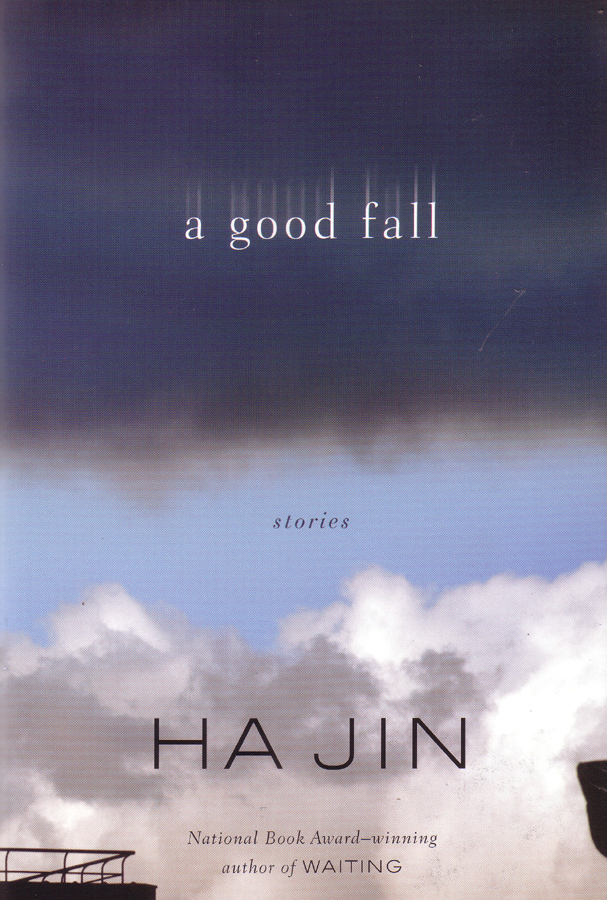
Book 83: A Good Fall by Ha Jin
A Good Fall by Ha Jin isn't uniformly rich and rewarding. The stories make you wonder why Jin doesn't stick with writing novels.
The stories feel clumsy and unfinished and many of them feel similar. Jin is going back over ground he's already plowed, which leaves the reading flipping back through the book thinking "wait a minute, didn't I already this story?"
There are currently some superb story collections in the bookstores. This isn't one of them.
Book 80: Mrs. Darcy and the Blue-Eyed Stranger by Lee Smith
I stumbled upon the writing of Lee Smith by pure serendipity.
I was at the Virginia Book Festival in Charlottesville to hear Colum McCann. Smith was on the program with him. I had a copy of Let the Great World Spin that I planned to have McCann sign.
Nothing by Smith, and that made me feel badly for her. So I picked up a copy of Mrs. Darcy and the Blue-Eyed Stranger, which she signed. What the hell.
More than a year went by before I picked up the book again and started to read.
What the hell? This was good. Very good. Smith has a knack for capturing the off-beat, the oddball who views the world just a little differently than the rest of us. And she's got this sly sense of humor that creeps into most of the stories; sometimes she's laughing with the characters, sometimes she's laughing with you.
Toastmaster, about a little boy and his mother in an Italian restaurant in Florida, is one of the funniest stories that I have ever read. And it's a story that I will return to in the years ahead. It's that good.
Mrs. Darcy and the Blue-Eyed Stranger is a uniformly rich and rewarding collection of stories. I've already added two more books by Smith to my read pile. What the hell.
Book 83: A Good Fall by Ha Jin
A Good Fall by Ha Jin isn't uniformly rich and rewarding. The stories make you wonder why Jin doesn't stick with writing novels.
The stories feel clumsy and unfinished and many of them feel similar. Jin is going back over ground he's already plowed, which leaves the reading flipping back through the book thinking "wait a minute, didn't I already this story?"
There are currently some superb story collections in the bookstores. This isn't one of them.
Friday, August 12, 2011
Technically, A Visit From the Goon Squad is a great book. Technically
More thoughts on July reading:
Book 78: A Visit From the Goon Squad by Jennifer Egan
Technically, Jennifer Egan's A Visit From the Goon Squad -- winner of the 2011 Pulitzer Prize -- is a great book. Technically.
Egan shows stunning facility in her ability to weave these vignettes, snapshots of characters' lives, into a coherent whole. The beginning and ending offer a perfect example of her expertise.
In the opening scene, we are introduced to two characters who reappear throughout the book. The emphasis in the opening pages is on one character, but by the final pages the emphasis is on the other. The manner in which Egan flips the emphasis over the course of the book from one character to another is neatly done, and an admirable piece of writing.
Egan also has an ability to introduce a minor character in the course of the narrative and to sum up the arc of his (or her) life in only a few descriptive phrases, phrases that are interjected almost as a casual footnote, but which have a powerful effect.
Yet, I have reservations about this novel as I did with Egan's Look at Me, which was shortlisted for the 2001 National Book Award. Egan tells a great story, but there is a noticeable absence of passion for her characters. It's not that they are flat or wooden -- they're not -- yet it's almost impossible to care for them.
They're less people on a page than devices to advance an intricate story, cleverly told.
Book 79: Lockdown by Walter Dean Myers
Lockdown was shortlisted for the National Book Award in the category of Young People's Literature. It doesn't hold up well against such books as Kathryn Erskine's Mockingbird (which won) or Paolo Bacigalupi's Ship Breaker.
And I can't imagine Lockdown having much appeal to any teen who stumbles upon it. It's transparent in its message, didactic, preachy and unrealistic.
Book 78: A Visit From the Goon Squad by Jennifer Egan
Technically, Jennifer Egan's A Visit From the Goon Squad -- winner of the 2011 Pulitzer Prize -- is a great book. Technically.
Egan shows stunning facility in her ability to weave these vignettes, snapshots of characters' lives, into a coherent whole. The beginning and ending offer a perfect example of her expertise.
In the opening scene, we are introduced to two characters who reappear throughout the book. The emphasis in the opening pages is on one character, but by the final pages the emphasis is on the other. The manner in which Egan flips the emphasis over the course of the book from one character to another is neatly done, and an admirable piece of writing.
Egan also has an ability to introduce a minor character in the course of the narrative and to sum up the arc of his (or her) life in only a few descriptive phrases, phrases that are interjected almost as a casual footnote, but which have a powerful effect.
Yet, I have reservations about this novel as I did with Egan's Look at Me, which was shortlisted for the 2001 National Book Award. Egan tells a great story, but there is a noticeable absence of passion for her characters. It's not that they are flat or wooden -- they're not -- yet it's almost impossible to care for them.
They're less people on a page than devices to advance an intricate story, cleverly told.
Book 79: Lockdown by Walter Dean Myers
Lockdown was shortlisted for the National Book Award in the category of Young People's Literature. It doesn't hold up well against such books as Kathryn Erskine's Mockingbird (which won) or Paolo Bacigalupi's Ship Breaker.
And I can't imagine Lockdown having much appeal to any teen who stumbles upon it. It's transparent in its message, didactic, preachy and unrealistic.
Monday, August 08, 2011
The Snowman a conventional thriller in an unconventional setting
Yes, I've been tardy. No postings for any of the books read during July or August. So let's change that . . .
Book 76: The Snowman by Jo Nesbo
A little neural clutter to dispatch before I can even think about The Snowman.
First, what is it with detectives named Harry? I mean there's Dirty Harry, made famous by craggy Clint Eastwood, and there's Michael Connelly's marvelous Harry Bosch. And now Norwegian author Jo Nesbo gives us Harry Hole.
And, yes, that's the second bit of clutter. "Harry Hole." Hairy Hole! Get it?
I'm having trouble with that one. I mean Nesbo's fictional detective is every bit the brilliant asshole the genre demands. He has issues with authority, trouble maintaining personal relationships and is an alcoholic. But to blatantly name the guy Harry Hole. Can't we let the reader reach his own conclusions.
And then I clock that Nesbo's Norwegian and that the way Hole is pronounced in Norwegian is not the way it is pronounced in English. A little bit of Google magic and we discover that it's pronounced HEU-leh. That I can live with. So, on the book.
I've been late to the party America's given for Scandinavian authors like Nesbo and Stieg Larsson. My attitude is that if I'm not ahead of the curve, I sure as hell don't want to be behind it. Case in point: I have yet to read any book with Harry Potter in the title. (And that's another damn Harry. I think I've known one Harry my entire life, so how do you account for the preponderance of Harrys in literature? I can't.)
The Snowman is creepy, and by any measure that's exactly what a reader is looking for in a Scandinavian thriller. Dark. Moody. Not just cool, but icy.
There's a serial killer on the loose. Harry sees it quickly, but no one believes him. Serial killers, like politicians from Texas, are the unique creation of America.
But Harry's instincts are spot on. A killer is on the loose and his murders -- seemingly unconnected -- are becoming increasingly gruesome. And, again in keeping with genre conventions, the killer is taunting Harry, issuing that age old invitation to find me before I kill again.
There's plenty of suspects, yet each one is eliminated as we build to the finale in which the killer's true identity is revealed . . . but not before Harry is put the supreme test.
By the time we reach this point in the book the killer's identity is all too apparent. Consequently, in a nice authorial concession, Nesbo reveals the killer and the motives behind his insane spree just as realization dawns for the reader. This clever bit of writing actually serves to ratchet up the tension, because now that we know who the killer really is we also know what's truly at stake.
The Snowman is a satisfying thriller, but not overly original. Conventions are honored. But the Scandinavian overlay makes for an interesting change of pace. I'll read Nesbo again, if for no other reason then I've gone to the trouble of nailing down the accurate pronunciation of Harry's last name.
Book 77: Rodin’s Debutante by Ward Just
Any book by Ward Just -- even one that falls short as Rodin's Debutante does -- has elements so well constructed, characters so finely drawn, that it's worth reading despite the letdown.
Rodin's Debutante revolves (briefly) around the founder of an exclusive Illinois boy's school and a student at that school who becomes a talented Chicago sculptor. The story never adds up to much, and that's the downfall of this book, which might have benefited from an additional 100 pages.
One of Just's talents is to accurately portray a certain kind of man, to reveal what motivates him and to show us how and why he lives as he does. Just is also skilled at striking a certain tone, capturing an atmosphere of elegance and restraint, that, in many cases, is as internal as it is external.
The best, and worst, that can be said about Rodin's Debutante is that it is an interesting book. Sadly, it could have been much more.
Book 76: The Snowman by Jo Nesbo
A little neural clutter to dispatch before I can even think about The Snowman.
First, what is it with detectives named Harry? I mean there's Dirty Harry, made famous by craggy Clint Eastwood, and there's Michael Connelly's marvelous Harry Bosch. And now Norwegian author Jo Nesbo gives us Harry Hole.
And, yes, that's the second bit of clutter. "Harry Hole." Hairy Hole! Get it?
I'm having trouble with that one. I mean Nesbo's fictional detective is every bit the brilliant asshole the genre demands. He has issues with authority, trouble maintaining personal relationships and is an alcoholic. But to blatantly name the guy Harry Hole. Can't we let the reader reach his own conclusions.
And then I clock that Nesbo's Norwegian and that the way Hole is pronounced in Norwegian is not the way it is pronounced in English. A little bit of Google magic and we discover that it's pronounced HEU-leh. That I can live with. So, on the book.
I've been late to the party America's given for Scandinavian authors like Nesbo and Stieg Larsson. My attitude is that if I'm not ahead of the curve, I sure as hell don't want to be behind it. Case in point: I have yet to read any book with Harry Potter in the title. (And that's another damn Harry. I think I've known one Harry my entire life, so how do you account for the preponderance of Harrys in literature? I can't.)
The Snowman is creepy, and by any measure that's exactly what a reader is looking for in a Scandinavian thriller. Dark. Moody. Not just cool, but icy.
There's a serial killer on the loose. Harry sees it quickly, but no one believes him. Serial killers, like politicians from Texas, are the unique creation of America.
But Harry's instincts are spot on. A killer is on the loose and his murders -- seemingly unconnected -- are becoming increasingly gruesome. And, again in keeping with genre conventions, the killer is taunting Harry, issuing that age old invitation to find me before I kill again.
There's plenty of suspects, yet each one is eliminated as we build to the finale in which the killer's true identity is revealed . . . but not before Harry is put the supreme test.
By the time we reach this point in the book the killer's identity is all too apparent. Consequently, in a nice authorial concession, Nesbo reveals the killer and the motives behind his insane spree just as realization dawns for the reader. This clever bit of writing actually serves to ratchet up the tension, because now that we know who the killer really is we also know what's truly at stake.
The Snowman is a satisfying thriller, but not overly original. Conventions are honored. But the Scandinavian overlay makes for an interesting change of pace. I'll read Nesbo again, if for no other reason then I've gone to the trouble of nailing down the accurate pronunciation of Harry's last name.
Book 77: Rodin’s Debutante by Ward Just
Any book by Ward Just -- even one that falls short as Rodin's Debutante does -- has elements so well constructed, characters so finely drawn, that it's worth reading despite the letdown.
Rodin's Debutante revolves (briefly) around the founder of an exclusive Illinois boy's school and a student at that school who becomes a talented Chicago sculptor. The story never adds up to much, and that's the downfall of this book, which might have benefited from an additional 100 pages.
One of Just's talents is to accurately portray a certain kind of man, to reveal what motivates him and to show us how and why he lives as he does. Just is also skilled at striking a certain tone, capturing an atmosphere of elegance and restraint, that, in many cases, is as internal as it is external.
The best, and worst, that can be said about Rodin's Debutante is that it is an interesting book. Sadly, it could have been much more.
Wednesday, July 13, 2011
Patchett's State of Wonder a vivid novel of hope and redemption; Penn builds a case for steel and leather
" . . . some people have asked, 'Will you tell us what this book is about?' I'll say, 'There's this tribe in the Amazon where the women can have children forever.' The audience gasps and recoils. Then I laugh and say, 'Yes,it's a horror novel.' "
Book 74. State of Wonder by Ann Patchett
It's always a delight when a reader's expectations and a writer's vision coincide. And, yes, that was the case for me and Ann Patchett's vibrant new novel, State of Wonder.
I've been a fan of Patchett for some time. I loved her early novels, The Magician's Assistant and The Patron Saint of Liars. Admiration for her creative talents peaked with Bel Canto, which won the 2001 PEN/Faulkner Award.
Her 2007 novel, Run, was something of a disappointment, but such a statement must carry a disclaimer. Most authors would proudly have their name on Patchett's most disappointing book. She's that good.
In State of Wonder, Patchett is flexing her literary muscles once again. Marina Singh, a Minnesota-born pharmaceutical scientist, is packed off to the Amazon on a multi-pronged mission. Her boss, who is also her lover, wants her to come back with answers from the all-too-independent doctor/scientist who is trying to isolate the chemicals that allow those Amazon women to procreate in old age.
Marina is also charged with finding out more about the death of her colleague, who was originally sent on the fact-finding mission and who died under mysterious circumstances.
Of course, it's complicated. The doctor/scientist has her own agenda. She's also Marina's former instructor. Marina was on the path to become a talented surgeon until a delivery room mishap led her to flee the program and eventually led her to become a research scientist.
Marina finds redemption and more in the Amazon jungles. It doesn't give much away to say that dismembering a snake with a machete is the least of it.
State of Wonder is a wonder. A vivid novel of hope, redemption and human tenacity. It's Patchett at her finest.
Book 75. It’s All About The Bike by Robert Penn
For me, biking will never supplant running. It's a nice substitute. A way to take some pressure off the knees and hips, spend a leisurely morning with friends and see a lot of countryside in a way you can't see running or in a car.
So, I'm not the audience for Robert Penn's account of his efforts to build his dream bike. It's All About The Bike is, well, all about the bike. It's about the hardware and, admittedly, some cyclists have a love affair with all those components.
I have this friend and biking has been very, very good to him. He's lost nearly 100 pounds because of cycling. He's read this book twice and the second time he was taking notes.
Hardcore bicycle junkies , like my friend, are going to love Robert Penn's book. And I have to admit, I liked it a lot. I was especially fascinated by his chapters on the headset and the saddle. The headset is that component that allows the front wheel to turn independently of the frame. Fifteen years or so of biking and I didn't know that. It's kind of cool.
As for the saddle (seat to you neophytes) anyone who rides 60+ miles for multiple days, as I have done, understands just how important it is. Your body has three points of contact with a bicycle -- the pedals, the handles and the seat. I can't emphasize the importance of the right saddle. To paraphrase Penn, you may hurt, but you don't need to suffer.
Penn is a stout advocate for the bicycle -- a machine that is rightfully enjoying a renaissance. He gives anyone who is thinking about assembling their own dream machine plenty to think about. Steel. Leather. Gears and Gruppo.
I'm not prepared to say it's all about the bike, but Penn makes a convincing case.
Book 74. State of Wonder by Ann Patchett
It's always a delight when a reader's expectations and a writer's vision coincide. And, yes, that was the case for me and Ann Patchett's vibrant new novel, State of Wonder.
I've been a fan of Patchett for some time. I loved her early novels, The Magician's Assistant and The Patron Saint of Liars. Admiration for her creative talents peaked with Bel Canto, which won the 2001 PEN/Faulkner Award.
Her 2007 novel, Run, was something of a disappointment, but such a statement must carry a disclaimer. Most authors would proudly have their name on Patchett's most disappointing book. She's that good.
In State of Wonder, Patchett is flexing her literary muscles once again. Marina Singh, a Minnesota-born pharmaceutical scientist, is packed off to the Amazon on a multi-pronged mission. Her boss, who is also her lover, wants her to come back with answers from the all-too-independent doctor/scientist who is trying to isolate the chemicals that allow those Amazon women to procreate in old age.
Marina is also charged with finding out more about the death of her colleague, who was originally sent on the fact-finding mission and who died under mysterious circumstances.
Of course, it's complicated. The doctor/scientist has her own agenda. She's also Marina's former instructor. Marina was on the path to become a talented surgeon until a delivery room mishap led her to flee the program and eventually led her to become a research scientist.
Marina finds redemption and more in the Amazon jungles. It doesn't give much away to say that dismembering a snake with a machete is the least of it.
State of Wonder is a wonder. A vivid novel of hope, redemption and human tenacity. It's Patchett at her finest.
Book 75. It’s All About The Bike by Robert Penn
For me, biking will never supplant running. It's a nice substitute. A way to take some pressure off the knees and hips, spend a leisurely morning with friends and see a lot of countryside in a way you can't see running or in a car.
So, I'm not the audience for Robert Penn's account of his efforts to build his dream bike. It's All About The Bike is, well, all about the bike. It's about the hardware and, admittedly, some cyclists have a love affair with all those components.
I have this friend and biking has been very, very good to him. He's lost nearly 100 pounds because of cycling. He's read this book twice and the second time he was taking notes.
Hardcore bicycle junkies , like my friend, are going to love Robert Penn's book. And I have to admit, I liked it a lot. I was especially fascinated by his chapters on the headset and the saddle. The headset is that component that allows the front wheel to turn independently of the frame. Fifteen years or so of biking and I didn't know that. It's kind of cool.
As for the saddle (seat to you neophytes) anyone who rides 60+ miles for multiple days, as I have done, understands just how important it is. Your body has three points of contact with a bicycle -- the pedals, the handles and the seat. I can't emphasize the importance of the right saddle. To paraphrase Penn, you may hurt, but you don't need to suffer.
Penn is a stout advocate for the bicycle -- a machine that is rightfully enjoying a renaissance. He gives anyone who is thinking about assembling their own dream machine plenty to think about. Steel. Leather. Gears and Gruppo.
I'm not prepared to say it's all about the bike, but Penn makes a convincing case.
Monday, July 04, 2011
McCullough's Greater Journey an exuberant, sprawling history
73. The Greater Journey by David McCullough
The Greater Journey is a sprawling, exuberant history of Americans in Paris during a 70-year span of the 19th Century.
It's hard to say this is McCullough's best book -- he does have those two Pulitzers after all -- but it's easy to understand why it's his favorite.
The book overflows with energy and inspiration, creativity and promise, so well does McCullough capture the spirit of Paris and the Americans who briefly called it home.
We meet novelist James Fenimore Cooper, Samuel F.B. Morse (famous in this country for inventing the telegraph, but who was a bold and muscular painter), the portraitist George P.A. Healey, the medical student Oliver Wendell Holmes, writers Ralph Waldo Emerson and Nathaniel Hawthorne, the sculptor Augustus Saint-Gaudens, painters Mary Cassatt and John Singer Sargent, future Senator Charles Sumner and the American ambassador Elihu Washburne.
It is a large, sprawling cast that's not limited to Americans. Paris, its citizens and sites -- from the Louvre to the Champs-Elysee to the Eiffel Tower (which appears surprisingly late in the story) -- also play a major role in McCullough's history.
McCullough's principal contention is that 19th Century Paris -- from 1830 to 1900 -- helped shape these Americans and consequently helped shape America. McCullough's American cast, and more, returned to their homeland having increased their knowledge, enhanced their expertise and awakened to an awareness of a wider world and a new perspective on that world.
It was in Paris, for example, that Sumner, who became a leading proponent for the abolition of slavery, first began to understand that the way blacks were treated in American was not part of the natural order, but an outgrowth of custom.
In entertaining fashion, McCullough leads us to re-examine the critical role that France played in the America we celebrate today.
The Greater Journey is a sprawling, exuberant history of Americans in Paris during a 70-year span of the 19th Century.
It's hard to say this is McCullough's best book -- he does have those two Pulitzers after all -- but it's easy to understand why it's his favorite.
The book overflows with energy and inspiration, creativity and promise, so well does McCullough capture the spirit of Paris and the Americans who briefly called it home.
We meet novelist James Fenimore Cooper, Samuel F.B. Morse (famous in this country for inventing the telegraph, but who was a bold and muscular painter), the portraitist George P.A. Healey, the medical student Oliver Wendell Holmes, writers Ralph Waldo Emerson and Nathaniel Hawthorne, the sculptor Augustus Saint-Gaudens, painters Mary Cassatt and John Singer Sargent, future Senator Charles Sumner and the American ambassador Elihu Washburne.
It is a large, sprawling cast that's not limited to Americans. Paris, its citizens and sites -- from the Louvre to the Champs-Elysee to the Eiffel Tower (which appears surprisingly late in the story) -- also play a major role in McCullough's history.
McCullough's principal contention is that 19th Century Paris -- from 1830 to 1900 -- helped shape these Americans and consequently helped shape America. McCullough's American cast, and more, returned to their homeland having increased their knowledge, enhanced their expertise and awakened to an awareness of a wider world and a new perspective on that world.
It was in Paris, for example, that Sumner, who became a leading proponent for the abolition of slavery, first began to understand that the way blacks were treated in American was not part of the natural order, but an outgrowth of custom.
In entertaining fashion, McCullough leads us to re-examine the critical role that France played in the America we celebrate today.
Sunday, July 03, 2011
Three to read, one to skip
Once again, I'm guilty of reading rather than blogging. The consequence is that there's a small tower of books on the stand next to the computer.
So, here's four quick summaries to reduce the tower to a more manageable size.
69. The Alchemist by Paolo Bacigalupi
Bacigalupi is Gaiman-like in his ability to master a variety of genres frrom pure science fiction to YA lit to unadulterated fantasy.
The Alchemist, an award-winning novella from Subterranean Press, is Bacigalupi's stab at fantasy. It's a compelling tale of a world in which each use of magic, however benign, spawns the growth of a thorny, poisonous, malevolent bramble.
The alchemist of the title uses magic to calm the persistent cough that threatens his daughter's health. He feels guilty about using magic, but justifies it by his search for a solution to eradicate the bramble.
I have only one complaint about The Alchemist -- it's a paired novella. The story of the alchemist, who is on the run when this book ends, is completed in a novella by Tobias Buckell. So many books, so little time.
70. Bradbury An Illustrated Life by Jerry Weist
It wouldn't work for just anyone, but Ray Bradbury is the perfect choice for an illustrated biography. This table-top sized book, assembled by Jerry Weist, makes no attempt to be a comprehensive story of Bradbury's life.
What it does do is capture a broad swatch of his creative life. The book is fat with reproductions of early fanzines in which Bradbury got his start, stills from television shows and movies, artist's illustrations of his stories that appeared in countless magazines, covers of pulps featuring his writing, pages of story adaptations from EC Comics and the covers of his books, including foreign editions.
It's a visual feast, and a fitting celebration of Bradbury's creative life.
71. The Lone Ranger and Tonto Fistfight in Heaven by Sherman Alexie
Humor and pain are the elements that war for dominance in Sherman Alexie's superb stories of Indian life in and around the Spokane Indian Reservation.
Alexie's stories are filled with vivid characters who confront heartbreak and loss, the devastating (and inevitable) effects of alcohol and the decades-old degradation that penetrates the soul of a conquered people with a sly humor and stoic acceptance.
Alexie, who tweaks our funny bone and our conscience, ranks among America's most gifted writers.
72. The Good Man Jesus and the Scoundrel Christ by Philip Pullman
This 2010 novel by Philip Pullman is a mean-spirited re-creation of the Gospel.
Mary gives birth to twins. One she names Jesus. The other, we are told, is given a common name, but Mary always calls him Christ, which is Greek for Messiah.
Inspired by his cousin, John, Jesus becomes an itinerant preacher who attracts a small following even as he begins to generate controversy among the religious rulers. Christ, who is regularly visited by a mysterious stranger, chronicles the events of Jesus's life and his sayings.
Eventually, Jesus is crucified. It is Christ who appears to Mary three days after the crucifixion, to several of the disciples on the road to Emmaus. Christ eventually leaves the area, marries and -- encouraged by the stranger -- sets to work on his account of Jesus's life.
" . . . as Christ sat . . . he couldn't help thinking of the story of Jesus, and how he could improve it. For example, there could be some miraculous sign to welcome the birth: a star, an angel. And the childhood of Jesus might be studded with charming little wonder-tales of boyish mischief leavened by magic, which could nevertheless be interpreted as signs of greater miracles to come."
It's an altogether cynical excursion into fantasy that rather than re-telling the life of Jesus, seeks to re-invent it, and the establishment of the Catholic Church, as a great hoax.
So, here's four quick summaries to reduce the tower to a more manageable size.
69. The Alchemist by Paolo Bacigalupi
Bacigalupi is Gaiman-like in his ability to master a variety of genres frrom pure science fiction to YA lit to unadulterated fantasy.
The Alchemist, an award-winning novella from Subterranean Press, is Bacigalupi's stab at fantasy. It's a compelling tale of a world in which each use of magic, however benign, spawns the growth of a thorny, poisonous, malevolent bramble.
The alchemist of the title uses magic to calm the persistent cough that threatens his daughter's health. He feels guilty about using magic, but justifies it by his search for a solution to eradicate the bramble.
I have only one complaint about The Alchemist -- it's a paired novella. The story of the alchemist, who is on the run when this book ends, is completed in a novella by Tobias Buckell. So many books, so little time.
70. Bradbury An Illustrated Life by Jerry Weist
It wouldn't work for just anyone, but Ray Bradbury is the perfect choice for an illustrated biography. This table-top sized book, assembled by Jerry Weist, makes no attempt to be a comprehensive story of Bradbury's life.
What it does do is capture a broad swatch of his creative life. The book is fat with reproductions of early fanzines in which Bradbury got his start, stills from television shows and movies, artist's illustrations of his stories that appeared in countless magazines, covers of pulps featuring his writing, pages of story adaptations from EC Comics and the covers of his books, including foreign editions.
It's a visual feast, and a fitting celebration of Bradbury's creative life.
71. The Lone Ranger and Tonto Fistfight in Heaven by Sherman Alexie
Humor and pain are the elements that war for dominance in Sherman Alexie's superb stories of Indian life in and around the Spokane Indian Reservation.
Alexie's stories are filled with vivid characters who confront heartbreak and loss, the devastating (and inevitable) effects of alcohol and the decades-old degradation that penetrates the soul of a conquered people with a sly humor and stoic acceptance.
Alexie, who tweaks our funny bone and our conscience, ranks among America's most gifted writers.
72. The Good Man Jesus and the Scoundrel Christ by Philip Pullman
This 2010 novel by Philip Pullman is a mean-spirited re-creation of the Gospel.
Mary gives birth to twins. One she names Jesus. The other, we are told, is given a common name, but Mary always calls him Christ, which is Greek for Messiah.
Inspired by his cousin, John, Jesus becomes an itinerant preacher who attracts a small following even as he begins to generate controversy among the religious rulers. Christ, who is regularly visited by a mysterious stranger, chronicles the events of Jesus's life and his sayings.
Eventually, Jesus is crucified. It is Christ who appears to Mary three days after the crucifixion, to several of the disciples on the road to Emmaus. Christ eventually leaves the area, marries and -- encouraged by the stranger -- sets to work on his account of Jesus's life.
" . . . as Christ sat . . . he couldn't help thinking of the story of Jesus, and how he could improve it. For example, there could be some miraculous sign to welcome the birth: a star, an angel. And the childhood of Jesus might be studded with charming little wonder-tales of boyish mischief leavened by magic, which could nevertheless be interpreted as signs of greater miracles to come."
It's an altogether cynical excursion into fantasy that rather than re-telling the life of Jesus, seeks to re-invent it, and the establishment of the Catholic Church, as a great hoax.
Sunday, June 19, 2011
Four books that include a cop's life and a sacrifical ballplayer
I hate writing about four books at once, but I also hate the stack of books lurking near my computer, reminding me that I need to say something about them. Let's say this -- they are all good books and I'd recommend each one.
Now for something a little more personal about each book.
Book 63: The Widower’s Tale by Julia Glass
There's an inherent appeal to a novel that features not one, but two tree houses as is the case with The Widower's Tale by Julia Glass.
I have enjoyed her novels since she made her debut with the award-winning Three Junes. Glass's novels have their share of dysfunction, heart ache and disappointment, but there is also a joy that emerges in her work, a celebration of life despite its pain and misfortune.
The Widower's Tale is the story of 70-year-old Percy Darling, a sharp-tongued curmudgeon who continues to mourn the passing of his wife decades after she drowned. As the novel progresses unexpected events, from a late-life romance to acts of eco-terrorism, help Percy shed his grief and embrace life and all it quizzical turns.
Book 66: A Well-Paid Slave by Brad Snyder
"A well-paid slave is nonetheless a slave." Curt Flood
As author Brad Snyder notes Cardinals' outfielder Curt Flood was not baseball's first free agent. Nor did his lawsuit, which ultimately made its way to the Supreme Court, create free agency or result in the elimination of baseball's reserve clause.
"But," Snyder writes, "his legal battle set the stage for free agency in baseball."
It's possible, I suppose, to see Flood as other than heroic. His decision to reject a trade from St. Louis to Philadelphia, to leave the game when he was among its highest paid players and to sue baseball, to challenge the reserve clause, directly led to the game we know today.
How you view that game will go a long way in determining how you view Flood.
The owner's contended that without the reserve clause baseball could not survive. Yet, today, the game flourishes. What owners surrendered to players was a share of the game's wealth.
Flood, whose baseball career and whose future in the game was wrecked because of his defiance, always knew that he would never benefit from his suit, but that other players would.
Snyder's challenge, and one that he meets with verve, is to make the legal aspects of this book -- which are at its very heart -- as spellbinding as the baseball. He provides a balanced portrait of Flood, a great player who struggled with alcoholism, and provides intriguing portraits of other men who played a role in this courtroom drama from labor leader Marvin Miller to baseball commissioner Bowie Kuhn.
Book 67: The Tragedy of Arthur by Arthur Phillips
Novelist Arthur Phillips ruptures the veil between the worlds of fiction and reality as he casts himself as the central character in this comic novel of a dysfunctional family with an obsession for William Shakespeare.
Phillips is the unreliable narrator of what is putatively the foreword to a newly discovered play by Shakespeare, but which quickly develops into an often whiny memoir of how his daddy loved his twin sister more.
Daddy has spent most of his life in prison for various schemes involving fraud and forgery, which naturally leads Phillips to suspect that this new play by Shakespeare -- stashed in his father's safety deposit box for decades -- wasn't written by the Bard, but dad.
As Phillips argues that the play isn't what it appears to be, everyone else -- from his sister, who has memorized huge swathes of Shakespeare's works, to university professors -- line up to proclaim that Shakespeare does indeed appear to have written this brilliant new play. Even Random House, Phillip's publisher in the novel and real life, gets in the act.
More than two-thirds of The Tragedy of Arthur is devoted to the memoir. Roughly another 100 pages feature the play, of the same name, which Phillips (the real one) wrote. I'll willingly confess I didn't read it.
So I read The Tragedy of Arthur, but not The Tragedy of Arthur, which makes perfect sense to anyone reading the newest novel/foreword/memoir by Arthur Phillips, real and imagined.
Book 68: Rizzo’s Fire by Lou Manfredo
It's the insider's understanding of a cop's day-to-day world that make Lou Manfredo's novels about Brooklyn detective Joe Rizzo such a pleasure to read.
Manfredo understands that a cop's life is about the quotidian chores of filing reports, canvassing the neighborhood and exploring unlikely leads, rather than the glamour of car chases and shoot outs. Yet, he manages to make the mundane magical.
Rizzo, who is only months from retirement, is a complicated figure. He's proud of his career, but strongly resists a daughter's efforts to follow in his footsteps. He's given to lecturing his new partner or to offering advice to a medical examiner on the scene of a murder out of a mistrust of motivation.
And he will cut corners to nail a bad guy, advance a partner's career or secure additional overtime to pad his retirement. He's quick to give a favor or ask for one.
He's a cop who is passionate about his work, but who also understands that at the end of the day it is a job that exacts a heavy price, a price he's always been willing to pay.
Rizzo's Fire and Manfredo's first book, Rizzo's War are terrific novels for their exceptional insight into a cop's life, the challenges he confronts each day and the trade offs he must make.
Now for something a little more personal about each book.
Book 63: The Widower’s Tale by Julia Glass
There's an inherent appeal to a novel that features not one, but two tree houses as is the case with The Widower's Tale by Julia Glass.
I have enjoyed her novels since she made her debut with the award-winning Three Junes. Glass's novels have their share of dysfunction, heart ache and disappointment, but there is also a joy that emerges in her work, a celebration of life despite its pain and misfortune.
The Widower's Tale is the story of 70-year-old Percy Darling, a sharp-tongued curmudgeon who continues to mourn the passing of his wife decades after she drowned. As the novel progresses unexpected events, from a late-life romance to acts of eco-terrorism, help Percy shed his grief and embrace life and all it quizzical turns.
Book 66: A Well-Paid Slave by Brad Snyder
"A well-paid slave is nonetheless a slave." Curt Flood
As author Brad Snyder notes Cardinals' outfielder Curt Flood was not baseball's first free agent. Nor did his lawsuit, which ultimately made its way to the Supreme Court, create free agency or result in the elimination of baseball's reserve clause.
"But," Snyder writes, "his legal battle set the stage for free agency in baseball."
It's possible, I suppose, to see Flood as other than heroic. His decision to reject a trade from St. Louis to Philadelphia, to leave the game when he was among its highest paid players and to sue baseball, to challenge the reserve clause, directly led to the game we know today.
How you view that game will go a long way in determining how you view Flood.
The owner's contended that without the reserve clause baseball could not survive. Yet, today, the game flourishes. What owners surrendered to players was a share of the game's wealth.
Flood, whose baseball career and whose future in the game was wrecked because of his defiance, always knew that he would never benefit from his suit, but that other players would.
Snyder's challenge, and one that he meets with verve, is to make the legal aspects of this book -- which are at its very heart -- as spellbinding as the baseball. He provides a balanced portrait of Flood, a great player who struggled with alcoholism, and provides intriguing portraits of other men who played a role in this courtroom drama from labor leader Marvin Miller to baseball commissioner Bowie Kuhn.
Book 67: The Tragedy of Arthur by Arthur PhillipsNovelist Arthur Phillips ruptures the veil between the worlds of fiction and reality as he casts himself as the central character in this comic novel of a dysfunctional family with an obsession for William Shakespeare.
Phillips is the unreliable narrator of what is putatively the foreword to a newly discovered play by Shakespeare, but which quickly develops into an often whiny memoir of how his daddy loved his twin sister more.
Daddy has spent most of his life in prison for various schemes involving fraud and forgery, which naturally leads Phillips to suspect that this new play by Shakespeare -- stashed in his father's safety deposit box for decades -- wasn't written by the Bard, but dad.
As Phillips argues that the play isn't what it appears to be, everyone else -- from his sister, who has memorized huge swathes of Shakespeare's works, to university professors -- line up to proclaim that Shakespeare does indeed appear to have written this brilliant new play. Even Random House, Phillip's publisher in the novel and real life, gets in the act.
More than two-thirds of The Tragedy of Arthur is devoted to the memoir. Roughly another 100 pages feature the play, of the same name, which Phillips (the real one) wrote. I'll willingly confess I didn't read it.
So I read The Tragedy of Arthur, but not The Tragedy of Arthur, which makes perfect sense to anyone reading the newest novel/foreword/memoir by Arthur Phillips, real and imagined.
Book 68: Rizzo’s Fire by Lou Manfredo
It's the insider's understanding of a cop's day-to-day world that make Lou Manfredo's novels about Brooklyn detective Joe Rizzo such a pleasure to read.
Manfredo understands that a cop's life is about the quotidian chores of filing reports, canvassing the neighborhood and exploring unlikely leads, rather than the glamour of car chases and shoot outs. Yet, he manages to make the mundane magical.
Rizzo, who is only months from retirement, is a complicated figure. He's proud of his career, but strongly resists a daughter's efforts to follow in his footsteps. He's given to lecturing his new partner or to offering advice to a medical examiner on the scene of a murder out of a mistrust of motivation.
And he will cut corners to nail a bad guy, advance a partner's career or secure additional overtime to pad his retirement. He's quick to give a favor or ask for one.
He's a cop who is passionate about his work, but who also understands that at the end of the day it is a job that exacts a heavy price, a price he's always been willing to pay.
Rizzo's Fire and Manfredo's first book, Rizzo's War are terrific novels for their exceptional insight into a cop's life, the challenges he confronts each day and the trade offs he must make.
Sunday, June 12, 2011
Miéville's novels are complex narratives, rich with ideas
Book 62: The City and The City by China Miéville
Book 65: Embassytown by China Miéville
Complex, challenging novels that are occasionally infuriating and always entertaining is how I would characterize the novels of British writer China Miéville.
These are not the pared-down, movie-script-as-a-novel books that Michael Critchton cranked out in his last few years. Rather, these are complex novels that reward the patient reader with a rich story that strikes the rare balance between ideas and action.
The City & The City -- co-winner of the 2010 Hugo Award with Paolo Bacigalupi for the delicious The Windup Girl -- is a noir-ish detective story in a science fiction setting. Yet because Miéville is faithful to both genres the novel never feels like a gimmick.
The novel begins as a conventional police procedural. A body is found, dumped near the ramps of a skateboard park. "Nothing is still as the death are still," observes Police Inspector Tyador Borlú́́, who is called in to investigate the murder.
Those opening pages -- a body unceremoniously dumped by a skateboard park, the police soberly looking on -- is the last time, the only time, that this novel is on familiar ground. Now it gets strange.
Borlú́́ is an inspector in the city of Besź́́̀́́el, which shares the same physical space, the same geography, as the city of Ul Qoman.
Miéville never explains why these two cities overlap, we're only told they do. It first appears as if there's been some quirky dimensional overlay from out of the pages of Marvel Comics. But that's not what's happening here.
Instead, it appear that the residents of Besź́́̀́́el and Ul Qoman have intentionally decided that one city is now really two. It's as if all the residents of a New York borough woke up one morning and decided that based on style of dress, the make of car, the architecture of a house, or the presence of certain colors, that their neighbor doesn't fully exist.
You can see them, but you try real hard not to. You can even visit this other city, but to do so, to visit a neighbor who literally lives across the street, requires that you pass through a checkpoint and a wear badge that identifies you as a visitor. And once you've done that you can't simply walk back across the street to your own home -- you have to pass through the checkpoint again to do that.
To complicate matters, part of the landscape seems to belong only to Besź́́̀́́el, part to Ul Qoman. Some overlaps and other areas aren't a part of either city.
And to complicate matters even more, all of this, this separation, is enforced by a shadowy presence known as the Breach.
This separation between the two cities is important to Borlú́́ because it appears the young woman was killed in one city, her body dumped in another. In the course of his investigation, Borlú́́ learns that the woman may have been murdered because she uncovered evidence of a second shadowy group of people living in the interstice of the two cities, a shadowy group that may be a threat to the Breach.
Miéville challenges the reader by not explaining everything -- either the words he's coined (both novels cry out for a glossary) or the reason that the two cities exist as they do.
Embassytown is just as challenging, just as potentially confusing. In this novel, we find ourselves on a far distant world where humans have established a small outpost, an embassy. The world's sentient life form, the Ariekei, have two mouths.
As a result, the Ariekei hear human speech, but are unable to perceive it as language. Nor are they capable of perceiving a normal human as an intelligent creature.
To communicate with the Ariekei, or the Hosts as they are known to the human residents of Embassytown, humans rely on the "Ambassadors," human twins, doppels, that share an empathetic connection and who separately represent each of the Hosts' two mouths. The Ambassadors are bred in Embassytown.
A crisis erupts when an Ambassador arrives from off world. This Ambassador is not a twin, but two distinct humans, and his/his speech is instantly addictive to the Ariekei.
Both races embark on efforts to free the Ariekei from this addiction. The solution found by the Hosts involves a severe form of self-mutilation that leaves them free of addiction, but unable to speak. The solution found by the human involves teaching the Ariekei to lie.
Further explanations elude me. It's all tied up with the idea that for the Ariekei language is literal. And it has to do with a small number of humans who literally become part of the Ariekei language. As a little girl our narrator becomes a simile in the Hosts language.
Describing Embassytown is as a challenging as reading it. It is a complex novel that demands multiple readings to reach a full understanding of what Miéville is trying to achieve -- if that's even possible.
One reading, or many, Miéville's books are among the most provocative to appear in years. His novels, and the ideas within them, defy the casual read. Yet despite the complexity -- or perhaps because of it -- Miéville also produces a gripping narrative of unparalleled richness.
Book 65: Embassytown by China Miéville
Complex, challenging novels that are occasionally infuriating and always entertaining is how I would characterize the novels of British writer China Miéville.
These are not the pared-down, movie-script-as-a-novel books that Michael Critchton cranked out in his last few years. Rather, these are complex novels that reward the patient reader with a rich story that strikes the rare balance between ideas and action.The City & The City -- co-winner of the 2010 Hugo Award with Paolo Bacigalupi for the delicious The Windup Girl -- is a noir-ish detective story in a science fiction setting. Yet because Miéville is faithful to both genres the novel never feels like a gimmick.
The novel begins as a conventional police procedural. A body is found, dumped near the ramps of a skateboard park. "Nothing is still as the death are still," observes Police Inspector Tyador Borlú́́, who is called in to investigate the murder.
Those opening pages -- a body unceremoniously dumped by a skateboard park, the police soberly looking on -- is the last time, the only time, that this novel is on familiar ground. Now it gets strange.
Borlú́́ is an inspector in the city of Besź́́̀́́el, which shares the same physical space, the same geography, as the city of Ul Qoman.
Miéville never explains why these two cities overlap, we're only told they do. It first appears as if there's been some quirky dimensional overlay from out of the pages of Marvel Comics. But that's not what's happening here.
Instead, it appear that the residents of Besź́́̀́́el and Ul Qoman have intentionally decided that one city is now really two. It's as if all the residents of a New York borough woke up one morning and decided that based on style of dress, the make of car, the architecture of a house, or the presence of certain colors, that their neighbor doesn't fully exist.
You can see them, but you try real hard not to. You can even visit this other city, but to do so, to visit a neighbor who literally lives across the street, requires that you pass through a checkpoint and a wear badge that identifies you as a visitor. And once you've done that you can't simply walk back across the street to your own home -- you have to pass through the checkpoint again to do that.
To complicate matters, part of the landscape seems to belong only to Besź́́̀́́el, part to Ul Qoman. Some overlaps and other areas aren't a part of either city.
And to complicate matters even more, all of this, this separation, is enforced by a shadowy presence known as the Breach.
This separation between the two cities is important to Borlú́́ because it appears the young woman was killed in one city, her body dumped in another. In the course of his investigation, Borlú́́ learns that the woman may have been murdered because she uncovered evidence of a second shadowy group of people living in the interstice of the two cities, a shadowy group that may be a threat to the Breach.
Miéville challenges the reader by not explaining everything -- either the words he's coined (both novels cry out for a glossary) or the reason that the two cities exist as they do.
Embassytown is just as challenging, just as potentially confusing. In this novel, we find ourselves on a far distant world where humans have established a small outpost, an embassy. The world's sentient life form, the Ariekei, have two mouths.
As a result, the Ariekei hear human speech, but are unable to perceive it as language. Nor are they capable of perceiving a normal human as an intelligent creature.
To communicate with the Ariekei, or the Hosts as they are known to the human residents of Embassytown, humans rely on the "Ambassadors," human twins, doppels, that share an empathetic connection and who separately represent each of the Hosts' two mouths. The Ambassadors are bred in Embassytown.
A crisis erupts when an Ambassador arrives from off world. This Ambassador is not a twin, but two distinct humans, and his/his speech is instantly addictive to the Ariekei.
Both races embark on efforts to free the Ariekei from this addiction. The solution found by the Hosts involves a severe form of self-mutilation that leaves them free of addiction, but unable to speak. The solution found by the human involves teaching the Ariekei to lie.
Further explanations elude me. It's all tied up with the idea that for the Ariekei language is literal. And it has to do with a small number of humans who literally become part of the Ariekei language. As a little girl our narrator becomes a simile in the Hosts language.
Describing Embassytown is as a challenging as reading it. It is a complex novel that demands multiple readings to reach a full understanding of what Miéville is trying to achieve -- if that's even possible.
One reading, or many, Miéville's books are among the most provocative to appear in years. His novels, and the ideas within them, defy the casual read. Yet despite the complexity -- or perhaps because of it -- Miéville also produces a gripping narrative of unparalleled richness.
Subscribe to:
Posts (Atom)