
D.C.'s own George Pelecanos, the U.S. Capitol in the background.
Below, Michael Connelly, creator of the Harry Bosch series.


 Doris Kearns Goodwin (above) is the author of the unrivaled Team of Rivals.
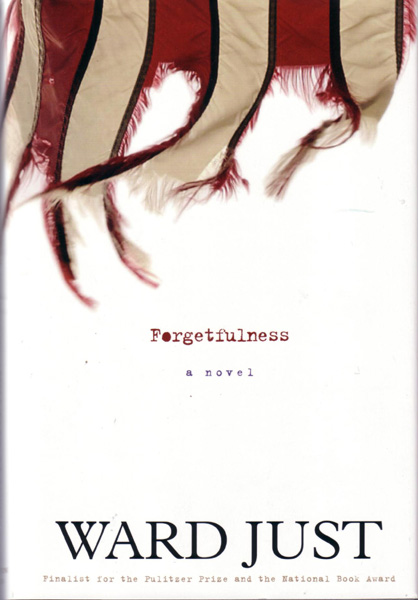 81. Forgetfulness, Ward Just. Fiction , 9-9, p. 258
How to describe the novels of Ward Just? Think of LeCarre, Furst and Greene, but there is also something here of Pete Dexter and Edith Wharton. Just writes of the manners and mores of the covert world of espionage. There is a certain way things are done, a protocol, as is unveiled in the French interrogation scene in this novel – in its violence, both tangible and latent, it is almost difficult to read.
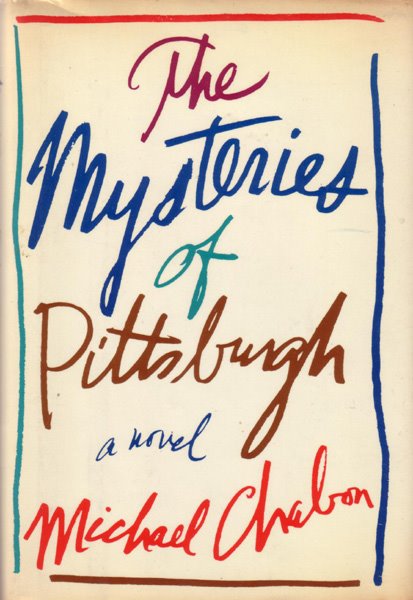 82. The Mysteries of
 Boy meets boy. Boy meets girl. Boy falls in love with girl. Boy falls in love with boy. Boy is confused.
The Mysteries of Pittsburgh, Michael Chabon’s first novel, is the story of a young man confused about his sexual identity. One assumes it is Chabon’s own effort at working out his sexual identify, although a reader must be careful about assigning such autobiographical leanings to a novelist’s work.
There are many, many books to read. In How to Read a Novel, John Sutherland says that today more novels are published in one week than Samuel Johnson had to deal with in a decade. As he calculates it, “it would take approximately 163 lifetimes to read the fiction currently available.” Given Sutherland’s sobering statistic give this book a pass and move directing to Chabon’s later works.
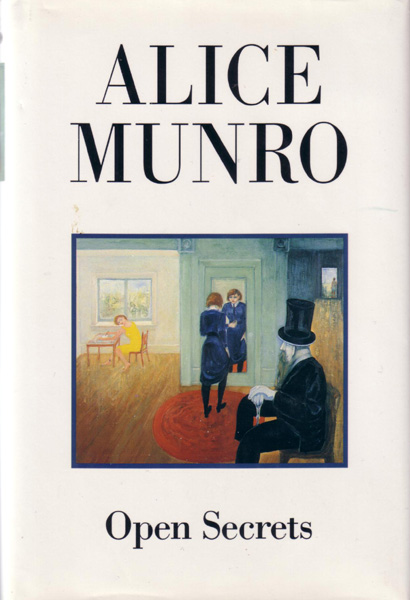 83. Open Secrets, Alice Munro. Short Stories, 9-19, p. 294
 Alice Munro is the best writer of short stories today. Not one of the best – the best. I have read many of these stories before. I suspect I will read them again and again. Many current novelists would be well served to closely read Munro. She can capture a world in a phrase, a sentence, a paragraph that would take others pages.
 84. Henry Adams and the Making of
 This book is not for the casual reader of history, but it will greatly reward the diligent student of history. It is a fascinating look at the legacy of Jefferson and Madison as seen through Henry Adams’ ambitious multi-volume history of
 80. Guests of the Ayatollah, Mark Bowden. History, 9-6, p. 637
 Mark Bowden is the author most likely to wear the crown abdicated, due to age and time, by David Halberstam. Bowden, like Halberstam, is one of the few writers today who is capable of taking multiple interviews, secondary accounts and voluminous personal research and constructing a coherent and engaging narrative.
This is the feat Bowden has accomplished in his extraordinarily readable Guests of the Ayatollah, an account of the 1979 Iranian hostage crisis that toppled the Carter Administration, launched Ted Koppel’s Nightline and permanently transformed
Bowden’s goal, in part, is to show how the hostage’s lived and survived during their 444 days of captivity. He does so vividly in an empathetic and powerful narrative. Bowden also demonstrates the impact of the crisis on both the Carter Administration and the Irianian leaders and students as well as leading us, step-by-step, through the misadventures of the failed rescue mission.
The hostages emerge as real people. Not so much heroes–although there is a heroic element to their suffering, strength and courage– as ordinary people making the best of extraordinary circumstances. President Carter warrants our sympathy perhaps as much as the hostages. He is a hopeful man whose Christian conviction leads him to believe that a resolution is possible – where none exists. Carter strives to do his best for the hostages and their families, and for
The hapless Iranians – the students, the secular leaders and iron-hearted mullahs – come off for the worst, as one might expect. No one in
Guests of the Ayatollah's 600-plus pages slip by with impressive speed; the book reads like an espionage thriller by LeCarre or Furst. It is skillfully told and impeccably researched. Let us hope Bowden wears his crown for many years to come.
(Bowden appeared at
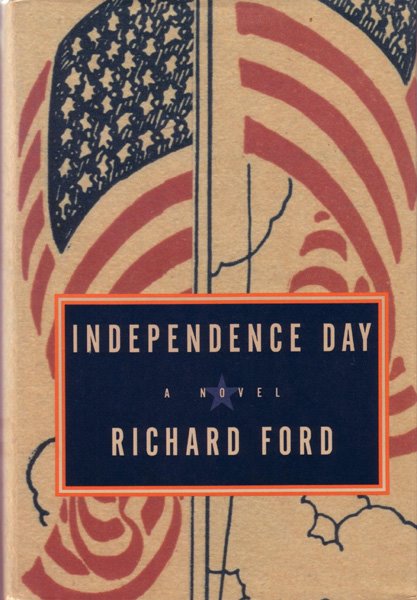 Richard Ford was at the Folger Shakespeare Theater in
 There was no question I would attend. The PEN/Faulkner Reading Series is a great event—readings by notable authors, followed by a book signing, wine and hors d’oeuvres.
Besides, six of the seven books that I have by Ford are unsigned, including a first edition of the Pulitzer Prize-winning Independence Day. I purchased a half-price ticket (more money for books), packed up the books and headed to the Folger.
Ford read from Percy Walker’s The Moviegoer. The reading, in Ford’s honeyed southern drawl, was the most entertaining and engaging of the evening.
At the reading’s conclusion, I darted into the reception room, heading for the author’s tables and a place at the front of the line. Ford grabbed a drink and visited with admirers before making his way to the table, where an impressive line of fans had formed.
“Are you ready to sign some books?” I asked.
“No,” he said. “You’re just going to sell these on eBay.”
I protested. I’m a collector. 2,500 books. My wife wishes I’d them on eBay, but no, these are destined for my shelves.
“You probably haven’t read any of these.” I protested once more. I had read them. All of them. Well, not Rock Springs, but it’s on the pile of books to be read some day.
Ford did sign the books. We chatted about his new book, sequel to Independence Day and The Sportswriter, and the tour that will bring him to back to
I was pleased he signed the books, but I fixated on the idea that he thought I was a book dealer. This has been happening a lot lately.
This summer Ivan Doig, one of my favorite authors, appeared at Politics & Prose, the premiere independent bookstore in
“I just made that fellow a lot of money,” he growled as I approached. He looked at me and my stack of books with an accusatory glare. “I’m not a dealer,” I assured him. “I’m a collector. These aren’t going to be sold.”
Doig signed, as Ford had, but I thought he eyed me doubtfully from time to time as he made his way through the stack of books I’d placed before him.
I’m not entirely certain why an author cares if a dealer waits in line, gets a book signed and then sells it on eBay or some other Internet site. Perhaps it’s just the idea that someone – not the author – is making a great deal of money on a single copy of a book. But that’s been going on long before eBay came onto the scene. As for me, some of the books were purchased used, from dealers, but others were bought at full retail.
No matter, I don’t want authors thinking I’m a book dealer, selling the fruits of their labor on eBay. What can I do?
I know – I’ll start dressing better.
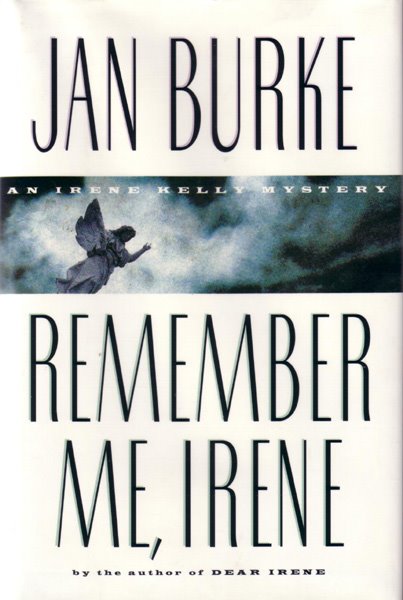 79. Remember Me, Irene, Jan Burke. Mystery, 9-2, p. 303
 I’ve been a fan of Jan Burke’s Irene Kelly series since reading Bones in 2000. Kelly is a reporter, married to a cop. She has a sister, two dogs and a cat. Invariably her work as a reporter leads her into mystery and intrigue. In the dozen years I was a reporter and editor I never solved a single murder and I’ve never known a colleague to do so either. Nor was I ever stalked by mad man (or woman for that matter), kidnapped or held hostage.
So Irene’s fictional career is far most interesting than the work-a-day world of most journalists. That’s OK because Burke’s novels are wonderfully entertaining. Kelly is a vibrant, spunky character and Burke does a fine job in bringing her and her cast of supporting characters to life.
The mysteries are not extraordinarily complex. Most often it’s not about whodunit or why (that’s usually clear early on), but how Irene will extricate herself from danger. This reader is grateful that Irene’s been successful through nine novels.
A
A second list, by City Pulse contributor Bill Castanier, included Ford’s The Sportswriter and Oates’ Them. It also included The Sporting Club by Tom McGuane and Waiting for the Morning Train by Bruce Catton.
 78. The Fourth Bear, Jasper Fforde. Fiction, 8-29, p. 383
 When Goldilocks carried out her home invasion of the Bear family’s domicile, there was a fourth bear present which led to tragic consequences for the self-absorbed young woman. The identity of that fourth bear, the reason behind Goldilocks’ brutal demise and much, much more are answered in The Fourth Bear, Jasper Fforde’s hugely entertaining second Jack Spratt novel.
Other questions that are answered include why there is a campaign for the right to arm bears, the dangers of the “cuclear” bomb and whether the psychotic Gingerbreadman is a cake or a biscuit.
The pleasures of Fforde’s novel are the same as those found in the Broadway production, Wicked. The witches of Oz are so much more interesting with a back-story than in the virtual cameo appearance they’re granted in the movie, The Wizard of Oz. Just so with Jack Spratt, Punch and Judy, the Gingerbreadman and various other Persons of Dubious Reality (PDR) who appear in Fforde’s two novels featuring Spratt’s Nursery Crimes Division.
It won’t be everyone’s cup of tea. Fforde goes to incredible lengths to set up a lame joke, only to have the characters comment on his efforts and the lameness of the joke itself. But it’s all good fun and when he’s on, as he is much of the time, Fforde is one of the few authors capable of eliciting a true laugh out loud from his reader.
And, no, I haven't read a single one of the books on this list.
 77. The Whole World Over, Julia Glass. Fiction, 8-24, p. 509
 Second books are not supposed to be this good.
Julia Glass emerged as something of a literary phenomena in 2002 when her first book, Three Junes, came out of nowhere to win the National Book Award. It was a very good book. The Whole World Over is better.
Cinematic in its construction, The Whole World Over focuses on the intersecting lives of four characters: Greenie, a talented baker and chef who leaves New York and her husband for New Mexico; Alan, Greenie’s unhappy husband; Walter, a gay restaurant owner looking for love and stability; and Saga a physically and mentally broken young women.
There’s nothing ground-breaking in the themes Glass explores – loss, love, the consequences of the choices we make and have made for us. The power of The Whole World Over is in the fondness we develop for Glass’ vivid characters, both major and minor. We’d like to sit in Walter’s restaurant, eat a slice of Greenie’s cake or sit in her kitchen in the cool morning as she bakes. Glass' success, and it is considerable, is that her characters inhabit a larger world than the pages of her book. They also inhabit our imagination.
 This won’t be well received, but I’m going to write it any way. I’m giving up on James Lee Burke. I think his novels have become derivative . . . of James Lee Burke.
 HarperColllins’ Eminent Lives series – a collection of brief biographies of a diverse group of notables – is a worthy successor to the Penguin Lives series. Matt Ridley’s biography of Francis Crick is an entertaining and informative read. Crick is an interesting figure, notable, if for no other reason, in that he was brilliant without being eccentric. As with any book about science or math (at least for me), the particulars challenge my comprehension, yet it is amazing how much of DNA and its components – the double helix, the sequence of the amino acid residues in proteins, the four types of nucleotides (adenine, cytosine, guanine and thymine) – are remotely familiar.
76. Positively
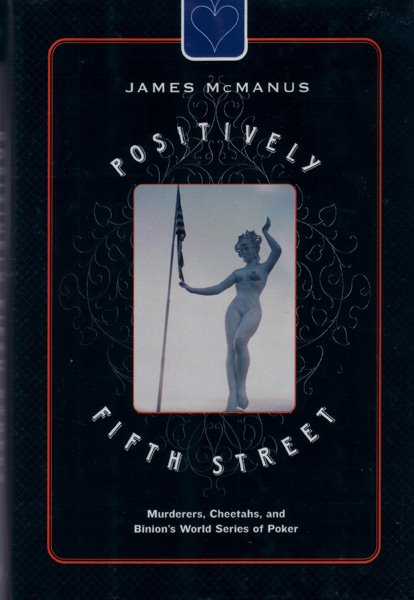 James McManus’ highly entertaining Positively Fifth Street is a minor classic in the small, but fascinating genre of books devoted to poker. McManus wrote his book just before the sport(?) became a cultural phenomenon due to ESPN’s broadcast of the World Series of Poker. McManus went to Vegas to write an article for Harper’s magazine on the Ted Binion murder trial (of Binion's Horseshoe Casino fame) and the recent success of women in what had been an exclusive all-male club. A gambler at heart (“the heart of a cliff diver”), McManus blows part of his advance from Harper’s on a qualifying tournament for the WSOP. He not only qualifies for the WSOP, but reaches the final table; a stunning accomplishment for an amateur player. In addition to his coverage of the murder trial and a riveting account of his tournament play, McManus ponders his justification for a lap dance (research) and the psychological and emotional motivations of the gambler. Let’s just you can equate risk with sexual excitement, losing with sexual excitement, winning with sexual excitement and sexual excitement with, well, cards, chips and nubile, young lap dancers. Masturbation plays a role in there somewhere, too. Just read the book – it’s the nuts.
I’ve been “tagged” to develop a book list by responding to nine questions. So, here goes:
The Road Less Traveled, Scott Peck
My Antonia, Willa Cather
Let’s stretch one into three: Tolkien’s Rings trilogy.
Just about any book by Bill Bryson. The same is true of Carl Hiaasen. Lucky You comes to mind.
Bambi did it. More recently, Ian McEwan’s Atonement.
On Writing: My Life As a Novelist by Biblio Baggins.
Mein Kampf, Adolph Hitler.
Positively
Love’s Labour’s Lost, William Shakespeare.
 73. Talk, Talk, T.C. Boyle. Fiction, 7-31, p. 340
 T.C. Boyle’s Talk, Talk is the Peggy Lee of novels – it leaves you asking, “Is that all there is?”
It’s the ending that’s disappointing, especially because Boyle’s takes the reader on a stomach-churning ride of anxiety and anger in the first couple of hundred pages. The opening, when the novel’s protagonist, Dana Halter, is hauled to jail, is particularly squirm inducing. It is Boyle’s skill at enlisting our identification with and sympathy for Dana, who is deaf, that makes his finish feel so incomplete. Cast in today’s psychobabble: There’s resolution, but not closure.
Dana is the victim of an especially pernicious form of identity theft that includes the theft of her “base identifiers.” In effect, the thief has adopted her identity as his own. An outraged Dana and her boyfriend, Bridger, track down the thief, following him as he flees from
Dana and Bridger ultimately confront the wayward Peck outside his mother’s home in upstate
But the conclusion, which the reader has been anticipating since the early pages of the novel, is flat and unsatisfying. Boyle mails this one in. I know that he can do better (see
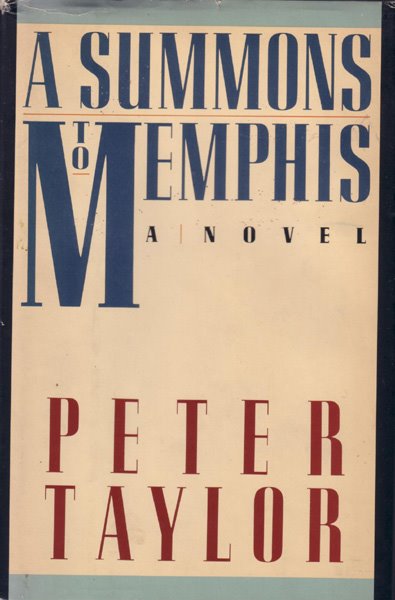 71. A Summons to
 Violent emotions seethe beneath a veneer of manners and mores in Peter Taylor’s A Summons to Memphis. The 1986 novel of a proper, but perverse
Echoes of Edith Wharton reverberate throughout
Wharton explored the mannered cruelties of Old New York.
A Summons to Memphis is the story of the Carver family; the father, George, and his three adult children, two daughters and a son. The children nurse unspoken hurts and resentments against their father – a needy despot whose rigid, unbending control over his family seems to extend from cradle to grave and which is always portrayed as well-meaning and in the children’s interest.
Their resentment begins in childhood when the family is uprooted from a comfortable life in
The anger lies buried, surfacing only in the most passive of expressions, until, soon after their mother’s death, the father, now quite elderly, contemplates a second marriage. Faced with the loss of their inheritance, alongside their empty, unfulfilled lives, the children take action.
It is not giving too much away to say that the marriage never takes place. The story is not about the aborted marriage, but in how the grown children use the conventions of
A Summons to Memphis was
 72. A Death In Belmont, Sebastian Junger. Non-Fiction, 7-28, p. 260
It would have made a fine magazine article.
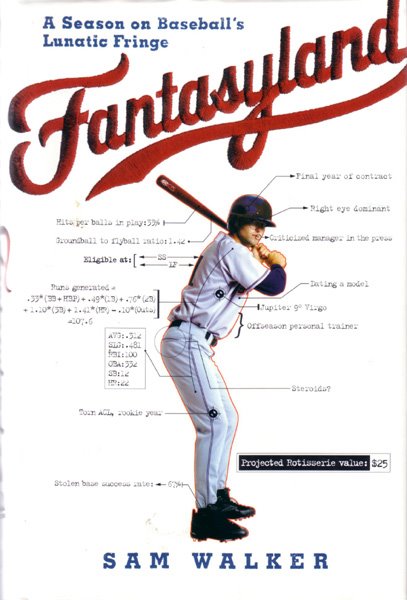 70. Fantasyland, Sam Walker. Baseball, 7-25p. 344
Books on baseball are generally reserved for deepest winter as a vital aid in recalling sun-drenched fields, an expanse of the greenest grass and the bluest sky. Intrigued by the premise of Sam Walker’s Fantasyland, I slipped the book onto the top of my reading list in July rather than January. It was the right thing to do. Fantasyland, a season in the trenches of the arcane world of Rotisserie League Baseball, would have been of no assistance whatsoever in summoning images of summer in the bleak mid-winter. Instead, this account of a game within the game proved a delightful distraction from baseball’s current off-field mischief and misdeeds.
Walker, a writer for the Wall Street Journal, competes in Tout Wars – an annual competition among the so-called experts of fantasy baseball.
To assist him in the process,
Is
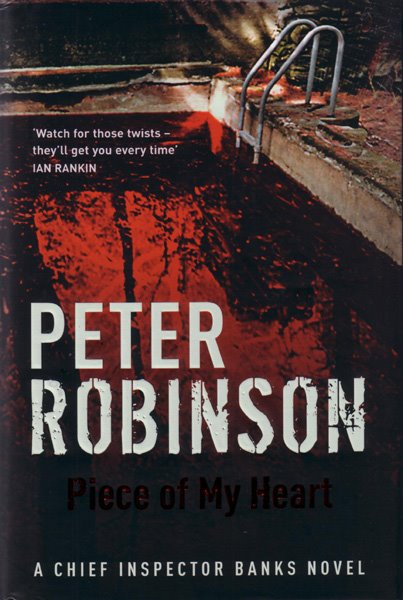 68. Piece of My Heart, Peter Robinson. Thriller, 7-23, p. 436
 In Playing With Fire, Robinson’s 2004 novel, Banks lost his lovely cottage in the Dales to fire. In the 2005 novel Strange Affair, Banks’ brother was murdered. In Robinson’s most recent work, Piece of My Heart, the most traumatic events confronting the Chief Inspector are mundane in comparison -- a run-in with his new superior and his son and his girl friend move in for an indefinite period of time.
Instead, we have parallel stories –a violent murder of a young woman at a rock concert in 1969 and, almost 40 years later, the bludgeoning death of a young rock journalist – that ultimately converge around a popular, local band that’s achieved international fame, the Mad Hatters.
It’s an ideal story for Robinson. Music has always played a part in his novels. We understand a great deal about Banks through the music he enjoys and his son is the member of a successful rock band. Robinson, along with Michael Connelly, Ian Rankin, George Pelecanos and Robert Crais, is one of our best writers in the genre today.
Piece of My Heart is the perfect summer read.
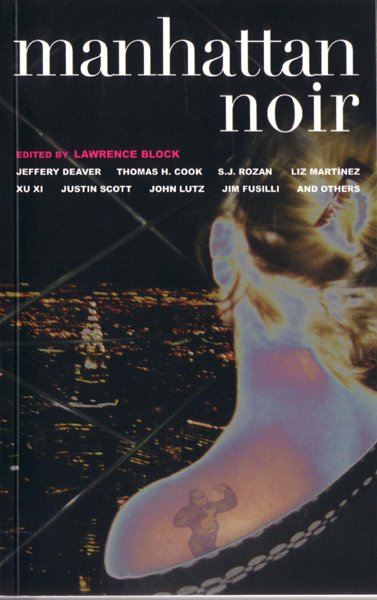 69.
69.
This is the third book in Akashic Books’ City Noir series that I’ve read. I didn’t like this collection nearly as well as I did D.C. Noir or Baltimore Noir. This was true largely, not because of the stories I liked, and there were several, but because of the stories I didn’t like. In particular, I didn’t think the story, The Organ Grinder, by the husband and wife team, Maan Meyers, really belonged in this collection.
 67. James A. Garfield, Ira Rutkow. Biography, 7-18, p. 139
 The most recent entry in Times Books’ American Presidents Series, Ira Rutkow’s biography of James A. Garfield, is a petite volume, even by the standards of this series. It weighs in at a tidy 139 pages.
The brevity of Rutkow’s biography is understandable considering the all-to-brief arc of
Rutkow neatly summarizes
Nearly half the book is given over to the assassination attempt, the dismal state of Nineteenth Century American medicine and the cruel 80 days of suffering
Charles Guiteau, the frustrated office-seeker who shot
In a fascinating summation, Rutkow notes that almost 100 years later, in 1981, President Ronald Reagan suffered far more serious wounds at the hands of an would-be assassin. Yet because of the advances in medical care, Reagan was on his feet within 24 hours and returned to the White House, “fully able to conduct the nation’s business,” within 11 days.
In addition to being a published author, Rutkow is a clinical professor of surgery at the
It is impossible to accurately appraise
 “Life is strange. It doesn’t give you warnings. It jumbles everything so you can’t pick and choose, and bloody moments follow moments of grace, just like that. It can make you wonder if man isn’t like one of those pebbles that lie on the road, lying in the same place for entire days until someone kicks it and sends it sailing through the air for no reason. And what can a pebble do?”
 --By A Slow River (p. 115), Philippe Claudel
66. By A Slow River, Philippe Claudel. Fiction, 7-15, p. 194
By A Slow River, by French writer Philippe Claudel, is a haunting and lyrical novel. Set in an obscure French village during World War I, it is a story of loss and regret.
The war rages nearby, at once remote and immediate. Remote because of a hill that separates the village from the front line. “But for the hill, we would have had the war right in our faces . . . By the grace of the hill we managed to dodge it . . .” The distant explosions of the battles arrive “deadened and decanted.”
The village is further insulated from the war by the town factory. “Our men kept the factory going and the factory kept them. An order was handed down from on high . . . all workers were reserved for essential civilian service. And so at least eight hundred strapping local lads would escape the raging guns . . . Eight hundred who in the eyes of some were never men at all . . . “
And so the war does make its way into the village. It arrives with a steady two-way stream of men; it is seen in the eyes of the healthy soldiers who march forlornly to the front and it is felt most keenly in the silence of the wounded as they are carted, like so much detritus, to the rear.
Along with the soldiers’ cruel judgment, death also enters the village. A lovely schoolteacher is founded hanged with no explanation for her suicide. A 10-year-old beauty is found strangled, her body discarded in a canal that winds alongside the factory.
These two deaths are enveloped in mystery. As he labors to uncover the secrets behind the mysteries, the local policeman finds himself probing the mysteries of the human heart, including his own: “Despaiux was waiting for my answer. He stood before me, his contempt growing as I sat there, looking back at him—and beyond him—into the emptiness where I alone could see Clémence. He pulled his hat down and turned his back on me without saying good-bye. He walked off. He went home to his regrets and left me to mine. No doubt he knew—as I do—that you can live in regrets as in a country.”
Few novels contain the clarity and penetrating power of By A Slow River. It is an exquisite novel of rare beauty – in its prose and in its insight.

