Friday, May 19, 2006

Tyler Explores Relationships in Provocative 17th Book

46. Digging to America, Anne Tyler. Fiction, 5-15, p. 277

In the past half century, few authors have probed the pain and the pleasure of relationships or the beautiful tumult of the American family as elegantly and incisively as Anne Tyler.

She has succeeded again in her provocative 17th book, Digging to America.

Because the release of Tyler’s novel coincides with a national debate over immigration and the treatment of illegal aliens, much has been made of this book’s exploration of the assimilation of immigrants and of what it means to be and to become an American.

But the immigrant experience is secondary to Tyler’s principle thrust in this novel, which is how we forge bonds of connection between one another. The Baltimore author uses Korean orphans, Iranian immigrants and well-meaning Americans to examine the question of what constituents a family.

The book opens at the Baltimore airport where two families have eagerly gathered to await the arrival of their recently adopted Korean daughters. One of the families, Bitsy and Dave Donaldson, is “American” – their immigrant experience a part of the distant past. They are noisy, dominating and heedless; they belong here.

The second family, the Yazdans, are quiet and deferential. Sami Yazdan is American born and fully assimilated. His wife, Ziba, and mother, Maryam, are Iranian immigrants and not altogether certain about their place in American society.

At the invitation of the Donaldsons, the two families meet for a “leaf raking” party and supper. Soon, they are seeing one another regularly, notably once a year to celebrate “Arrival Day,” the anniversary of the girls’ arrival in America. “Arrival Day” is one of many ill-conceived notions of Bitsy Donaldson, who never stops to consider that to celebrate an “arrival” also serves to underscore that a person was once apart and did not belong.

As the families’ friendship develops there are the predictable, but unfortunate misunderstandings. The families’ approaches to child-rearing are poles apart. The Donaldsons retain their adopted daughter’s Korean name, dress her in traditional Korean garb and refuse to use anything but cloth diapers. The Yazdans quickly immerse their daughter in American life; they re-name her Susan, whisk her off to pre-school and dress her in blue jeans.

As the two girls age, we see how quickly children become assimilated into a foreign culture. Although, in truth, American culture is not foreign to the two Korean orphans, it is the only culture they know.

It is via the adults that we see how misunderstandings arise. There are subtle resentments. The Yazdans view the Donaldsons as too loud, too pushy, too opinionated. In particular, Maryam resents the Donaldsons eager embrace of Iranian culture, customs and food. “Americans are all larger than life,” she says. “You think that if you keep company with them you will be larger too, but then you see that they’re making you shrink; they’re expanding and edging you out.”

The Donaldsons seem largely enamored of the Yazdans because of their very foreignness, yet also silently criticize their patterns of speech or appearance.

This tension and struggle for understanding is an important part of Digging to America, but it’s not the most important part. Ultimately, the book focuses on three people, Bitsy, her father, Dave, and Maryam.

Bitsy may be Tyler’s most irritating character. She is also among her saddest. Bitsy is a clumsy, awkward woman, who has never truly fit in. It’s instructive that when Bitsy and Dave, both in their 40s, meet the Yazdans they have no close friends beyond their immediate family. Bitsy is a woman of decided opinions, which she foists on people like some women extend food or hospitality. The opinions are her defense against a world she has never been comfortable with and which has caused her pain.

Her father, Dave, is a rumpled, well-intentioned man, who finds himself at loose ends upon the death of his wife. Maryam is a reserved woman who has never felt at quite at home either in her native Iran or in America. She severely limits her friends and is most contented in her moments alone.

A romance blooms between Maryam and Dave, but falters after an unfortunate proposal.

In the interchange between these three characters Tyler explores the question of what it means to develop a relationship with another person, to “assimilate” that person into one’s life. Such assimilation is a universal part of the human experience. It comes naturally to so many, but others—like Bitsy—struggle for understanding and acceptance.

In the culminating moments of Digging to America, the walls come down and three people recognize their mutual need, love and affection for one another. As with the mysterious Borg in the Star Trek series, assimilation has begun.

Saturday, May 13, 2006

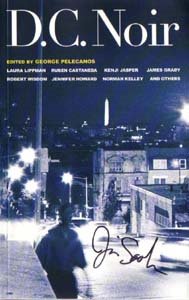
D.C. Noir a fine introduction to unknown authors

45. D.C. Noir, edited by George Pelecanos. Short Stories, 5-12, p. 308

As a collector, I am inordinately fond of book series.

Because a series is a defined or limited set, it is easily collectible – which makes its appeal difficult to resist.

Series of recent interest include the Penguin Lives set of biographies and Times Books’ American Presidents. Past series of interest, which are more difficult to collect both because of availability and price, include the American Trail series and Rivers of America.

A new addition to my interest is the "Noir” series issued by Akashic Books. Conceived by Akashic publisher Johnny Temple, it debuted in 2004 with Brooklyn Noir and has since grown to include D.C. Noir, Baltimore Noir and Dublin Noir. Beyond its appeal simply because it’s a series, the “Noir” books are distinguished by vibrant writing.

Temple has astutely combined established writers like George Pelecanos, Laura Lippman and Jim Fusili with virtual unknowns. In the introduction to D.C. Noir, which he edited, Pelecanos writes, “It’s about the collective memories of the locals, and also about the voices. If you close your eyes and listen to the people of this city, you will hear the many different voices, and if you’ve lived here long enough, the cadences and rhythms, the familiarity of it, the feeling that you are home, will make you smile.

“This is a collection of short stories that, in the context of crime/noir fiction, attempts to capture those voices.”

Pelecanos, Fusili and Lippman do not disappoint. Their stories are the work of polished professionals. Lippman's story, in particular, is deliciously evil. But equally enjoyable -- impressively so -- are stories by Robert Andrews (Solomon’s Alley) and Richard Currey (Names of the Lost), to name only two.

The stories are not uniformly great, but it is a rare short story collection that achieves such uniformity. The majority of the stories in D.C. Noir are well worth reading. On more than one occasion a story sent me flipping to the back of the book to read the author’s bio to see what else they had written.

Temple and Akashic are to be applauded for introducing readers to a host of new or unknown writers. Dublin Noir, Baltimore Noir and Manhattan Noir are all on my shortlist. I look forward to reading each book and to collecting the entire series with great anticipation.

Wednesday, May 10, 2006

Brooks' March a book of hard realities

44. March, Geraldine Brooks. Fiction, 5-10, p. 273

I’ve never read Little Women. The window of opportunity for me to read Alcott’s classic novel would have been in the mid ‘60s and no respectable male teen or pre-teen of that era was going to read a novel with such a title.

It’s the same sensibility that led her publishers to suggest that Janice Rowling publish under the sobriquet, J.K. Boys, of a certain age, simply don’t read books by women. My J.K. Rowling was Andre Norton. I didn’t learn that Andre was Alice until it no longer mattered; it’s not that I was no longer put off by a woman author (I wasn’t), I just wasn’t reading juvenile sci-fi by Andre or Alice.

All this is a roundabout introduction to Geraldine Brooks’ 2006 Pulitzer Prize winner, March, which extrapolates passing events from Little Women into a full-fledged novel. Brooks even furnishes us with a back story on one of Alcott's minor characters – more on that later.

In many respects – and certainly in those that are most important – March has nothing to do with Little Women in the way that The Jane Austen Book Club did with Austen and her works. The Jane Austen Book Club was an affectionate tribute to Austen as well as a tender and amusing examination of the trials and tribulations of contemporary romance.

March isn’t tender or amusing. It’s a dark, brooding novel that explores the brutality inflicted on Blacks before and during (and one can only assume after) the Civil War and the stark absence of understanding that can occur between a husband and wife, who may dearly love one another, but make unfortunate assumptions about one another’s desires.

March focuses on Mr. March, the sire of those darling little women, who is limited to a cameo in Alcott’s novel.

The bulk of the novel is given over to March’s Civil War experiences, which, not to put to fine a point on it, don’t go well. As for the back story, it’s critical to understanding this principled, but hapless man, who is viewed by his own wife as an “inconstant, ruined dreamer.”

As a callow youth, March tromped through Virginia as an itinerant peddler. He is oblivious to the harsher aspects of slavery until he teaches a young slave girl to read and write. Abruptly, he is exposed to the cruelty of slavery as he witnesses firsthand the effects of the lash upon an innocent women’s back.

A man of extremes, especially for his time, Marsh is a vegetarian (he eschews milk because it belongs to the calf), a guide on the Underground Railroad, a financial underwriter of John Brown’s ill-starred ventures and an unconventional minister of religion. But when tested under the greatest of extremities, Marsh learns that principle and action do not always find accord.

March is an insightful, powerful book and elegantly written, but it is not an enjoyable read in light of the unrelenting brutality of slavery, war and marital misunderstanding.

Monday, May 08, 2006

Lippman novel an enjoyable read

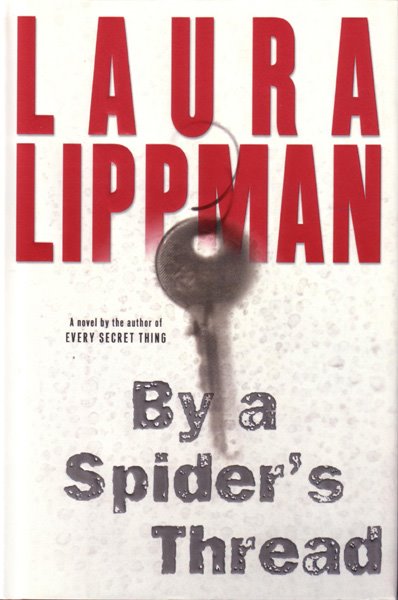
43. By A Spider’s Thread, Laura Lippman. Mystery, 5-4, p. 354

Baltimore writer Laura Lippman has a loyal following in the Washington, D.C. area. After reading, Every Secret Thing, I thought that enthusiasm might have more to do with geography than literary skill. The book did not live up to expectations.

But after reading, By A Spider’s Thread, which features Baltimore P.I. Tess Monaghan, it’s evident that the enthusiasm for Lippman is not misplaced. This is a terrific yarn and Monaghan, a Jewish-Catholic Baltimore native, is a terrific character.

I have one more Lippman novel on my reading list, To the Power of Three, a one-off, which doesn’t feature Monaghan. So, it represents a literary rubber match of sorts.

Saturday, April 29, 2006

Three Recent Reads

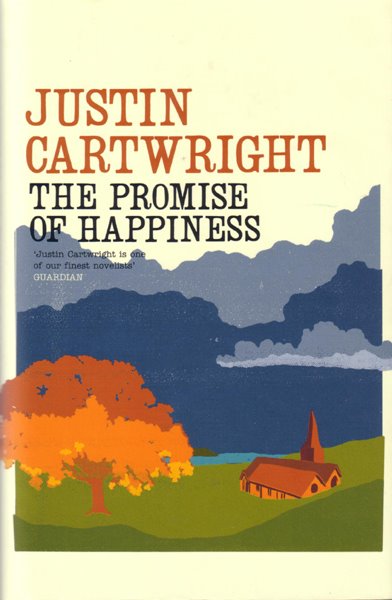
39. The Promise of Happiness, Justin Cartwright. 4-23, p. 306

40. Apex Hides the Hurt, Colson Whitehead. 4-25, p. 212

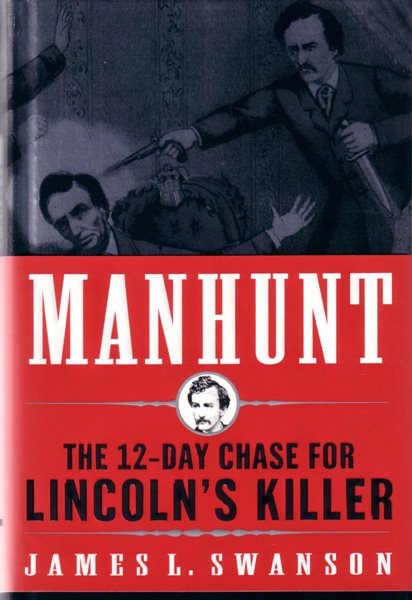
41. Manhunt, James L. Swanson. 4-28, p. 391

Three recommendations, two enthusiastic and one qualified.

The Promise of Happiness by Justin Cartwright and Manhunt by James L. Swanson receive the enthusiastic recommendations.

Cartwright’s novel is a superb exploration of what it means to be a member of a family. The Judd’s are delightfully dysfunctional and, admittedly, a bit exceptional – I’ve never known anyone who had a daughter in federal prison or a son who made millions via the Internet.

But set that quibble aside. This is a superbly written, superbly told book. Each character is vividly realized. And Cartwright simply, but skillfully pulls back the curtains to unveil life within a family; life, at once, both difficult, but necessary and vital.

Here’s one passage, typical of Cartwright’s insight:

“This is family. In the family you are a certain kind of person. Your mother, my mother in particular, piles one half-truth about your character on another until she has built up a whole structure, a fabricated person. It begins in small ways: you are untidy or reliable or good with figures or you each too fast; you’re frightened of frogs, you hold your pen in the wrong way, and then these threads are woven into the family tapestry, a sort of Bayeux which forever commemorates this entirely imaginary scene. Now he is becoming – the myth declares – competent.” (p. 127)

My current measures of fine fiction are Gilead by Marilynne Robinson and Atonement by Ian McEwan. If The Promise of Happiness doesn’t rise to the level of these works, it only fails to do so by the narrowest of margins.

There are many books on Abraham Lincoln, but do I not recall ever reading one quite like Swanson’s Manhunt, which focuses on Lincoln’s assassination and the search for John Wilkes Booth and his co-conspirators.

It is a grim, but fascinating story; a strange and unsavory footnote in American history. The book is both well-researched and well-written and well worth reading.

The qualification is reserved for Colson Whitehead’s Apex Hides the Hurt. It’s a quirky book – something Whitehead specializes in. If I didn’t like it, I would have said it was odd.

Whitehead’s unnamed protagonist is a nomenclature consultant. He names things, from cars to multicultural adhesive bandages. Now, he’s hired to settle a tug-of-war between a town council who can’t agree on the new name for their town.

Whitehead’s writing, like green olives, is something you have to learn to like. I have. It’s not great prose—not by a long stretch—but it is delicious, wicked satire.

Saturday, April 22, 2006

Coming up Flat on a Cross-Country Ride

38. Riding with the Blue Moth, Bill Hancock. Adventure, 4-21, pp. 246

Perhaps I was disappointed in Bill Hancock’s Riding with the Blue Moth because I expected too much.

The book was recommended by a friend and I’m certain I know why he thought I should read it. In search of solace after the unexpected death of his son in a plane crash in 2001, Hancock sets off on a 36-day, 2,746-mile bicycle ride from the Pacific to the Atlantic, California to Georgia. Riding the Blue Moth tells that story.

My friend and I have put in a few miles together on the bicycle. Although he’s a far more serious cyclist than I and just the sort to come up with a scheme to ride coast to coast. For me, it’s one of those things that 's really cool to think about, but which I will never do. My friend also knew that 2006 was a year of loss, bringing both the death of my mother, after a grueling five-year battle with cancer, and the unexpected death of a beloved Corgi.

Little wonder then that I approached Riding with the Blue Moth with the hope that I might assuage my pain by vicariously sharing in Hancock’s experiences as he rides across America.

But that didn’t happen. Hancock tries too hard. I won’t describe his observations as banal, that’s too harsh. He’s an earnest and well-intentioned man, which makes for a great husband, father and employee, but not a great writer. His observations are of the dime-store variety. There’s nothing deep or unexpected here, no hidden truths revealed.

As a primer on coping with grief, Hancock’s book cannot approach the depth—lyrically, emotionally or intellectually—of Didion’s The Year of Magical Thinking. As an adventure tale it fails to tap into either the humor of Bill Bryson’s A Walk in the Woods or the sense of a genuine trial as expressed in Chris Duff’s On Celtic Tides or The Water in Between by Kevin Patterson.

I’ve no doubt Riding with the Blue Moth will resonate, on some level, with many readers. I just wasn’t one of them. I do, however, wish Mr. Hancock and his wife, Nicki, all the best and it is my heartfelt desire that while time may have eased the pain of their son’s death, it has done nothing to lessen their memory of him.

Wednesday, April 19, 2006

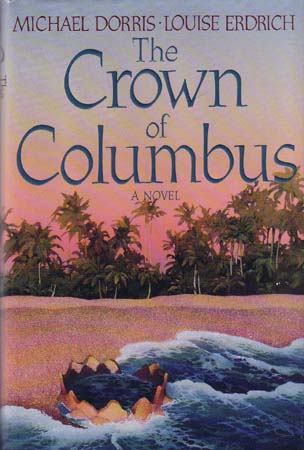
Crown of Columbus fails to sparkle

37. The Crown of Columbus, Michael Dorris and Louise Erdrich. Fiction, 4-18, pp. 382

This book must have seemed like a good idea.

Two talented authors, Louise Erdrich and her now-deceased husband, Michael Dorris, team up to write a novel.

It seems like a good idea. Until you read the book.

I moved The Crown of Columbus, a 1994 novel, to the top of my reading list because I’m committed to reading the complete works of Erdrich. Sadly, the qualities that attract me to Erdrich’s writing are largely missing from this clunky, improbable novel.

Erdrich’s appeal lies in her ability to vividly capture the Native American voice; to peel back and expose layers of their hearts, minds and souls. She shows us, in so many of her novels, how some Native Americans still cling—proudly and stubbornly—to ancient ways, while others have been destroyed by American culture, microbes and booze.

The Crown of Columbus is unsuccessful in giving full expression to Erdrich’s unique voice. The voice is there, but it’s overwhelmed by a sort of cuteness.

The Crown of Columbus is set at Dartmouth. The principals are two professors—Vivian Twostar, a Native American anthropologist seeking tenure, and her lover, the insufferable Roger Williams, scholar and poet. Roger is writing “the” epic poem of Columbus as the quincentennial approaches. Vivian finds herself caught up in a mystery that lead to the discovery of not only Columbus’ diary, but a genuine New World treasure.

I’m curious about who wrote what. Did Erdrich write the passages of the token Native American professor or did her late husband take that on in a not-as-clever-as-it sounds bit of authorial role playing. “Hey, I have an idea, Louise. You write the passages narrated by the stuffy New England poet-professor and I’ll do the brassy, female Indian.”

I don’t know if that’s how it was done. I only know that The Crown of Columbus falls flat. As I said, it’s improbable. It’s also melodramatic and tepid – although it tries to whip the reader into an emotional frenzy on about a half-dozen fronts, ranging from European treatment of native Americans to the relationship of these academic lovers to . . .

Well, never mind. It’s not worth re-counting.

Erdrich is almost always worth reading. Almost. Always.

Tuesday, April 18, 2006

Much-anticipated forthcoming titles

I eagerly await the forthcoming release of:

  • Digging to America, Anne Tyler (5-1)
  • The Hard Way, Lee Child (5-6)
  • Piece of My Heart, Peter Robinson (5-30)
  • Alentejo Blue, Monica Ali (6-6)
  • The Night Gardener, George Pelecanos (8-6)
  • Echo Park, Michael Connelly (September or October)

Monday, April 17, 2006

Brooks' March wins 2006 Pulitzer

March, Geraldine Brooks' novel that imagines the life of the fictional father in Louisa May Alcott's Little Women, was awarded the 2006 Pulitzer Prize for fiction on Monday.

For the first time since 1997, the Pulitzer board declined to award a prize for drama.

Brooks depicted the life of John March, the father absent for most of Alcott's famed novel of four sisters growing up in Massachusetts during the Civil War.

She beat finalists including E.L. Doctorow, whose The March, the fictionalized account of Gen. William Tecumseh Sherman's brutal conquest of the South during the Civil War, had won the PEN/Faulkner and National Book Critics Circle Prizes.

David M. Oshinsky was awarded the history prize for Polio: An American Story. The prize for general non-fiction went to Caroline Elkins for Imperial Reckoning: The Untold Story of Britain's Gulag in Kenya.

Kai Bird and Martin J. Sherwin took the prize for biography for American Prometheus: The Triumph and Tragedy of J. Robert Oppenheimer. The prize for poetry went to Claudia Emerson for Late Wife.

Tuesday, April 11, 2006

Ford's Wildfire is anything but

35. Wildlife, Richard Ford. Fiction, 4-10, pp. 177

Richard Ford gained well-deserved prominence with his novel The Sportswriter and its sequel Independence Days.

Novels like Wildfire explain why he’s drifted from the literary radar.

Wildfire is an inconsequential novel set in Great Falls, Montana. Its passive teenage narrator doesn’t demonstrate any emotional response as his father is fired from his job as a golf pro only to leave home to fight a forest fire, while his mother takes up with a local businessman. Dad returns, learns of Mom’s indiscretion and almost sets himself and the businessman’s house afire. The novel is as flat as the narrator.

It’s hard to understand exactly what Ford wanted to accomplish in Wildfire. There are a few preachy moments passed on as folk wisdom (mom and dad are both given to pontificating before junior) and one can only assume Ford’s point is to be found in these rather vapid pronouncements

---------------------------------------------

I read this book in a day and still had time to dip into 20-30 pages of the non-fiction work I’m reading. Ford is an accomplished writer and this is a breezy 177 pages.

Monday, April 10, 2006

Attractions in the Queue at Borders

Standing in line at the check-out at Border’s Sunday.

Just ahead of me was a mom and three children; a toddler in arms and two boys who looked to be about 5 and 3.

The 3-year-old, a tow-head, was moving restlessly, fingering the alluring items that presented themselves where the queue forms at the registers.

“We’re not getting candy,” mom said, as he fingered the chocolate. “Put the bookmark back.” Every item he brought forward was rebuffed.

Mom was finally summoned to the register. The tot lingered behind, head down, lip out. “There are soooooo many things here I want,” he said.

“Me too, buddy,” I thought. “Me too.”

Thursday, April 06, 2006

Cornwell, Pelecanos and Nabokov's Butterfly

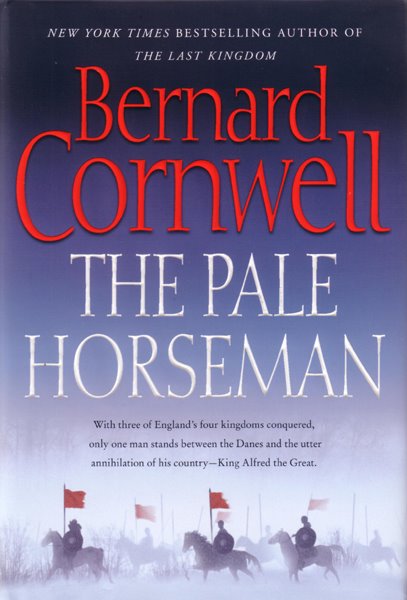
31. The Pale Horseman, Bernard Cornwell. Fiction, 4-2, p. 346

Scroll down the page or use the handy links on the right and find my post about Bernard Cornwell’s The Last Kingdom. What I said about that book applies here.

It’s an entertaining read. One of those books that entices you to trot out words like rollicking, which I used for The Last Kingdom, and probably shouldn’t use again, although it’s apt.

I do have one burgeoning concern about The Last Kingdom and A Pale Horseman, however. They are the first two books in a series and Cornwell is a prolific writer. I may not fully comprehend what I’ve let myself in for.

32. Nabokov’s Butterfly, Rick Gekoski. Books on Books, 4-4, p. 240

I love this book. It’s a collection of 20 vignettes on major 20th Century books, ranging from Lolita to Harry Potter. That is quite a range, come to think of it.

I don’t suppose everyone will fall as deeply in love with Nabokov’s Butterfly as I did, but if you’re a reader or a collector, I can’t understand not being smitten at some level.

Gekoski’s book is especially entertaining when he’s sharing insight into the book trade (J.K. Rowling received an advance of $2,700 for the first Harry Potter novel) or when he’s actually bought and sold the book in question as with Graham Greene’s inscribed copy of Lolita.

I have only one peeve with Nabokov’s Butterfly and that has to do with the publisher (Carroll & Graf) not Mr. Gekoski. In England, the book was published under the title of Tolkien’s Gown. What was wrong with that title, I wonder? Did they think we did not know who Tolkien was? Or that we would be not be interested in reading about his gown? As Vonnegut would say, “So it goes.”

Under any title, Nabokov’s Butterfly is interesting, education and entertaining and it’s all about books – can’t ask for more than that.

33. Hell to Pay, George Pelecanos. Mystery, 4-5, p. 344

I noticed the ad in USA Today asks, “Have you read Pelecanos yet?” Good question. If not, why not?

George Pelecanos is one of the finest practitioners of the thriller today. He ranks with Michael Connelly, Ian Rankin and Robert Crais. Nuff said.

I thoroughly enjoyed this book. One interesting note, Pelecanos’ early works were very dark, noir-ish efforts in which everyone was booze-soaked and died in the end. Hell to Pay is hopeful, forward looking. I think Pelecanos is an idealist, who truly loves his hometown of Washington, D.C.

As with all his books, Washington is a major character in Hell to Pay. Not the D.C. most people know. The Mall. The Capitol. The Monuments. But the real Washington, D.C., of neighborhoods where people live, and die.

Have you read Pelecanos? You really, really should.

Wednesday, April 05, 2006

A Disappointing Novel and a Riveting Poker Read

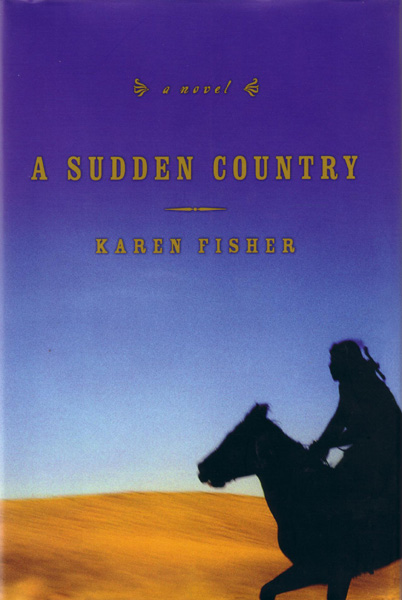
29. A Sudden Country, Karen Fisher. Fiction, 3-27, p. 366

Karen Fisher’s debut novel, A Sudden Country, is over-written and overwrought.

Which is a shame, because a potentially compelling narrative is betrayed by the author’s strained prose and her inexplicable decision to focus on an improbable love affair on the prairie.

A Sudden Country is the account of one family’s migration to Oregon. It made the PEN/Faulkner’s shortlist of best fiction in 2006, losing to E.L. Doctorow’s The March.

In the New York Times, critic Sally Eckhoff observed that “the real fascination of this journey lies in the details of the travel itself.” Eckhoff’s right, and had Fisher been more restrained in her story and in her prose, this might have been an exceptional book.

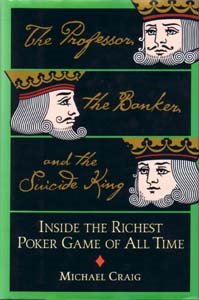
30. The Professor, the Banker and the Suicide King, Michael Craig. Poker, 3-30, p. 262

This is a fun little book, especially if you are as fascinated with the current wave of poker mania as I am.

Author Michael Craig has done fine job of ferreting out the details of a long-running poker game between banker Andy Beal and many of the newly famous Vegas poker players, such as Howard Lederer and Jennifer Harman, and the legendary Doyle Brunson.

Craig’s portraits of the poker players, who’ve become household names with ESPN’s annual telecast of the World Series of Poker, and of Beal, a self-made multi-millionaire, and the tense poker games with millions riding on the outcome, are delightful reading—especially since it’s not my money at stake.

Tuesday, April 04, 2006

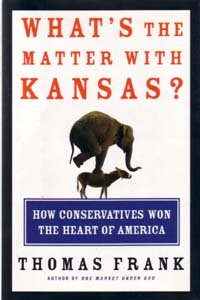
What's the Matter With Kansas?

28. What’s The Matter With Kansas?, Thomas Frank. Current Events, 3-24, pp. 251

I avoided this book for as long as I reasonably could.

There were many reasons for this avoidance, some book related (and that’s another post entirely), others having to do with the fact that I am a native Kansas. I know the people within these pages. Not just “know,” you understand, in some general sense that I “know” Kansans, but many of the people in this book are very, very specifically known to me.

Many of those who were interviewed are friends, others passing acquaintances. I worked for many years for Governor Bill Graves (and still like and admire him). Senator Sam Brownback, “God’s Senator,” frequently attended a Methodist church service led by my wife.

It’s a hell of an easier thing to read about people in a state that is removed from your life than it is your friends and acquaintances in your native state.

So what do I think . . . that what friends still living in Kansas want to know. And so here it is: Frank is largely right. At times, he rants, and that’s tiresome, but he’s taken a hard look at an important and disturbing issue, and I think that’s good. He gets most of it right, but not everything.

Frank contends that the good people of Kansas are acting against their own economic interests by abandoning the Democrat Party and electing conservative Republican state legislators and Congressmen. Not an unreasonable assertion, but what troubles me is that these people—his people, for Frank is also a native Kansan—are faceless enigmas to the author.

They are not faceless to me. I do know them. And I know this, their faith is important to them. Vastly important. More important than their economic interests. Most of these people would say they’re OK financially. Hey, they’re not getting rich, but they pay their bills on time and can afford a few of the niceties of life. And they would also say that any sacrifice they make is OK with them if it advances God’s kingdom. These people are willing foot soldiers in the culture wars. They don’t like the direction their country is headed and it’s the Conservatives who seem willing to do something about it even if, as Frank notes, that ain’t the case.

I reserve my scorn for the politicians—state and federal—who prey on these good people. Advancing their political careers and fattening their wallets, while promising some restoration of 1950s cultural values. I think there are many Conservatives who genuinely believe in the moral crusade they are advancing, but others are merely being expedient; they’re mouthing phrases and slogans that they’ve learned resonate with voters.

It’s a sad state of affairs. I’m embarrassed—very embarrassed—by all that’s unfolded in Kansas in the past several years . . . the debate over evolution, Fred Phelps and his miserable homophobic family, the abortion protests in Wichita . . . you name it.

My home state has become a small-minded, mean-spirited place. That's what’s the matter with Kansas.

Monday, April 03, 2006

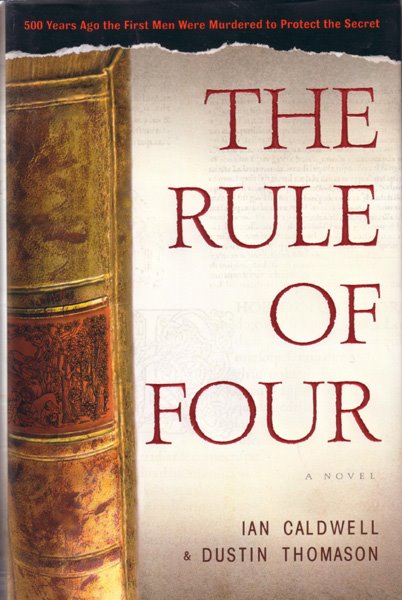
It's No Mystery, The Rule of Four

27. The Rule of Four, Ian Caldwell and Dustin Thomason. Fiction, 3-20, p. 368

The Rule of Four alternates between efforts to unravel a code buried within the text of the Hypnerotomachia Poliphili, a very real 15th Century manuscript, and a peak into student life at Princeton. It’s the rituals and rites of Princeton that emerge as vastly more interesting than the mysteries that may lie within the Hypnerotomachi. And that’s bad.

It’s bad because The Rule of Four wants desperately to be a biblio-mystery. The biblio-mystery is a relatively obscure sub-genre, which I enjoy. Readers interested in pursuing this thread are advised to take up John Dunning’s Cliff Janeway novels or Carlos Ruiz Zafon’s superb The Shadow of the Wind.

A successful biblio-mystery must involve a book (or books) and there must (naturally) be some mystery associated with the book (or books). A healthy dose of suspense is also an important ingredient.

The Rule of Four, by Ian Caldwell and Dustin Thomason, has the book, but there’s not much mystery and very little suspense.

I suspect that the book rose to prominence on the New York Times’ bestseller list in 2004 because of a clever marketing campaign that suggested “if you liked The Da Vinci Code, you’ll like this.” Maybe some folks did, but the book didn’t resonate with me.

It’s been suggested, by at least one reviewer, that The Rule of Four is more a coming of age novel than it is a proper biblio-mystery. I think that’s about right. The authors have given us a setting and a back story that overwhelms and distracts from their mystery story. Ultimately, The Rule of Four is two books in one and it’s no mystery that that doesn’t work.

Sunday, April 02, 2006

The Bookery and the Book Fair

I have not forgotten my promise, dear Reader, to entertain you with my musings on the recent additions to my reading list. Those observations will be forthcoming this first week of April, 2006.

I do want to mention a successful two days of booking; Friday in Lexington, Kentucky, and Sunday in Lansing, Michigan.

In Lexington, I visited Glover’s Bookery and the Black Swan. On the edge of downtown, Glover’s, which I have visited many times, is the archetypal used bookstore . . . the two-story former house groans under the weight of the thousands of dusty tomes. Glover’s excels in Kentuckian, books on horses and horse racing, the Civil War and military history. It’s fiction selection is like someone's maiden aunt--old, lean and best neglected.

Here are the books I purchased at Glover’s:

  • Kansas, A History of the Jayhawk State by William Frank Zornow
  • Deadeye Dick by Kurt Vonnegut

Both books were first editions. At $10, I thought the copy of Deadeye Dick was a bargain.

The Black Swan, which is near the UK campus, is the polar opposite of Glover’s. It’s tidy where Glover’s is unkempt. It bright and well lit, while Glover’s is gloomy. The books are bright and clean. There is a nice selection of modern first editions. It was my first visit there.

Here are the first editions I purchased at the Black Swan:

  • Tales of Burning Love by Louise Erdrich
  • Wonder Boys by Michael Chabon

I like both book shops, which clearly appeal to a different clientele.

On Sunday, I flew to Lansing, Michigan. I flew here for work, but could not resist the attractions of the 43rd Michigan Antiquarian Book & Paper Show. The show boasted more than 90 dealers from the U.S. and Canada.

Here it was I purchased:

  • Jacklight by Louise Erdrich
  • Searching for Caleb by Anne Tyler
  • High Fidelity by Nick Hornby

A collection of poetry, Jacklight is Erdrich’s first book. It was paperbound . . . called “wraps” by those in the book trade. It was the one book I was searching for at the show. I am close now to assembling a run of Erdrich’s published works.

I am also close to a complete run of Anne Tyler. This has taken patience. Not because her books are rare, but because they are expensive. At least for me. Tyler has long been a favorite author of mine. I do sense that she has fallen out of favor with many collectors and, perhaps, if I continue to be patient I can snag her earliest books for a reasonable sum. Not that my wife will find any sum reasonable.

The copy of High Fidelity was a British first. It was surprisingly affordable. I now have British first editions of Hornby two earliest books, High Fidelity and Fever Pitch, his memoir of life as a football (soccer) fan. These books are coveted because they are the true first editions, preceding the American firsts. They are also coveted because Hornby is a Brit and collectors are always urged to “follow the flag,” which means to collect the earliest editions from an author’s home country.

Friday, March 31, 2006

Recent Reads . . . More to Follow

Time has been at a premium lately. But here's the most recent books I've read:

  • 27. The Rule of Four, Ian Caldwell and Dustin Thomason. Fiction, 3-20, p. 368
  • 28. What’s The Matter With Kansas?, Thomas Frank. Current Events, 3-24, p. 251
  • 29. A Sudden Country, Karen Fisher. Fiction, 3-27 p. 366
  • 30. The Professor, the Banker and the Suicide King, Michael Craig. Poker, 3-30, p.262

Thursday, March 23, 2006

Thoughts on Sources of Books to Read

I am always astounded at people who express a desire to read, but then indicate that they have trouble identifying what to read. There’s more than 50 books in my “to be read” pile and hundreds, if not thousands, of books I’d like to read.

So, this post is dedicated to our selection-challenged, wanna be readers.

The first, and I think most obvious, source of reading material is the literary (or Western) canon. A category that’s broad enough to include everyone from Shakespeare to Thorstein Veblen to Hemingway.

Wikipedia (http://en.wikipedia.org/wiki/Western_canon) provides a nice overview of the Western canon. The link to Great Books of the Western World will keep you occupied for a month or two.

I try (but don’t always succeed) to read something by Dickens, Shakespeare, Wharton and Cather every year. There’s great pleasure in reading classic works apart from the demands of a college class. Tapping canonical authors can also lead to a powerful process of rediscovery.

The shortlists of notable literary prizes provide endless possibilities. There’s the Booker, the National Book Award, the Pulitzer, the PEN/Faulkner and the National Book Critics Circle. The shortlists generally feature a nice combination of the established – Carey, McEwan, Doctorow – and the unfamiliar – Karen Fisher, Sebastian Barry, Rene Steinke.

The shortlists are issued annually, which means you aren’t going to run out of material any time soon. Plus, a visit to a website dedicated to any of these prizes will generate more possibilities from past selections.

My first introduction to many of the authors that I now routinely read came from the shortlists. I also find that if you like an author’s book it’s worth exploring the author’s earlier material.

Of course, friends shouldn’t be ignored as a source of recommendations. Some will insist on The Kite Runner or The Time Traveler’s Wife, but others may steer you to Frederick Busch, Anthony Bourdain or such extraordinary books as Aidan Hartley’s The Zanzibar Chest.

Anyone who is, or wants to be, a great reader must develop several friends whose judgment they value, someone whose recommendation is automatically accepted.

I scan book reviews daily, notably those published in the Washington Post, the New York Times and the Guardian. Reviews account for only a small percentage of the books that I choose to read, but sometimes serendipity intervenes. The Internet provides ready access to these resources.

One source that I eschew is the best-seller list. Most of the material here has no appeal to me. Nor have I ever been part of a book club, which could be a good starting point, but might become limiting after your critical selection skills are fully engaged.

Sunday, March 19, 2006

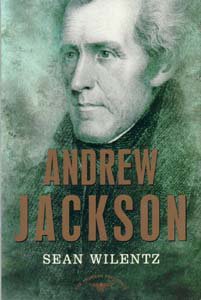
Wilentz Provides Balanced Portrait of Jackson

“Questions thus linger over Jackson’s contributions and leadership. What difference did he really make in the democratization of Americans’ political sensibilities and practices? Given the terrible conflicts that followed, does his presidency deserves admiration or condemnation? Was he truly a democratic man of the people or a vengeful backwoods autocrat?”

Princeton history professor Sean Wilentz asks these questions late in his biography of Andrew Jackson. He strives, ably, to answer them in a tidy 166 pages.

Andrew Jackson is part of The American Presidents Series from Times Books. I highly recommend the series. Generally less than 200 pages each, the books in the series provide a brief biography of each President and a skillful analysis of the successes and failures of each Administration.

Wilentz provides an exceptionally insightful and balanced portrait of Jackson, as in this passage: “More than any other American, Jackson oversaw the decline and fall of the elitist, gentry order established by the Framers, and its replacement with the ruder conventions and organization of democracy. More than any other president before him, he made the office of the presidency the center of action in national politics and government. Yet the incompleteness of Jackson’s democracy . . . contributed to the eventual disunion and terrible civil war he so deeply feared.”

Friday, March 17, 2006

Shuman's Debut Novel A Suspenseful Turn

25. 18 Seconds, George Shuman, 3-17, pp. 320

First novels are not supposed to be this good.

Despite the improbable conceit underlying this thriller, George Shuman’s 18 Seconds is a riveting read. Shuman, a former D.C. cop, delivers the requisite twists, thrills and creepiness in his suspenseful debut effort. I can’t wait until the movie.

The conceit is this: abandoned as a child, Sherry Moore is blind, not because of a physical condition, but from emotional trauma. Someone, as a result of that emotional short circuit, Sherry also has an unusual ability. By touching the hand of a dead person, Sherry can retrieve that person’s final 18 seconds of memory. Shuman trots out a computer analogy to explain Sherry’s “gift.” She is, in effect, a biological data retrieval system.

The “gift” won’t work on living people. We have some sort of biological firewall in place that keeps our thoughts and memories from trickling out at the merest touch. But with the dead, the security system goes down, allowing Sherry to tap into their memories.

It doesn’t always work. The longer someone’s been dead the less likely it is the data is intact. Plus, the memories aren’t sequential. They’re random. Someone’s thoughts might jump from the man in front of them with a gun to a childhood memory to their teen years. Sherry has to make sense of it all.

For the most part, she manages to do just that; which makes Sherry a valuable resource to the law enforcement personnel willing to work with a psychic. That's how the public understands Sherry's gifts, although the reader knows she's more Microsoft than medium.

Sherry’s also beautiful and without the customary mannerisms we associate with the blind. Recently Shuman said he didn’t have an actress in mind to play Sherry in the movie – and Hollywood should definitely option this book – but it’s a no-brainer. Ashley Judd is Sherry Moore.

Sherry’s special skill drives the book, but there’s far more too it than just a beautiful biological data retrieval system. The serial killer, Earl Sykes, is suitably creepy. Shuman’s added an especially nice touch with Earl. At the beginning of the novel, he’s in prison, not for the murders he’s committed, but for a tragic accident involving a school bus. When he’s eventually released from prison, the unpleasant Mr. Sykes isn’t on anyone’s radar.

Lt. Kelly Lynch-O'Shaughnessy, the small-town cop, is earnest, confused about the direction of her marriage and dogged in the investigation into the disappearances of several women from the beach town of Wildwood, N.J. But, predictably, she’s looking in the wrong direction. She’s also beset by wrong-headed parents, city administrators and a drunken lout of a cop.

It all works. Many of the elements of thrillers have become formulaic, but Shuman’s material rises above the banal. The pacing is brisk, the characters well drawn and the suspense, well, suspenseful. Also to his credit, Shuman pulls all the loose ends together for a satisfying conclusion. There are elements of improbability to 18 Seconds, but when it’s all said and done you won’t care. I didn’t.

Wednesday, March 15, 2006

The Last Kingdom a terrific diversion

24. The Last Kingdom, Bernard Cornwell, 3-12, pp. 329

Books engender a great many responses. Perhaps the greatest response any book can evoke from a reader is disappointment that it’s ended. And that’s exactly what I experienced after reaching page 329 in Bernard Cornwell’s The Last Kingdom.

This is not a great book. It is not a piece of enduring literature. But, boy, is it fun. To the degree that it is a finely executed piece of historical fiction, The Last Kingdom recalls the Purity of Blood by Arturo Perez-Reverte, but only to a degree. There are differences. Some superficial – it’s longer. Some significant—Purity of Blood was set in Spain during the Inquisition, The Last Kingdom is set in ninth century Britain.

The biggest difference is this book is more fun. Purity of Blood is terrific, but Perez-Reverte’s Captain Alatriste is a gloomy fellow. The hero of The Last Kingdom is, well, Conan. OK, that’s not his name, it’s Uhtred, and it’s all sword, no sorcery, but Robert E. Howard would feel comfortable around these pages.

It’s better written than anything by Howard, well researched and purposeful. It’s also a rollicking saga that I didn’t want to end. The good news it didn’t—the sequel, The Pale Horseman, was released earlier this year. Cool.

*****

In a column in The Guardian, author Annie Proulx takes Oscar voters to task. Proulx is disappointed that Brokeback Mountain, the movie based on her terrific short story, didn’t win the Best Picture Award. Her disappointment is understandable. The tenor of her comments isn’t.

Proulx decries the "atmosphere of insufferable self-importance" at the Oscar ceremony. She writes that the event was "reminiscent of a small-town talent-show night." She also calls Best Picture winner Crash “Trash.”

Whoa! A little harsh Annie. I liked Crash. I didn’t think it was a perfect film and it probably wouldn’t be my choice as best picture, but it generated a great deal of conversation between my wife and I over the period of about a week, which compares favorably to most films which are forgotten by the time I've reached my car. Any film that can promote ideas, and generate conversation, has something going for it.

I haven’t seen Brokeback Mountain. I admire the short story and I do plan to see the movie. Still, I am disappointed in Proulx and her response. Anyone who has watched the Oscar ceremonies recognizes that the best pictures don’t always win the Oscar. It a political process and it’s a subjective process too. Book awards aren't much different.

Two thumbs down, Annie.

Sunday, March 12, 2006

Shooting Straight About New Journalism

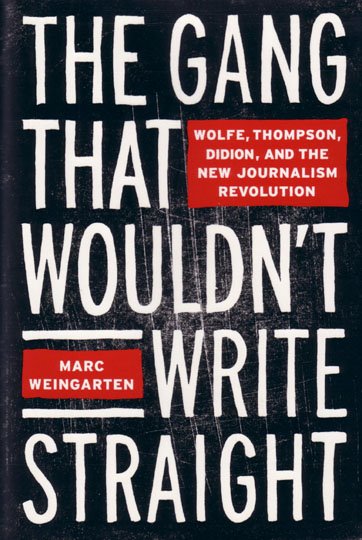
A caution: The average reader isn’t going to be as thrilled with this book as I am. I’m a little over the top on the subject matter—journalism. It’s an abiding passion. So please, run that through your critical filter before rushing out to buy Marc Weingarten’s The Gang That Wouldn’t Write Straight.

That said, I loved this book. Plowed through it like it was a work of fiction. Speaking of works of fiction, maybe this should be the test for prospective readers, if you don’t instantly know the title is a derivation of a Jimmy Breslin novel—The Gang That Couldn’t Shoot Straight—put the book down and back away.

Weingarten’s book is a brief, and by no means comprehensive history, of Breslin and other practitioners of the so-called “New Journalism.” Tom Wolfe. Hunter S. Thompson. Joan Didion. Michael Herr.

In the early 70s, as a journalism student, these writers were an inspiration to me. They were re-writing, literally, the norms of journalism even as they skewered societal norms and it seemed so right, so fun and so important.

I was too much the adherent of hard news to ever be a “new” journalist. My standards were shaped by juco instructor Bill Bidwell—a twitchy, chain-smoking ex-newspaperman. Bidwell taught to me get it right. Be objective. Never omit the attribution to a quote. Spell names correctly and always, always, always confirm a scoop with at least three sources.

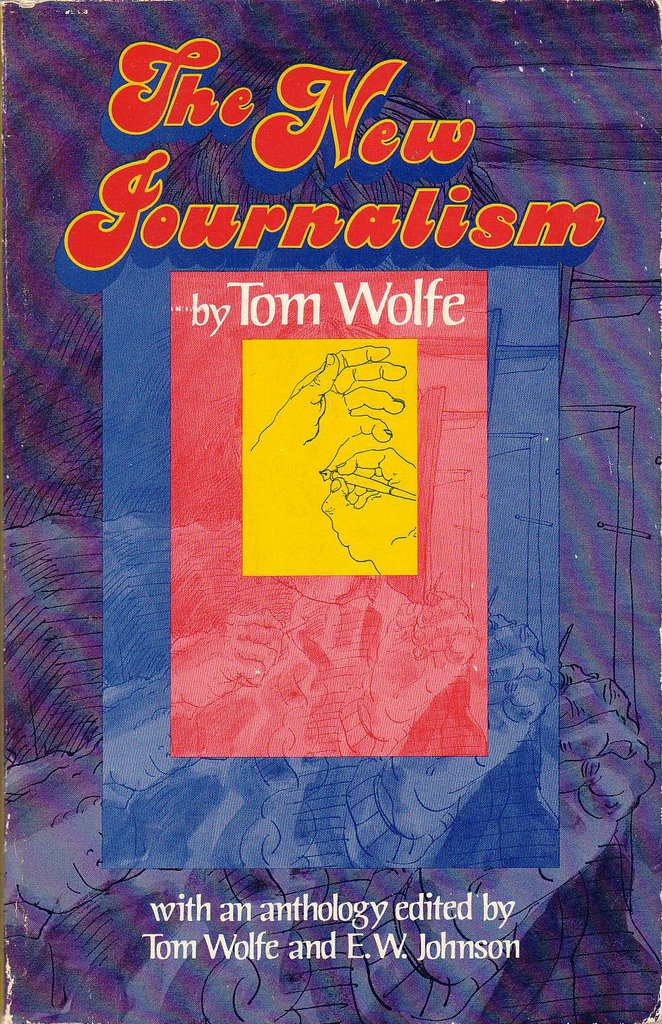
Bidwell’s training did not stop me from being influenced by Thompson and company. In 1973, Wolfe and E.W. Johnson issued an anthology/text book on the new journalism. It’s still on my shelves.

As Weingarten notes the New Journalism wasn’t exactly new. This kind of participatory journalism has been around a while. It’s just that this particular variant involved so many writers, appeared in so many high-profile publications and came along at a time of great social upheaval and change.

“New Journalism as Wolfe envisioned it—as the great literary movement of the postwar era—died a long time ago, but its influence is everywhere. Once a rear-guard rebellion, its tenets are so accepted now that they’ve become virtually invisible. The art of narrative storytelling is alive and well; it’s just more diffuse now, spread out across books, magazines, newspapers, and the Web,” writes Weingarten in the book’s epilogue.

The book is best early as we’re introduced to Wolfe, Didion, Herr and Thompson. It’s not perfect, there are a few curious omissions. In recounting how Rolling Stone (the magazine, not the band) dispatched Thompson and Timothy Crouse to cover the 1972 election, Weingarten neglects to mention Crouse’s superb book, The Boys on the Bus. Published in 1973, it was a scathing and brilliant insiders account of the media, who covered the ’72 Presidential race.

Weingarten’s final chapter on Rupert Murdoch’s seizure of New York magazine from Clay Felker is over long and doesn’t fit comfortably within the book’s overall theme. It does serve as an unfortunate introduction to the sad state of affairs that is magazine journalism today.

Still, it’s a good read and a good work. Personally, I can’t imagine anyone not finding this stuff riveting.

Everyone: “Hernia, hernia, hernia, hernia . . . “

Friday, March 10, 2006

Former D.C. Cop Makes Authorial Debut

18 Seconds is not George Shuman’s first book. It’s just his first to be published.

He’d written another book a few years ago. It attracted an agent’s interest, but found no takers when it was auctioned to the various New York publishing houses. Shuman put it away and kept writing.

He’s currently on tour to promote 18 Seconds. His publisher, Simon & Schuster, has teamed him with best-selling author Robert Crais, a clever marketing move to build early interest in Shuman’s debut novel. Shuman signed a contract with Simon & Schuster just this week for a sequel.

18 Seconds features Sherry Moore, a blind woman who has the unique ability to “see” a deceased person’s last 18 seconds by touching the corpse; a serial killer, who is serving prison time, not for the murders he’s committed, but a deadly traffic accident; and a New Jersey policewoman investigating a young woman’s disappearance that recalls similar unsolved cases from the seventies.

The mystery novel is set in Wildwood, New Jersey. “I start with location. Draw characters into and see where it goes.” Shuman choose Wildwood because he has pleasant memories of visiting there with his parents as a child.

Shuman is a 20-year veteran of the D.C. police force. He career includes serving as an undercover narcotics detective and as a sergeant in Internal Affairs.

During an appearance, with Crais, at a Smithsonian-sponsored program on crime novels, Shuman was asked if he had ever used a psychic, like Sherry Moore, during his career in law enforcement. “Never,” he said. Would he? “Never.”

Shuman researched both memory and mediums before setting down to write 18 Seconds.

A binge writer, Shuman might write for days without stopping, only to come to halt because he’s suddenly caught up in the research. When he starts to write, he has no outline or plan about where the book is heading. Instead, he lets his characters take him where they want to go.

Crime novels enjoy an enduring popularity, Shuman said, because “they are the place where heroes are born.”

Thursday, March 09, 2006

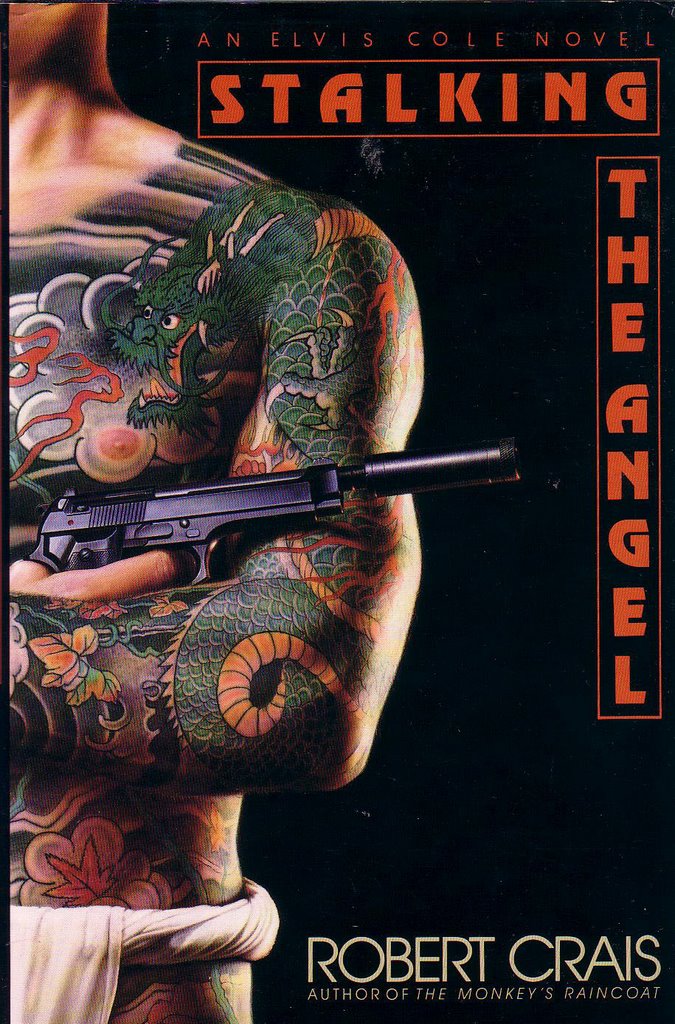
Down the Rabbit's Hole with Robert Crais

Robert Crais looks every inch the best-selling author. Lean, of medium height, he’s a darkly handsome man. Hair cropped short with a few days growth of beard on his chin. He’s dressed the part . . . jeans, soft-sided, soft-soled shoes, blue and black striped socks, a dressy black T beneath a wool sports coat.

He’s alternately funny and serious. A published author since 1987 and hugely successful since L.A. Requiem in 1999, he’s right at home at books events like this one March 8 at the Smithsonian in Washington, D.C.

A native of Baton Rouge, Crais comes from four generations of police, although he was never a cop himself. He saw the job from the family’s perspective. “I saw who cops are when they come home.” It’s that understanding he brings to his novels, which include the highly successful Elvis Cole series.

Crais’ new book, The Two Minute Rule, is a one-off, featuring an entirely new cast of characters. It began as an Elvis Cole novel, but en route a new character—Max Holman—began to assert himself. Holman is a former bank robber, just released from prison and trying to go straight. He’s an appealing character. So much so that Crais vows he will re-appear in future books, perhaps alongside Elvis.

The FBI’s Los Angeles bank squad aided Crais in his research for the new book. They also provided him with its title. Two minutes is all the time a bank robber has to get in and to get out if he’s to avoid capture.

Authenticity is important to Crais. “If it’s inaccurate I’ll get 862 emails.” Consequently, he also believes in research. “It leads me to ideas that are better than anything I could make up.”

Crais, who novels grow out of a character not plot, always researches a book before he writes it. Before writing, he also spends about a third of his time outlining the new book. “I develop an over-riding structure. I often have a clear idea of the ending before I start writing.”

He’s works closely with his editor during this preliminary phase. This practice eliminates pitfalls that might arise if the editor doesn’t see the book until it’s written.

Crais’ first exposure to the American detective novel came at age 15. He picked up a copy of Raymond Chandler’s The Little Sister, attracted by the “hot chick on the cover.” Reading Chandler, he said, “was like tumbling down the rabbit hole.”

Crais honed his writing skills as a screen writer in L.A. It was exciting, fun and an education, but not an experience he cares to repeat soon. Crais did write the original screenplay for his 2001 novel Hostage. By the time the movie, which starred Bruce Willis, was made the screenplay had gone through so many changes Crais didn’t receive a writing credit.

“The check cleared,” he said of the experience. “It taught me the lesson of non-involvement.”

Elvis Cole and sidekick, Joe Pike, won’t ever appear on film. “The Elvis Cole books are special to me. They’re my life work.” Plus, Crais views his readers as collaborators. Each reader has a different vision of Elvis Cole. “I don’t want that to be lost.”

Crais avoids trends in the mystery genre, perhaps because he had trouble selling his first book, The Monkey’s Raincoat. The market was flooded with detective novels in the late 1980s. Most publishing houses already had an author turning out P.I. novels and weren’t interest in someone new. Crais persisted, The Monkey’s Raincoat was published as a paperback original by Bantam and today he’s consistently on the best-seller list.

“I tell aspiring writers to ignore trends. Write what you love to read.”

Crais describes his approach to writing as “dogged.” He writes six to seven days a week for hours at a time. “I don’t believe in the muse. I don’t wait for inspiration. I don’t believe in writer’s block.”

Mysteries remain a popular and enduring genre, Crais believes, because they are entertaining and because of their “car-wreck quality.” Mysteries are also popular, he said, “because our own lives are so fraught with every day mysteries,” such as how to pay for a child’s braces or a college education.

People are attracted to mysteries because the protagonist “divines order from chaos, ferrets out the truth from lies.”

Robert Crais On Elvis Cole, Joe Pike and His Next Novel

Best-selling author Robert Crais and fledgling novelist George Shuman presented A Hard-Boiled Look at the Crime Novel Wednesday in Washington, D.C. as part of a Smithsonian Associates’ program.

Here are the highlights from Crais, creator of the Elvis Cole novels:

  • His first exposure to the American detective novel was at age 15. Attracted by the “hot chick on the cover,” he picked up a paperback copy of Raymond Chandler’s Little Sister. “It was like falling down the rabbit hole.”

  • Crais won’t allow his best-selling Elvis Cole series to be filmed by Hollywood. “The Elvis Cole books are special to me. They’re my life’s work.” Crais views his readers as collaborators, who have an image of Cole and sidekick Joe Pike in their mind. “I don’t want that to be lost.”

  • Joe Pike will be featured prominently in Crais’ next novel. In the original draft of Crais’ first book, The Monkey’s Raincoat, Pike was supposed to have died. “But I couldn’t do it.”

  • The Louisiana-born writer is okay with selling his one-offs to Hollywood. Asked about his experience as a screen writer on the movie version of Hostage, Crais said, “The check cleared.” Crais wrote the original screen play, but didn’t receive screen writing credit as the work was taken over by others. “It taught me the lesson of non-involvement.”

  • On writers who say their characters tell them the course of a story. “The day my characters start talking to me, I’ll go on medication.”

  • Elvis Cole’s sweetheart Lucy Chenier attracts a lot of hate mail.

  • Expect Max Holman, bank robber turned good guy in Crais' new novel The Two Minute Rule to appear in a future book, perhaps alongside Elvis Cole. "I will definitely write about Max Holman again."

  • Why no hyphen in The Two Minute Rule? "We tried it. I didn't like the hyphen."
More on Crais and Shuman to follow . . .

Gordon Parks: Creative Force, American Original

Parks' took this photograph of cleaning lady Ella Watson in 1942. while working for the Farm Security Administration. It launched his career.
Gordon Parks died Tuesday at the age of 93. A native Kansan, Parks was a major creative force – a photographer, writer and movie director. Here’s what two newspapers have to say about Parks extraordinary career:

An iconoclast, Mr. Parks fashioned a career that resisted categorization. No matter what medium he chose for his self-expression, he sought to challenge stereotypes while still communicating to a large audience. In finding early acclaim as a photographer despite a lack of professional training, he became convinced that he could accomplish whatever he set his mind to. To an astonishing extent, he proved himself right.

–Andy Grundberg, New York Times, 3/8/06

Parks, who died Tuesday at the age of 93 in New York, crisscrossed America and the world for decades. He was an artist, writer, movie director. He was a Life photographer when that gig gave you a powerful cachet. In America, he used his cameras like six-shooters, aiming right at the nation's broken souls, her sad-eyed children, her blacks, browns and whites, her shoeshine men and faceless women with both dishrag and dignity.

–Will Haygood, Washington Post, 3/9/06

Wednesday, March 08, 2006

Parker's California Girl Proves Biblio Baggins Wrong

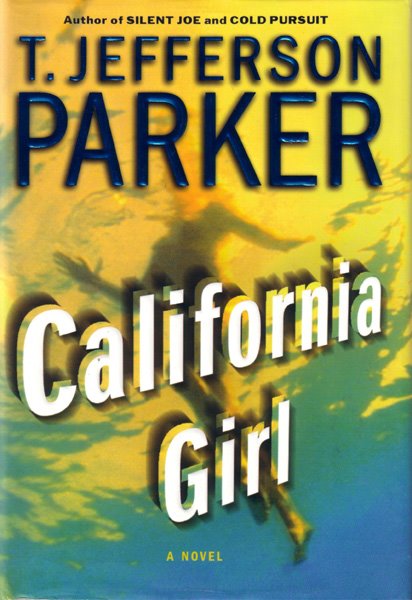
22. California Girl, T. Jefferson Parker. Mystery, 2-7, pp. 370

I love being wrong about a book or an author. I really do. Wrong in that I’m certain that I won’t like the book, that I have a pretty good sense of what the author’s about. I know the type of writer he is and, “Thank you, no,” it’s not for me. And I am certain about all this without being, in any way, “informed” about either; I haven’t read the book or anything by the author.

That was my attitude about California Girl by T. Jefferson Parker. I’ve seen his books around, but never deigned to pick one up. I figure his books were – I don’t know – not my type. Not all that good, perhaps. I finally picked up a book by Parker for a buck at a book sale. It was a lousy sale and I really had to stretch to find three books. Parker’s book was clean and a first edition, so I thought, “What the hell. Can’t go too wrong for a buck.”

After completing California Girl yesterday, I would have paid more. Much more.

California Girl was a delight; a well-written, fast-paced read. Riveting. Remember, in the past I’ve said I enjoy books by John Lescroart. And I do. He’s good a writer with strong, memorable characters. But Lescroart’s plots leave something to be desired. They’re strained, a little too improbable, too convoluted. Parker’s plots aren’t like that. Here’s what Parker does – or better yet what he doesn’t do – there’s a murder and someone solves it. No complicated plot, but a simple, straight forward murder investigation.

Rather than the plot, Parker focuses on the people and their motives, their motivations. People, even good people, sometimes lie in the course of a murder investigation. Not because they committed the murder, but because they’ve got secrets. Secrets they don’t what others to know about. Sometimes people do things, extreme things, to keep those secrets from being exposed.

California Girl isn’t about the dead girl and it’s only peripherally about solving her murder. It's really about the three Becker brothers – a cop, a reporter and a pastor – whose lives are caught up with that of the dead girl. Parker's novel is about these three respond to the pressures imposed by the murder and that – far more than the crime itself or its solution – is what makes California Girl so good.

I will read other books by T. Jefferson Parker. Even if I have to pay more than a buck a book.

Saturday, March 04, 2006

Miscellaneous Book Thoughts

21. The Best British Mysteries 2005, ed. Maxim Jakubowski. Mysteries, 3-4, pp. 341

Best is an arguable description for this collection of short stories. Ian Rankin, Peter Robinson and a smattering of other authors are definitely worth perusing, but it's an uneven assortment at best.
---
Attended the annual Washington Antiquarian Book Fair yesterday. I'm not at all certain why I parted with $12 to do so. I bought two books, both from the same dealer. Generally, the books on offer are extremely over-priced. Book fairs do tend to attract dealers who are quite proud of their inventory. In fairness, book fairs are costly ventures for dealers--there's the cost of travel and subsistence as well as the registration fee. I do wonder if they serve much of a purpose. I enjoy looking (but not buying) all the rare and expensive books on offer. Such pleasure is increasingly offset by the $12 opening day fee and the difficulty of getting to the Washington Book Fair which is, strictly speaking, in Arlington, Virginia.
---
Borders annoys me. They persist in shelving Joan Didion's fine memoir, The Year of Magical Thinking, among the fiction. I have found other memoirs there, also. This is most annoying. Why don't the powers-that-be at Borders establish a section for biographies, autobiographies and memoirs? In this, they could learn from their counterparts at Barnes & Noble.

The March Wins Second Book Award

NEW YORK (AP) -- E.L. Doctorow's The March, his acclaimed story of Gen. William Tecumseh Sherman's ruthless Civil War campaign, received yet another literary honor Friday night, winning the National Book Critics Circle prize for fiction.

"I've wondered for many years if awards are good for literature," said Doctorow, who also won the critics' prize for his 1989 novel, Billy Bathgate. "But I find when I'm offered an award I tend to accept it."

Doctorow's novel, the rare work of American fiction last year to attract both strong sales and widespread praise, has already won the PEN/Faulkner prize and was a finalist for the National Book Award. It stands a strong chance of bringing the author his first Pulitzer Prize in a 45-year career that includes Ragtime, World's Fair and Loon Lake.

"The independent witness of book writers I think provides the deepest and profoundest ... form of communication in our society," said Doctorow, 75, who observed that books are written in silence and read in silence, a "soul to soul" bond unique in the modern world.

Also Friday, Svetlana Alexievich won the general nonfiction award for Voices from Chernobyl, an oral history of the 1986 nuclear disaster. Kai Bird's and Martin J. Sherwin's American Prometheus, a work on atomic pioneer J. Robert Oppenheimer that took so long to write the book's first two editors retired, was the biography winner. Francine du Plessix Gray's Them, a memoir about her glamorous, but troubled mother and stepfather, won for autobiography.

"There was so much good in them, along with the naughty and the slightly evil," Gray said Friday of her stepfather, Conde Nast editorial director Alexander Liberman, and mother, the Russian-born designer Tatiana Yakovleva du Plessix Liberman.

The poetry winner was Jack Gilbert's Refusing Heaven, and William Logan's The Undiscovered Country won for criticism. Logan, an NBCC criticism finalist in 1999, acknowledged Friday that his demanding assessments have caused hard feelings, saying that one poet threatened to run him over and another poet to threaten assault by hand.

He then joked that his wife, herself a poet, was relieved to be married to him because "I could not review her."

Among the runners-up Friday: Joan Didion's memoir, The Year of Magical Thinking; Doris Kearns Goodwin's biography of Abraham Lincoln, Team of Rivals; and a collection of art criticism by John Updike, Still Looking.

There are no cash prizes for the NBCC awards.

Two honorary awards were presented. Bill Henderson, an author, editor and founder of the Pushcart Press, received a lifetime achievement prize, and Wyatt Mason, a critic and translator whose essays have appeared in Harper's, The New Yorker and elsewhere, was cited for excellence in reviewing.

The National Book Critics Circle, founded in 1974, has about 500 members.

Friday, March 03, 2006

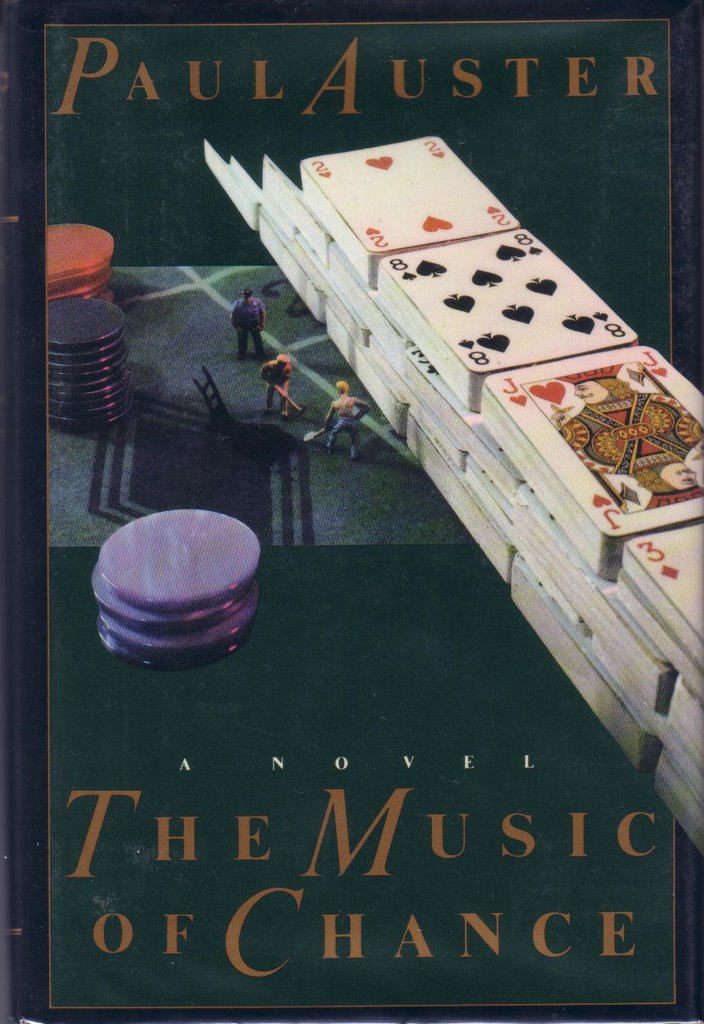
Auster's Music of Chance Unsatisfying

20. The Music of Chance, Paul Auster, Fiction, 2-2, pp. 217

An unexpected inheritance arrives too late to save Jim Nashe’s marriage. Consequently, he packs his young daughter off to his sister’s, quits his job and embarks on a purposeless cross country drive. So begins Paul Auster’s equally purposeless The Music of Chance.

Just as his funds begin to dwindle, Nashe picks up a young hitchhiker, who has clearly been beaten. The hitchhiker turns out to be a foul-mouthed wannabe gambler, robbed of his funds while en route to a high stakes game with two millionaires.

Nashe risks what’s left of his inheritance by staking the gambler in his can’t miss venture. Of course, can’t miss can and the gambler, Jack Pozzi, loses all Nashe’s money and his car. Destitute and oweing the two millionaires a substantial sum, Nashe and Pozzi are virtually enslaved as they agree to work off their debt.

The book is replete with homoerotic implications. There’s enough strangeness to fill a much larger book, including a weird model “City of the World” and a mysterious wall being erected in a meadow.

Auster fails to resolve several plot points—the millionaires virtually vanish from the pages of the novel, we never do learn Pozzi’s ultimate fate or truly understand what drives Nashe to his final, inexplicable act. The Music of Chance raises more questions than it answers. The lack of resolution is as unsatisfying as is the read.

Thursday, March 02, 2006

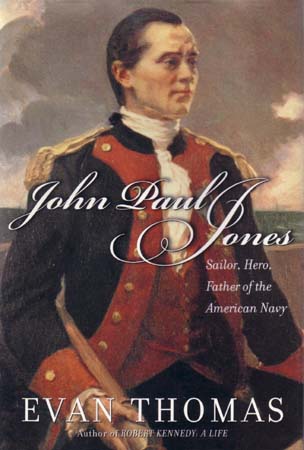
Book 19 An Even-Handed Biography of the Pirate John Paul

19. John Paul Jones, Evan Thomas, Biography. 3-2, pp. 311

A nicely rendered portrait of John Paul Jones, whose exploits on behalf of American independence are largely forgotten today. Thomas paints a balanced portrait of the corsair—Jones was thin-skinned, quick to take offense and inept at handling his subordinates. He was also a courageous man, driven by a steady determination to succeed and a visionary, who saw the need for a strong U.S. navy and who successfully terrorized the British during the American Revolution.

A few factoids about Jones that Thomas reveals:

  • He was a Scot, whose real name was John Paul.
  • While captain of a British merchant ship, Jones killed a sailor who was stirring up the crew. Jones called the incident “that great misfortune of my life.”
  • To avoid arrest by civil authorities in Tobago, where the crime took place, Jones fled to Fredericksburg, Virginia.
  • Jones served briefly and unhappily as an admiral in the Russian Navy during the reign of Catherine the Great.
  • Jones probably never said, “I have not yet begun to fight.” He may have said, “I may sink, but I’ll be damned if I strike” or something similar.
  • Jones died in France. His remains were brought to America by Theodore Roosevelt in 1906. He was laid to rest at the Naval Academy in Anapolis.

Smithsonian Features "Presidents All"

Four authors and four presidents were spotlighted Wednesday, March 1, in a Smithson Associate’s program in Washington, D.C. The program, Presidents All, featured the following presidents and their biographers:


  • Thomas Jefferson by Joyce Appleby, professor of history, UCLA
  • James Monroe by Gary Hart, former U.S. Senator from Colorado
  • Andrew Jackson by Sean Wilentz, professor of history, Princeton
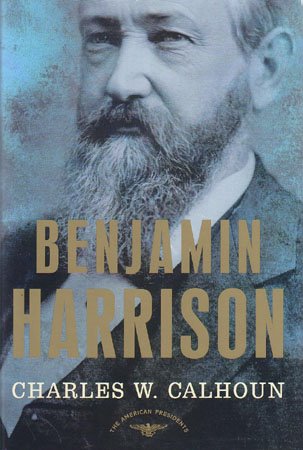
  • Benjamin Harrison by Charles W. Calhoun, professor of history, East Carolina State
All four books are part of Times Books American Presidents Series. Times Books is a subsidiary of Henry Holt.

Thomas Jefferson
Jefferson’s reputation has gone up and down through the years, Appleby said. It’s currently at a low, just as it was prior to the Civil War and again late in the 19th Century. Jefferson’s reputation was at a high under FDR, she said, because Roosevelt and his advisors decided to make Jefferson the founder of the Democrat Party.

As the Civil Rights movement gathered strength, Jefferson’s reputation began to ebb. Appleby said inquiries into Jefferson as a slaveholder, as the father of a child by a slave and as a man who kept his progeny in slavery served to damage his reputation. Although other Founding Fathers also kept slaves, Jefferson’s reputation was especially damaged because he raised our expectations with his affirmation of human rights, Appleby said.

James Monroe
Monroe was first and foremost a solider, according to Hart. The former Senator said Monroe’s outlook on his role as a public servant was conditioned by his military service. Hart also said that Monroe had a preoccupation with what we today call national security. Monroe was aggressive in securing U.S. borders.

Hart also said Monroe had a lengthy career as a diplomat, but that it was largely unsuccessful.

Andrew Jackson
Wilentz noted that Arthur Schlesinger Jr., general editor of the series, is the author of the definitive biography on Jackson. He said that being asked to write about Jackson by Schlesinger was like being asked to write about baseball by Babe Ruth.

Jackson thought of himself as a Jeffersonian, Wilentz said, but Jefferson was horrified that a military man, like Jackson, had become president. Jackson’s reputation peaked in the 40s and has since declined largely because of his policies on the American Indian. “He became known for one thing and one thing only,” Wilentz said, “Killing lots of Indians. He is remembered for his greatest failure.”

Wilentz described Jackson as a “strange guy” and the first “perfect nobody” to become president. He said Jackson was truly a self-made man whose politics were simple: He hated the British and aristocracy and believed fervently in the U.S. Constitution.

Benjamin Harrison
Unlike Jefferson and Jackson, whose reputations have gone up and down, Harrison’s reputation has remained steady, said Calhoun. He has always been lightly regarded. “He is often regarded as a caretaker between Grover Cleveland’s two terms. The truth is more complex.”

Harrison, who came into office at a time that the presidency had been diminished because of the impeachment of Andrew Johnson, made significant contributions to the office. Calhoun said those contributions included his effectiveness as a communicator and as a “legislative president.” Unlike previous presidents, who took the separation of powers seriously, Harrison promoted issues, and legislation, that he thought was important, including Civil Rights legislation. Harrison was also active in foreign affairs because of the illness of his Secretary of State James G. Blaine.

McKinley is generally regarded as the first "modern" president. Calhoun suggested that designation truly belongs to Harrison. He said both McKinley and Cleveland, in his second term, learned from Harrison.

American Presidents series
The American Presidents series comes highly recommended. It takes the Penguin Lives approach to biography – bite-sized biographies, usually no more than 200 pages in length. The emphasis in each book is on the individual’s presidency. The series is well written and impeccably researched.

    Wednesday, March 01, 2006

    Chabon Delays Release of Newest Novel

    Michael Chabon recently announced the delay of his newest novel, The Yiddish Policemen's Union. Information below is taken from Chabon's website, http://www.michaelchabon.com/

    The Yiddish Policemen's Union

    As of December 10, 2005, 07:21 AM

    Alert readers of the Schedule page on this website may notice that a number of dates (twenty-six in all) have been deleted. These dates represented the putative book publicity tour for The Yiddish Policemen's Union.

    I have decided never to do another such tour, and from now on to refuse to be photographed or interviewed. With my family I am retreating to a fire-spotting tower on a mountain outside of Trinity, California. When I am required by some extraordinary circumstance to make a public appearance I will send a lookalike, wearing my trademark voluminous alpaca topcoat and a vintage-1984 Debra Winger model Rene of Paris wig.

    Actually, with my publisher's generous assent, I pulled the plug on April publication.

    HarperCollins had been sort of rushing the thing along, over a steady but polite murmur from the author that perhaps they were moving too quickly. The manuscript was complete. It was not impossible to make the April 11 pub date. But we didn't even have a finished jacket. Many people who were selling and marketing the book hadn't had the opportunity to read it. Everything just felt too rushed and when that sense of undue haste finally caught on at the publishing house, I was able to persuade them to see reason, and wait.

    Unfortunately, their Fall list is already set, which means that the book won't come out until Winter 2007. I had hoped never to repeat the seven-year gap between The Mysteries of Pittsburgh and Wonder Boys, but now--if you don't count Summerland (for younger readers) or The Final Solution (a novella)--I will have done it again. Oh, well.

    The good news, from my point of view, is that I will now be able to take the step that I had been obliged by the accelerated schedule to sacrifice: giving the book to some trusted readers, some of them with special knowledge of the subjects involved. Based on their responses, I will have a last precious opportunity to take one more run through the manuscript.

    Anyway, if you were hoping to get to read it anytime soon, or to come hear me read from it this April, I'm sorry. I promise it is going to be worth the wait.